
Valet Ticket Reconciliation: A Shift-End Guide for Operators

Valet ticket reconciliation is the shift-end check that proves every ticket issued matches a car, a key and a payment. Done well, it takes minutes, and it catches missing keys, duplicate tickets, sequence gaps and cash shortages before they turn into guest disputes or damage claims. This guide walks through what to match, what to record, how often to do it and which controls make the process hold up.
TL;DR
- Reconcile at every shift change: each key tag has a car in the lot, each claim ticket has a key on the board, and every exception is written down before handoff.
- Use one log per shift, and treat missing ticket numbers and sequence gaps as exceptions that need an explanation.
- Record the ticket number, vehicle details, key location, pre-existing damage, attendant and payment state so the chain can be traced end to end.
- Separate duties: the person who collects cash should not be the person who reconciles and prepares the deposit.
- Pre-numbered, multi-part tickets make the whole process faster because every number can be accounted for.
Table of Contents
- What valet ticket reconciliation actually involves
- What to record on the ticket and in the log
- How often to reconcile and who reviews it
- A shift-end reconciliation, step by step
- Common discrepancies and how to investigate them
- Controls that prevent the problem
- Our perspective
- Putting reconciled tickets to work
- FAQ
- Sources
What valet ticket reconciliation actually involves
A valet operation runs on three records that must agree: the ticket, the key and the car. Reconciliation is the act of proving they do. At shift change, a typical reconciliation verifies that every key tag issued has a matching vehicle in the lot, every claim ticket has a corresponding key in the box, and any exception is documented before the shift hands off.
There is a financial half to the same job. Parking revenue reconciliation means checking that ticket counts, sequence ranges and open or missing tickets match the system or manual logs, and that cash, card and mobile payments add up to the total deposit.

Public-sector auditors treat this seriously for a reason. A county internal audit of parking services found that cash collected at special events was reconciled to pre-numbered ticket stubs, and recommended tracking overages and shortages. The same logic applies to a hotel valet stand or a hospital garage: a numbered ticket is a unit of accountability.
The three-way match
Think of every reconciliation as three questions:
- Tickets to cars. For each ticket issued and not yet closed, is there a vehicle parked and recorded?
- Tickets to keys. For each open ticket, is the key on the board at the position that matches that ticket number?
- Tickets to money. For each closed ticket, does the payment, validation or comp match the rate and the deposit?
If all three match, the shift is clean. If one does not, you have an exception to investigate while the people involved are still on site.
What to record on the ticket and in the log
A reconciliation is only as good as the data captured at the curb. A numbered claim ticket should link to the vehicle record, the key location and the damage documentation. Industry operations guidance says attendants should note pre-existing damage and record the odometer at acceptance, because that documentation is the main tool for limiting liability to damage that occurs in valet care.
For a paper-based or hybrid operation, the minimum record per ticket looks like this:
| Field | Why it matters at reconciliation |
|---|---|
| Ticket number | The anchor for every other record; gaps in the sequence show up immediately |
| Time in | Lets you check retrieval-time accuracy and overnight status |
| Vehicle make, model, color | Confirms the right car is matched to the right ticket |
| License plate and state | Resolves duplicates and lost-ticket cases |
| Key tag or board position | Proves key custody and location |
| Pre-existing damage notes | Protects the operation if a claim follows |
| Attendant initials (in and out) | Shows who handled the car at each step |
| Rate, payment type, validation | Ties the ticket to the deposit |
| Notes | Unusual conditions, such as a damaged tag or an unclaimed car |
Software makes this denser. One valet platform’s documentation describes tickets linked to a scanned barcode, attendant, price, reservation details, parking spot, scheduled retrieval, vehicle details, photos and damage marks, and requires the key tag to be scanned or edited and marked checked in. The principle is the same whether the record lives on paper or on a tablet: every field exists so that one ticket number can lead you to the car, the key, the person and the payment.
Why the ticket format matters
The number of parts on a ticket decides how much of the match you can prove. Insurance guidance on valet risk notes that two-part tickets match the car to the owner, while three-part tickets also provide positive identification of the key, and that attendants should initial the ticket when the vehicle arrives and when it is delivered.
In practice, a three-part set puts the guest copy in the guest’s hand, the key copy on the key tag and the stub on the windshield or the vehicle log. At reconciliation, you are lining up halves of the same number. Our 3-part valet tickets and 4-part valet tickets are made for exactly that workflow, and the extra part in a four-part set gives you a copy for the office or a damage record.

How often to reconcile and who reviews it
The standard is every shift change. Most teams complete the log at every shift change and review it with the incoming or outgoing lead. Use one log per shift so exceptions do not get mixed across crews or time windows. If a mismatch appears on Saturday night, you want to know which crew’s window it belongs to.
There are three rhythms worth setting:
- Every shift: the three-way match of tickets, keys and cars, plus a count of tickets issued by rate.
- Daily: a manager reviews the exceptions and the deposit against the manual logs or system report.
- Monthly: revenue is reconciled to bank statements and validation or invoice reports.
That cadence follows what municipal auditors recommend. One U.S. city audit of parking revenue controls calls for regular reconciliations, daily review of account information and exceptions, and monthly bank reconciliation. It also says manual logs should be checked for accurate entries, sequential receipt numbers and agreement with deposit slips.
Large institutions work the same way at a bigger scale. A university parking program’s job posting describes monthly financial reconciliation covering invoices, validation reporting, revenue and labor, and PCI compliance documentation. A single valet stand does not need that much paperwork, but the layers are the same: shift, day, month.
A shift-end reconciliation, step by step
This routine suits a hotel, restaurant or event valet stand with paper tickets and a key board. Adjust it to your system.
- Stop issuing from the outgoing book. Note the last ticket number used and the first number of the next book or set.
- Count the board. Count keys on the board and keys in the field (cars not yet returned). The total must equal tickets issued minus tickets closed.
- Match each open ticket to a car. Walk the lot with the open-ticket list. Confirm each plate, color and parking position against the log.
- Match each key to its position. Every key position on the central board should correspond to a claim ticket number. Check that the tag number on each key agrees.
- Check the sequence. Lay the closed stubs in numerical order. Any missing number is an exception: voided, lost, still in a guest’s hand or never issued. Find out which.
- Count transactions by rate. Verify the count of transactions at each price against the cash, card and mobile totals. This is the same approach one valet system’s shift-audit guidance describes: verify transaction counts by price, sequential ticket issuance and retrieval-time accuracy, and mark a ticket done only when the customer has the keys.
- Check voids, comps and validations. Each one needs authorization. Voided, comped and discounted tickets should be supported by authorization, and manual adjustments should have documented approval.
- Log exceptions and sign. Record each mismatch, classify it, assign an owner and have both the outgoing and incoming leads initial the log.
Common discrepancies and how to investigate them
The usual suspects are missing keys, duplicate tickets, vehicle-count mismatches and vehicles moved without a log update. The best practice is to record mismatches immediately, classify them as blocking or non-blocking, and assign follow-up actions.
A blocking exception is one that stops the shift from closing cleanly: a key with no ticket, a car with no record, or a cash total that does not match the count. A non-blocking exception can be followed up after handoff: a smudged ticket number that is still legible, or a tag that needs replacing.
| Symptom | Likely cause | First check |
|---|---|---|
| Key on board, no matching ticket in the log | Ticket never logged, or logged under the wrong number | Compare tag number with the stub book and time of arrival |
| Ticket open, no key | Key still with an attendant, or moved to the wrong position | Check runner pockets and neighboring board positions |
| Ticket open, car missing | Car retrieved without closing the ticket, or moved off-site | Check the retrieval log and the lot walk by plate |
| Two tickets with one number | Duplicate or mixed books | Check for overlapping number ranges between books |
| Gap in the sequence | Voided, lost or skipped ticket | Find the physical ticket or a signed void |
| Cash short or over | Wrong rate, unlogged comp, or error at the stand | Recount by rate against the ticket count |
Treat sequence gaps with respect. Missing ticket numbers should be handled as exceptions requiring an explanation, not harmless clerical noise. A gap is either a documented void or an unexplained one, and the second kind is the one an auditor or insurer will ask about.
When you find something unusual, document it on the spot. Damaged tags, unclaimed vehicles and similar conditions should be recorded at the time of discovery with photographs or detailed notes so the audit trail stays complete. For a closer look at the most frequent ticket-level errors, see our guide to valet ticket mix-ups, their causes and fixes.
Matching retrieval and payment records
Retrieval is where records most often drift. Staff should connect the guest’s claim reference, the vehicle, the parking position, key custody and the responsible attendant, and keep that chain current. Retrieval states such as requested, in progress and returned should have agreed wording and triggers, so “on the way” means the same thing to everyone on the crew.
Some systems let staff find a request by phone digits, PIN, name or tag number, assign it, retrieve the car and mark it Returned immediately after the guest drives away. On paper, the equivalent is the attendant’s out-initials and time on the ticket, which you check against the payment record at the end of the shift.
Lost tickets
A lost ticket is a reconciliation event, not just a customer service moment. A proper release record captures the date, time, guest name, ID type, license plate, ticket number, staff and manager initials, and the guest’s signature. Attach that record to the original ticket number in the log so the open ticket closes with evidence, not a shrug. We cover the damage side of this in our valet damage claim ticket checklist.
Controls that prevent the problem
Reconciliation finds errors. Controls reduce how many there are to find.
- Secure key board. Keep key boards in a locked, supervised-access area, maintain a master key log, and let keys leave the board only with an authorized runner fulfilling a retrieval request.
- One position, one ticket. Each position on the central board maps to a claim ticket number, so a missing key is visible at a glance.
- Pre-numbered, sequential tickets. Unique numbers make gaps and duplicates detectable. See why sequential valet tickets matter and the role of ticket numbering.
- Segregation of duties. The auditors’ point is that the person collecting cash should be different from the person who reconciles and prepares it for deposit. On a small crew, the next best thing is a manager who reviews the log and initials it.
- Approved voids and comps. Nothing leaves the sequence without a signature.
- Digital tracking where it fits. Digital valet management tools can help managers follow vehicle status changes, responsible attendants and payment states across mobile and dashboard views. The sound approach is to put software behind procedures your team already follows, not to expect software to invent discipline.
Paper, barcode or machine-issued
The right ticket format depends on volume and equipment.
- Paper multi-part tickets suit hotels, restaurants and events where a crew writes and matches by hand. Carbonless copies give every party the same record in one pass.
- Barcoded tickets let a scanner populate the log, which speeds the match at shift end and reduces transcription errors. Our barcoded valet tickets are listed at $42 to $48.
- Machine-issued tickets suit garages and high-volume lanes, where a printer issues the number and the system holds the record. See our machine-issued valet tickets.
If you also keep a running record of vehicles in the lot, our overview of the valet parking log shows how it pairs with the ticket book, and our valet key tag system guide covers the key side of the match.
Our perspective
Most reconciliation trouble we hear about starts before the shift ends, at the moment a ticket is written. A smudged number, a missing carbon copy or a book that overlaps another one makes the match harder for everyone downstream.
That is why we have focused on ticket manufacturing since 1937. Clear, durable printing, sequential numbering, barcoding, logos and security features are not cosmetic. They are what let a lead close out a shift in minutes instead of an hour. Multi-part carbonless sets mean the guest, the key and the log all carry the same number, written once.
Our tickets are built to work with the major parking systems, including Amano, TIBA, SKIDATA, FLASH Parking, Scheidt & Bachmann and Flowbird. Whether you run a paper stand or a machine-issued lane, we recommend starting with the ticket, because every control that follows depends on it.
Richard
Putting reconciled tickets to work
If your reconciliation log keeps turning up sequence gaps, illegible numbers or mixed-up books, the fix often starts with the ticket stock. Caymil manufactures custom and stock valet tickets in 2-part, 3-part and 4-part formats, with sequential numbering, barcoding, logos and custom colors, and ships nationwide. Our 4-part valet tickets are listed at $42 to $48, and you can see every format on the valet ticket pages.
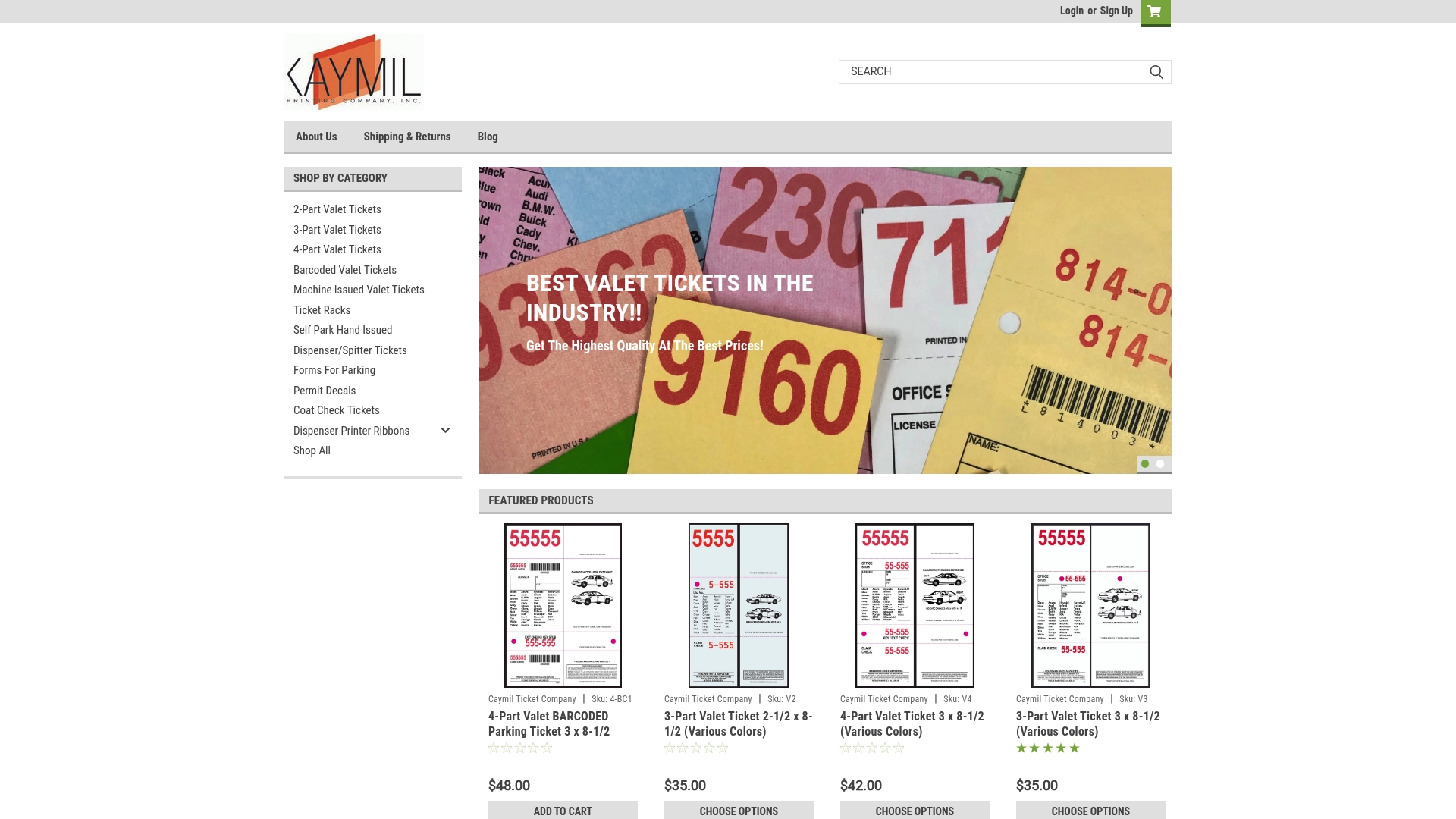
If you need ticket racks, permit decals or dispenser supplies to complete the setup, start from the Caymil home page and choose the product line that fits your stand.
FAQ
How often should valet tickets be reconciled?
At every shift change, using one log per shift so exceptions stay tied to a single crew and time window. Managers should review exceptions daily, and revenue should be reconciled to bank records monthly.
What should I do when a ticket number is missing from the sequence?
Treat it as an exception and find out what happened to it. It should turn out to be a signed void, a ticket still held by a guest, or a ticket never issued. Record the explanation next to the number so the gap does not reappear at audit.
Who should review the reconciliation log?
The outgoing and incoming leads should review and initial it together at handoff. A manager who does not handle the cash should then review exceptions and compare the deposit with the ticket counts.
What information should be on a valet ticket for reconciliation?
At minimum: a unique ticket number, time in, vehicle description and plate, key tag or position, pre-existing damage notes, attendant initials and the rate or payment type. Multi-part tickets let each of these details travel with the guest, the key and the log.
Do paper tickets still work for reconciliation?
Yes. Pre-numbered, multi-part paper tickets give you a physical sequence to count and match, and municipal audits treat numbered stubs as a standard control. Barcoded or machine-issued tickets add speed when volume is high.
Sources
- Valet Key Tag and Ticket Reconciliation Log Template
- Parking Revenue Audit and Ticket Reconciliation Template
- Parking Services Internal Audit Report, Cuyahoga County
- Parking Revenue Controls Audit
- University of Miami Parking and Transportation program coordinator posting
- Parking Valet Operations Manual: Key Control, Damage
- Issue valet overnight tickets (valet software documentation)
- Conduct operational and shift audits (valet software documentation)
- Valet parking risk guidance, Allianz Commercial
- Valet basics (valet software documentation)
- Lost valet ticket policy
- Digital vehicle check-in checklist for valet teams