
What Is a Complimentary Parking Ticket? Full Guide

A complimentary parking ticket is an official document or code issued by a business that covers a customer’s parking cost at no charge to the customer. The industry term for this practice is “validated parking,” though “complimentary parking ticket” describes the specific authorization a business provides as a courtesy or incentive. Hotels, retail stores, restaurants, event venues, and healthcare facilities all use these tickets to remove the friction of parking costs and encourage visits. Understanding how they work protects you from surprise fees and helps businesses design programs that actually build loyalty.
What is a complimentary parking ticket and how does it work?
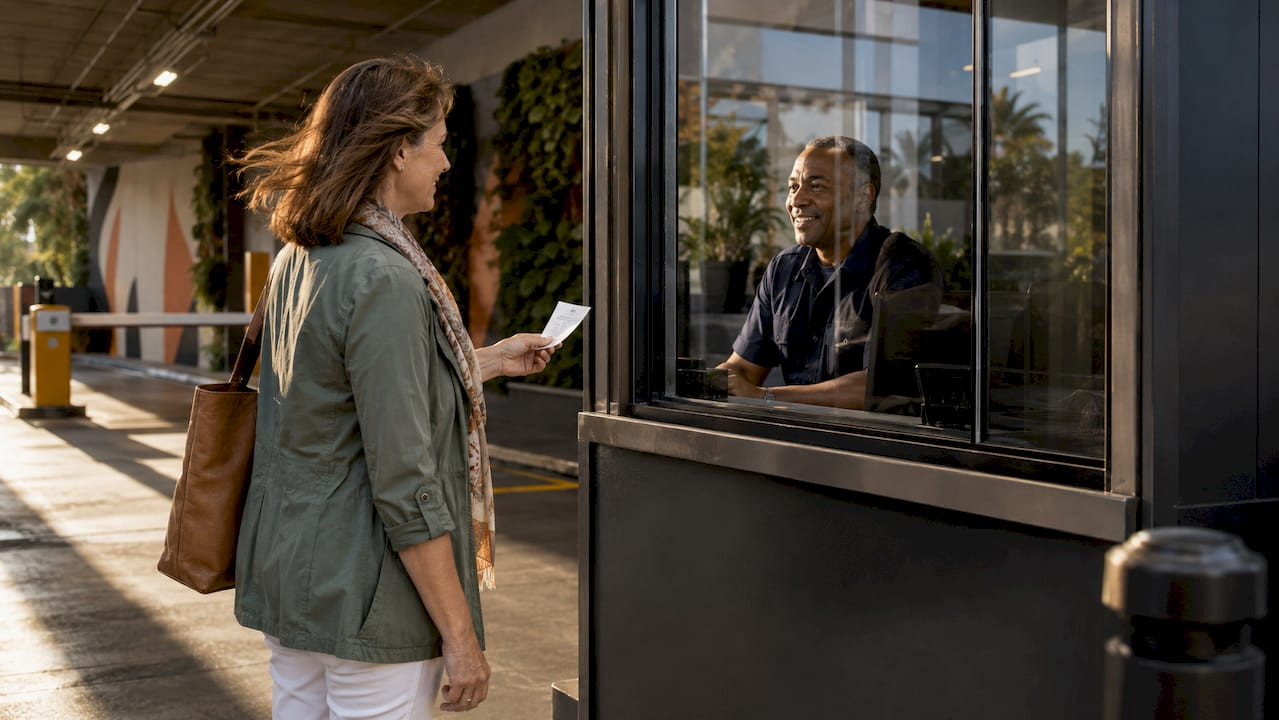
A complimentary parking ticket functions as proof that a business has agreed to cover your parking fee, either fully or partially. You receive it as a physical ticket, a stamp, or a digital code, and you present it at the exit to reduce or eliminate what you owe. The term “complimentary” strictly means the business is absorbing the cost as a courtesy, not that parking infrastructure is free by default.
The redemption process follows a predictable sequence:
- Enter the parking facility. Take a ticket from the machine or gate upon arrival. This ticket records your entry time and is required for exit.
- Visit the business. Complete your transaction, check in, attend the event, or receive your service.
- Request validation on-site. Ask a staff member, front desk, or kiosk to validate your ticket before you leave the building. Validation methods include physical stamps, barcode scans, digital codes, or app-based confirmation.
- Present the validated ticket at exit. Hand it to the attendant or insert it into the exit machine. The system reads the validation and adjusts your fee accordingly.
- Pay any remaining balance. Some programs cover only the first two hours or a flat dollar amount. You pay the difference, if any.
Validation requires on-site confirmation before exit. Customers who leave the facility without validating typically lose the benefit entirely and pay full rate.
Common rules attached to complimentary parking programs include minimum spend thresholds (often $20 at restaurants or $50 at retail stores), time limits, and restrictions on vehicle type or lot location. Partial validations are also standard. A hotel might cover the first two hours free for a restaurant guest but charge for additional time.
Pro Tip: Always validate your ticket before returning to your vehicle. Once you are at the exit gate, most systems cannot retroactively apply a validation code.

Who benefits from complimentary parking, and why do businesses offer it?
Complimentary parking benefits three groups directly: customers who avoid unexpected fees, businesses that use parking as a competitive differentiator, and valet staff who see higher gratuities when service feels generous.
From the customer side, the most common beneficiaries include:
- Hotel guests, who often receive complimentary parking as part of a room package
- Event attendees at arenas, convention centers, and theaters where parking is bundled into ticket pricing
- Retail shoppers at malls or shopping centers that validate for purchases above a threshold
- Restaurant diners at upscale or urban locations where parking costs would otherwise deter visits
- Healthcare patients at hospitals that waive fees for treatment appointments
From the business side, the motivation is rarely pure generosity. Complimentary parking is often bundled into room rates or service fees, meaning the business maintains revenue neutrality by embedding parking costs into overall pricing. A hotel advertising “free parking” has typically factored that cost into its nightly rate. The customer perceives value; the business preserves margin.
“Premium venues typically use complimentary parking to strengthen brand loyalty, while mid-market locations rely more on fee-based parking models to cover operational costs.” — Open Door Valet
One underappreciated effect involves valet tipping behavior. Complimentary valet parking generates higher gratuities because guests feel goodwill toward the service. Fee-based valet tends to produce lower tips, which affects staff compensation and retention. For hospitality operators, this dynamic is worth factoring into the decision between complimentary and paid valet models.
Complimentary parking also functions as a tactical marketing label. Businesses use it to signal premium positioning, reward loyalty program members, or compete against nearby venues that charge for parking. The perceived value often exceeds the actual cost to the business.
Complimentary vs. validated vs. free parking: what is the difference?
These three terms are frequently confused, and the confusion costs customers money. Each describes a distinct arrangement.
| Term | Who covers the cost | Conditions | Common context |
|---|---|---|---|
| Complimentary parking | Business covers cost as courtesy | May require purchase, stay, or event attendance | Hotels, restaurants, event venues |
| Validated parking | Business subsidizes cost after verification | Requires on-site validation before exit | Retail, medical offices, office buildings |
| Free parking | No fee structure exists | No conditions; open to public | Street parking, municipal lots, some retail |
| Discounted parking | Customer pays reduced rate | May require code or membership | Airports, garages, loyalty programs |
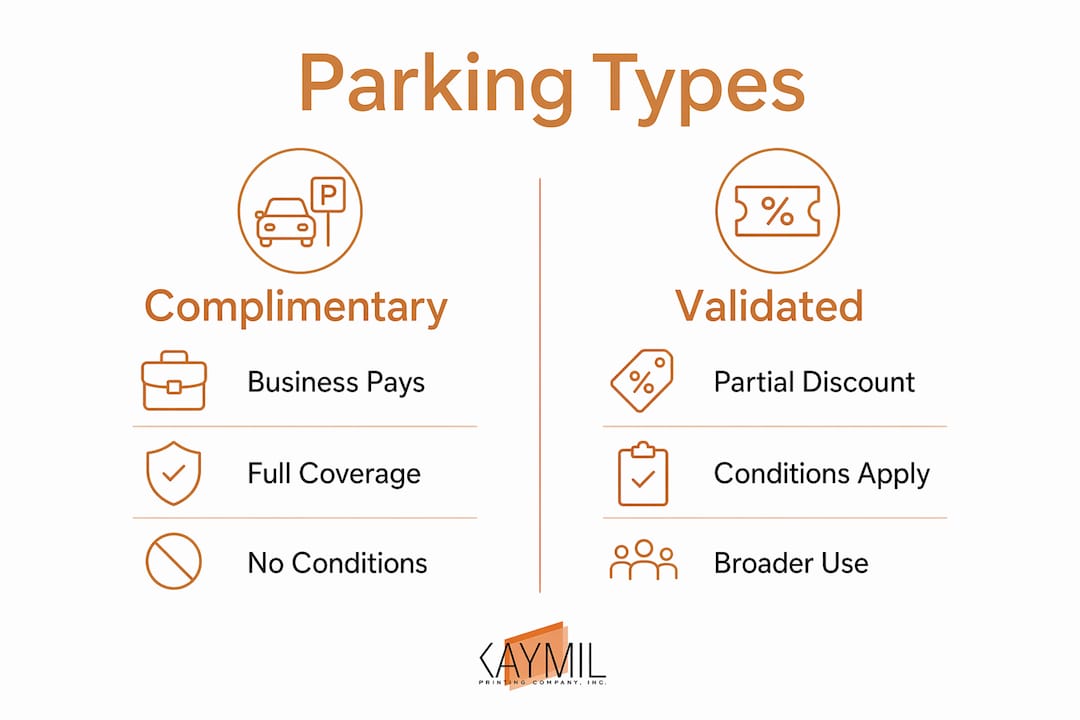
The distinction between “parking available” and “complimentary parking” is significant. “Parking available” means a lot exists on-site. It says nothing about cost. “Complimentary parking” explicitly means fees are waived as a courtesy. Consumers frequently assume on-site parking is free without verifying the fee structure, which leads to disputes at exit gates.
Validated parking is the broader category. Validated parking includes flat-rate discounts, free time blocks, partial validations, and full coverage, all issued via stamps, codes, or tickets. A complimentary parking ticket is one specific output of a validated parking program, typically representing full coverage rather than a partial discount.
Pro Tip: When booking a hotel or event venue, search specifically for “complimentary parking” rather than “parking available.” Call ahead to confirm whether validation is required and whether your vehicle type qualifies.
Public sector programs add another layer. The IAH Airport veteran program offers complimentary parking for veterans with qualifying DV license plates, allowing up to 60 days free parking in certain lots with original documentation. Standard rates after the free period run approximately $6.47 per day at ecopark lots and $25 per day at terminal garages. This illustrates that even government-issued complimentary parking programs carry specific eligibility rules and time limits.
Practical tips for getting and managing complimentary parking benefits
Whether you are a customer trying to use a complimentary parking pass or a business designing a program, the details determine whether the experience works.
For customers
- Confirm terms before arrival. Check the business website or call ahead to verify whether complimentary parking is available, what conditions apply, and whether your vehicle type qualifies. Confirm parking validation eligibility before you arrive to avoid surprise fees.
- Keep your entry ticket. Lose the entry ticket and you may face a lost ticket fee regardless of your validation status. Review how lost ticket fee policies work at the facilities you use most.
- Ask for validation immediately. Request your validation stamp or code at the point of service, not as an afterthought on your way out.
- Check time limits. A two-hour complimentary window sounds generous until your appointment runs long. Know the cutoff and plan accordingly.
- Use digital options when available. Many modern facilities use app-based or QR code validation. These systems update in real time and reduce the risk of a stamp being misread at the gate.
For businesses
Designing a complimentary parking program that customers actually use requires more than printing tickets. Proper signage and upfront communication about validation conditions directly reduce disputes and improve satisfaction.
- Post clear signage at the parking facility entrance, at your front desk, and at point of sale explaining exactly how validation works.
- Train all customer-facing staff to offer validation proactively, not only when asked.
- Offer both paper and digital validation options to accommodate different customer preferences.
- Set realistic time limits that match your typical service duration. A 90-minute restaurant validation that expires before a typical dinner is finished creates frustration.
- Audit your program regularly. A parking facility audit helps identify where customers are losing their complimentary benefit and where your process breaks down.
Validation technology is moving toward digital and app-based solutions that allow real-time ticket validation and reduce manual errors. Businesses that integrate these tools into their existing parking management systems see fewer disputes and faster throughput at exit gates.
Pro Tip: If your business is transitioning from complimentary to fee-based valet, communicate the change clearly and plan for a 3–6 month adjustment period with careful messaging to maintain customer satisfaction.
Key takeaways
A complimentary parking ticket is a business-issued authorization that waives parking fees as a courtesy, and its value depends entirely on clear validation processes, honest communication, and well-designed program rules.
| Point | Details |
|---|---|
| Definition is specific | A complimentary parking ticket covers parking costs as a courtesy, not simply because parking is on-site. |
| Validation is required | Customers must validate on-site before exit or lose the benefit entirely. |
| Cost is rarely zero for businesses | Parking costs are typically embedded in room rates, service fees, or pricing strategies. |
| Terms vary widely | Time limits, spend thresholds, and vehicle restrictions all affect whether you qualify. |
| Digital tools reduce errors | App-based and QR code validation systems improve accuracy and customer experience. |
Why complimentary parking programs deserve more strategic attention
I have spent years working with parking operators, hotel groups, and event venues on ticketing and validation programs. The most consistent mistake I see is treating complimentary parking as a passive amenity rather than an active customer experience tool.
Businesses spend significant money on lobby design, staff training, and brand presentation, then hand customers a confusing parking ticket with no clear instructions. The result is a dispute at the exit gate that erases the goodwill built during the visit. The ticket itself is the last touchpoint before a customer leaves. It should reinforce the experience, not undermine it.
The shift toward digital validation is real and accelerating. Mobile app integrations, QR codes, and license plate recognition systems are replacing stamped paper tickets at high-volume venues. But paper tickets are not going away. Multi-part carbonless formats, barcoded tickets, and machine-issued rolls remain the backbone of most mid-size parking operations because they are reliable, auditable, and cost-effective. The smart approach is not to choose one over the other but to design a program that uses both where each performs best.
The businesses that get complimentary parking right treat it as a brand statement. Custom-branded tickets with logos, clear instructions, and professional printing signal that the business takes the full customer experience seriously. That detail matters more than most operators realize.
— Richard
How Caymil supports complimentary parking ticket programs
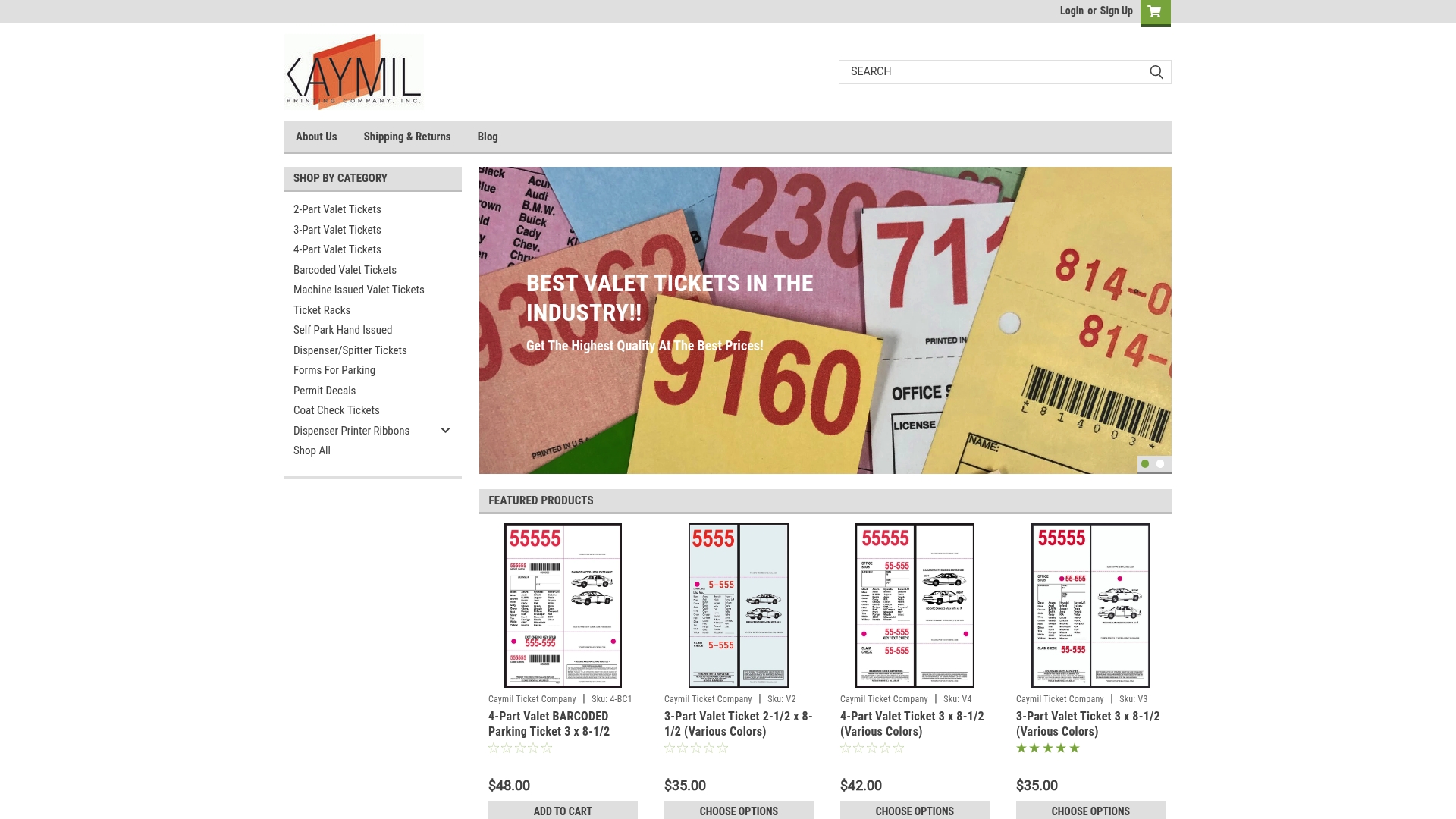
Caymil has manufactured parking and valet tickets since 1937, and the product range covers every format a complimentary parking program might require. From machine-issued valet tickets for high-volume garages to 2-part carbonless valet tickets, 3-part formats, 4-part tickets, and barcoded valet tickets for facilities using automated scanning systems, Caymil supplies the physical infrastructure that complimentary parking programs depend on. All tickets are available with custom logo branding, sequential numbering, and security features that make validation auditable and fraud-resistant. Businesses managing complimentary parking for hotels, event venues, or retail locations can browse the full range of parking forms and ticket options to find formats that integrate with their existing validation process.
FAQ
What is a complimentary parking ticket?
A complimentary parking ticket is an official document, stamp, or digital code issued by a business that covers a customer’s parking fee as a courtesy. It is the physical or digital output of a validated parking program where the business absorbs the cost.
How does complimentary parking work at hotels?
Hotels typically include parking costs in room rates or offer validation at check-in. Guests receive a ticket or code that waives the parking fee, though terms like vehicle type restrictions and time limits may apply.
What is the difference between complimentary and validated parking?
Validated parking is the broader category covering discounts, partial coverage, and full waivers. A complimentary parking ticket specifically means the business covers the full cost as a courtesy, with no charge to the customer.
Do I need to do anything to use a free parking pass?
Yes. You must request validation from the business on-site before returning to your vehicle. Leaving without validating typically results in losing the benefit and paying the full parking rate at the exit gate.
Can businesses customize complimentary parking tickets?
Yes. Tickets are available in machine-issued rolls, multi-part carbonless formats, and barcoded versions, all with options for custom logos, sequential numbering, and color coding to match a business’s branding and validation process.
Recommended
- What Is a Stock Parking Ticket? A Clear Guide - Caymil Printing Co., Inc.
- Parking Receipt vs Parking Ticket: Know the Difference - Caymil Printing Co., Inc.
- What is an event parking ticket? The pro’s guide - Caymil Printing Co., Inc.
- Parking Machine Ticket: What Every Driver Should Know - Caymil Printing Co., Inc.