
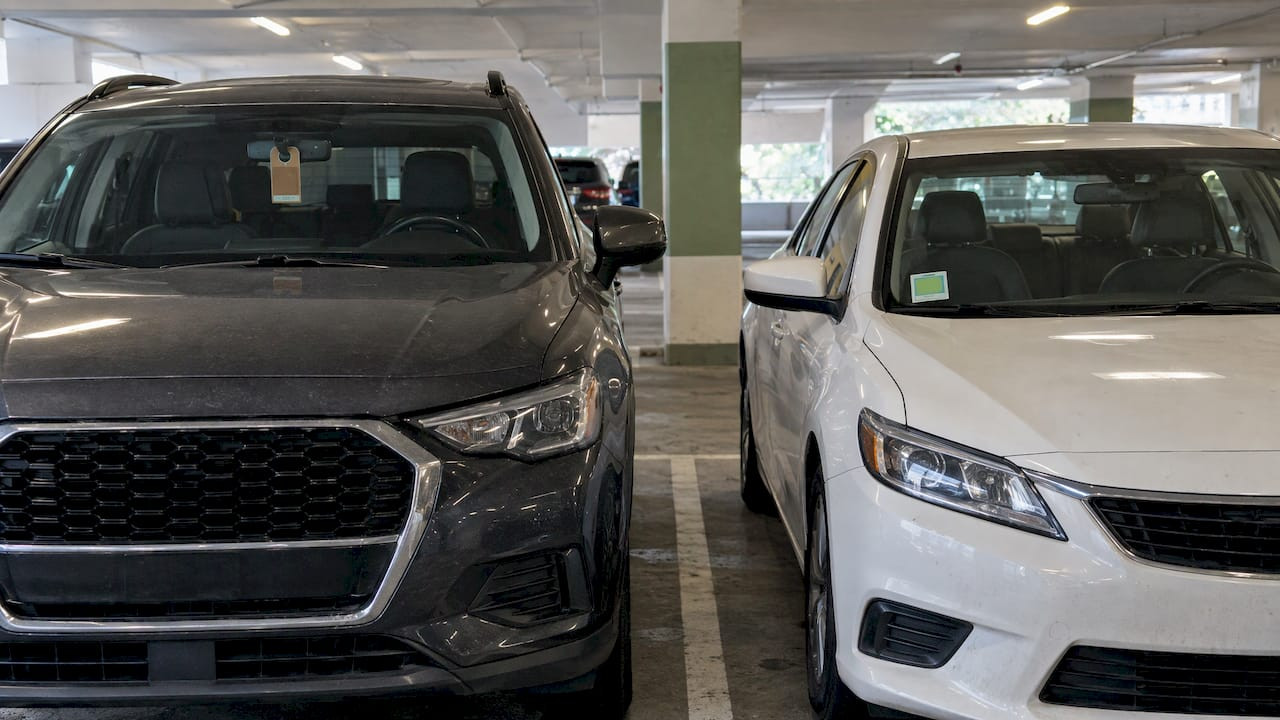
Hang Tag vs. Windshield Permit: Which Fits Your Lot?

A hang tag hangs from the rearview mirror and moves easily between vehicles. A windshield permit is a decal or sticker fixed to the glass, usually in a set corner, and stays with one vehicle. Choose hang tags when permit holders switch cars or you issue short-term and visitor access. Choose windshield decals when you want a permit tied to one vehicle for a long period and a fixed spot where enforcement staff always look.
The rest of this guide covers how each permit is displayed, how they compare on security and day-to-day handling, and which one suits a managed lot, garage, hotel, valet operation or event. It ends with a checklist for specifying either one.
TL;DR
- Hang tags suit shared, temporary or multi-vehicle use. Holders move them from car to car, and enforcement staff read them through the glass.
- Windshield permits suit one vehicle for a long period. Their fixed position makes patrols fast, but they are harder to move between vehicles.
- Placement rules vary by facility, so print clear display instructions on the permit or issue them with it.
- Whichever format you choose, a unique number, an expiration date and the issuer’s name or logo make the permit enforceable.
- Pair the permit with a written parking policy. Without one, the permit has nothing to enforce.
Table of Contents
- The core difference between the two formats
- How each permit is displayed
- Security, transfer and misuse
- Durability and day-to-day handling
- Which permit suits which operation
- What to specify when you order
- Our perspective
- Order permits and tickets built for your lot
- FAQ
- Sources
The core difference between the two formats
Both formats do the same job: they tell an attendant or enforcement officer, at a glance, that a vehicle is authorized to be there. They differ in how they attach to the vehicle.
A hang tag is a rigid or semi-rigid card with a hole or loop that hangs from the interior rearview mirror. It is held by the mirror, not by adhesive, so it can be taken down and placed in another vehicle.
A windshield permit is a sticker or decal with adhesive that bonds to the inside of the glass. Some are also called self-adhering permits. Once applied, it is meant to stay on that vehicle until it expires or is removed.
Everything else, from security to cost of reissue, follows from that one difference: one is removable, the other is fixed.

How each permit is displayed
The display position is what makes a permit easy to identify during enforcement. Published rules from US facilities show a consistent pattern, with local variation.
| Hang tag | Windshield permit | |
|---|---|---|
| Typical position | Hanging from the rearview mirror, printing facing out | Fixed to the front windshield, often the driver-side lower corner |
| Visibility requirement | Printing readable through the windshield | Placed so it is visible and clear of the driver’s line of sight |
| Attachment | Mirror, no adhesive | Adhesive on the glass |
| Moves between vehicles | Yes | Generally no |
A few real examples show how institutions write the rule:
- Indiana University asks that hang-tag permits are suspended from the rearview mirror with the letter or graphics showing through the front windshield below the tinted portion. Its sticker permits go in the center of the front windshield, behind the mirror, below the tint and out of the driver’s line of sight.
- At the University of Michigan, windshield permits go on the driver’s-side lower left corner of the front windshield, and hang tags are displayed on the mirror with the instructions on the back facing the driver.
- West Virginia University requires permits to be attached to the lower front driver-side windshield facing outward, and hang tags to face outward on the rearview mirror. Failing to display one properly is a parking violation.
- Washington Administrative Code 132W-117-160 says a permanent permit hangs from the interior rearview mirror facing out. If there is no mirror, it goes in the driver-side lower corner of the windshield. A temporary permit goes on the dashboard where it can be plainly observed.
The lesson for operators is that no single national rule exists. Your lot sets the rule, and the permit should state it. Printing a simple placement diagram or instruction on the back of a hang tag, or on the carrier of a decal, prevents most citations that come from drivers putting the permit in the wrong place. Our guide to windshield permit placement walks through placement for decals that need to stay legible for months.
Security, transfer and misuse
Transfer between vehicles
This is the clearest practical split. Texas A&M’s parking office notes that hangtags may be transferred from vehicle to vehicle, while a holder of a self-adhering permit who brings a different vehicle to campus must buy and display a temporary permit.
For an operator, that has two consequences:
- Hang tags suit people who drive more than one vehicle, share a car with a household member, or rotate rental or fleet vehicles.
- Windshield permits suit vehicles that rarely change, such as resident, employee or reserved-space holders with a dedicated car.
Misuse and fraud
Portability cuts both ways. A tag that moves easily can also be lent to someone else. The City of San Jose described this when it moved its residential permit program away from plastic hang tags: physical permits invited misuse and fraud, so the city shifted to a license-plate-based virtual system.
That is a city-scale program with its own enforcement tools. A private lot or garage does not have to go virtual to reduce misuse. It can limit sharing through design choices: unique serial numbers, color coding by zone or period, tamper-evident construction and a permit database that staff can check. Our article on tamper evidence for parking permits covers how to apply and check these features in seconds.
Reading time at the gate or on patrol
A windshield permit in a known corner means a patrol officer or attendant looks in one place. A hang tag is also in one place, the mirror, but it can twist, be turned around or be removed when the driver leaves. If your enforcement relies on walking rows of parked vehicles, make the printed face large, high contrast and readable in about three seconds. Our piece on monthly parking permit design explains how to lay that out.
Durability and day-to-day handling
Hang tags take wear from handling. Drivers take them down, toss them on a seat and hang them back up. The hole at the top is the weak point, and a tag that tears has to be replaced. Reinforced holes, heavier stock and coatings extend the life. We cover those construction choices in reinforced hang tags and in our guide to mirror-safe permit materials.
Windshield permits take wear from sun, heat and the glass itself. Printing sits behind the windshield, so it is protected from rain but exposed to UV. Adhesive quality matters most: a decal that curls or lifts becomes unreadable and may need reissue. The fixed position removes the handling problem, but you can’t easily reuse the permit if the holder changes vehicles.
Cost of ownership depends on how often permits are lost, damaged or transferred. A hang tag that lasts a full term may cost less to replace than a decal, but only if holders don’t lose it. A decal can be cheaper per unit and cleaner to administer for permanent vehicles. Published prices differ widely by program. As one example of how permit pricing is set, the City of Fort Worth lists a vendor hangtag permit at $595.38 for one full calendar year, alongside resident permits that are stickers on the lower left corner of the front windshield. That figure reflects one city’s pricing and parking policy, not what a private lot will charge.

Privacy on the printed face
Because either permit sits in plain view, avoid printing personal data on it. Names, unit numbers, phone numbers and email addresses don’t belong on the face. Use the permit as a visual pass with a number, and keep the holder’s details in your database. A barcode or QR code that links to your records lets staff verify without exposing anything.
Which permit suits which operation
Managed lots and garages
Monthly or annual parkers with one vehicle are a natural fit for windshield decals. Holders who rotate vehicles, such as employees with a shared car or contractors with several work trucks, are better served by hang tags. Many garages issue both: decals for permanent holders and tags for flexible ones. If you are starting a program, our walkthrough on how to launch a garage permit hang tag program covers the steps.
Hotels and valet operations
Hotel guests change vehicles constantly and stay for a few nights, so a removable permit is the practical choice. A hang tag lets a guest or visiting vendor display authorization without applying adhesive to a personal or rental car. Valet operations also run on tickets, and permits and tickets work together: the ticket tracks the individual vehicle during the visit, and the permit identifies staff, long-stay guests or residents.
Events and temporary access
For a one-day or one-week event, a hang tag or a dash-placed temporary permit is faster to hand out and doesn’t need adhesive. Washington’s rule that a special or temporary permit goes on the dashboard shows how some facilities treat short-term access differently from permanent permits. See our examples of temporary parking permit best practices for layout and issuing ideas.
Contractors and vendors
Contractor traffic is the hardest to track because vehicles and crews change. Hang tags with company names, date ranges and color coding make missing or expired permits easier to spot. Our guide on contractor parking permits covers how to find missing tags quickly.
Quick decision guide
| Situation | Better fit |
|---|---|
| One vehicle, long term | Windshield permit |
| Multiple vehicles per holder | Hang tag |
| Short stay, guest or visitor | Hang tag |
| Event day or temporary access | Hang tag or dash permit |
| Fixed enforcement corner, regular patrols | Windshield permit |
| Shared or rotating fleet | Hang tag |
What to specify when you order
Whatever format you pick, the permit works only if it carries the right information and ties to your rules. Use this list when writing a spec:
- Unique permit number. Every functional tag needs one, along with an expiration date and the issuing organization’s name or logo, as LegalClarity’s design guide puts it.
- Zone or period coding. A color-coded border or zone marker directs drivers and helps staff spot a permit in the wrong area. Our post on parking hang tag design covers five decisions facility managers should settle up front.
- Optional barcode or QR code. Linking to your permit database speeds verification.
- Display instructions. State where the permit goes and which side faces out.
- Material and finish. Match the stock to how the permit will be handled, from a hole reinforcement on tags to adhesive on decals.
- Written parking policy. A permit is only as enforceable as the policy behind it. A property-management perspective is that a printed tag means nothing legally unless it connects to a written policy that users have agreed to. For leased properties, that usually means a signed lease addendum covering authorized spaces and towing.
Keep the mirror in mind too. Hang tags should hang below the mirror housing and not block the driver’s view, and some states restrict objects hanging from the mirror. Check your state’s law with your counsel or local authority, and tell permit holders to remove the tag while driving if your jurisdiction or lot rules call for it.
Our perspective
We have printed parking and valet paper since 1937, and the question of hang tag versus windshield permit comes up in almost every permit program we help with. Our answer is that the format should follow how your holders actually park.
If holders drive one vehicle for months, a decal in a consistent corner gives your team a fast, repeatable check. If holders change vehicles, visit for short stays or work in rotating crews, a hang tag removes the friction and the reissue cost. Many of our customers run both side by side.
What matters more than the format is how the permit is built. Clear numbering, readable print, durable stock and, where you need them, barcodes and security features turn a piece of paper into a control tool. We make custom permits with those options so that the permit reads quickly and holds up to real use.
Specify the permit around your enforcement process first, then choose the format. That order saves reprints and citations disputes later.
Richard
Order permits and tickets built for your lot
If you run decals, we offer parking permit decals, including round window decals and badge-shaped window decals. Permit decals are listed at $88. For hang tags, we manufacture custom permits with sequential numbering, logos, color coding and security features, and you can start from our home page to request a custom design.
Valet and garage teams can also pair permits with our barcoded valet tickets or ticket racks, so permits, tickets and racks all come from one supplier with millions of tickets in stock and fast nationwide shipping.
FAQ
Can a hang tag replace a windshield permit?
In most programs, yes, if your rules allow it. A hang tag works wherever staff can see the mirror through the windshield. Your lot’s policy decides which formats are valid, so state the accepted formats on the permit and in your parking rules.
Which is harder to share or counterfeit?
A windshield decal is harder to move between vehicles, because it is bonded to the glass. A hang tag is easier to lend, as San Jose found with its former plastic tags. Unique numbering, tamper-evident features and a permit database reduce misuse for either format.
Where should a hang tag be placed?
Hang it from the interior rearview mirror with the printed side facing out through the windshield. Many facilities, such as Indiana University, specify that the printing be visible below the tinted portion. Follow the instructions of the lot that issued it.
What if a holder has no rearview mirror or changes vehicles?
Set a rule for it. Washington’s code, for example, places a permit in the driver-side lower corner of the windshield when a vehicle lacks an interior mirror. For vehicle changes, hang tags transfer, while decal holders typically need a temporary permit.
Sources
- Displaying Your Permit, Indiana University Parking
- WAC 132W-117-160, Washington State Legislature
- Parking FAQ, City of Fort Worth
- Faculty and staff rules and regulations, University of Michigan
- Parking Compliance Rules and Regulations, West Virginia University
- Permit/Transponder Information and Placement, Texas A&M
- Virtual Residential Permit Parking, City of San Jose
- Car Hang Tag Template: Design, Print, and Display It Right, LegalClarity
- Free Hanging Parking Permit Templates to Print, LegalClarity