
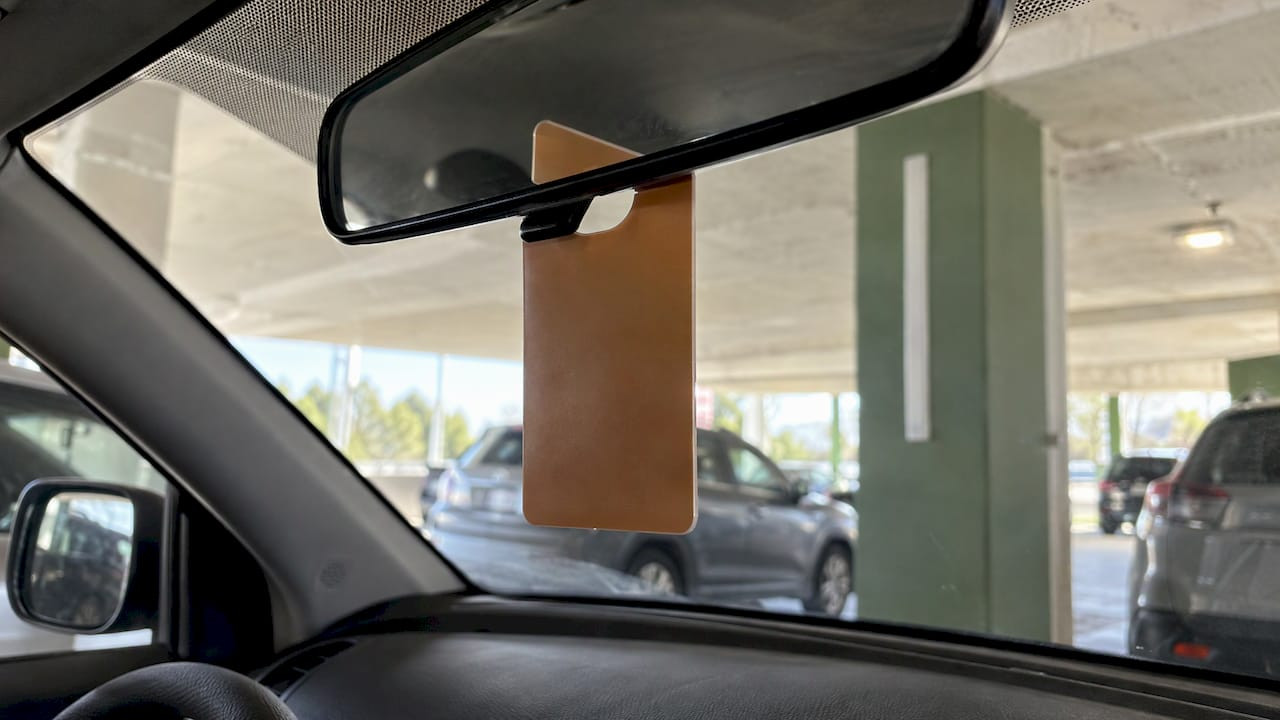
Mirror-Safe Permit Materials: Choosing Hang Tags That Last

A mirror-safe permit is a rigid but lightweight hang tag, usually plastic for repeat use and paper or card stock for one-day passes. It has a smooth, rounded hanger opening. It is sized so the driver’s view stays clear and nothing presses on the mirror. This guide covers how to pick the material, size and display method for each type of permit program, and which rules affect hanging anything from a mirror.
TL;DR
- Use a rigid plastic hang tag for permits that are issued, returned and reissued or worn for months. Use paper or card stock only for single-day or short event passes.
- Keep the tag light and the hanger smooth. Heavy tags and sharp edges are what strain a mirror mount or scratch the mirror housing.
- Hang tags are not legal to hang in every state. Nine states prohibit hanging items from the mirror, so ask your counsel and your drivers’ states before choosing a format.
- Where a mirror display is restricted, an adhesive window decal is the usual alternative.
- Match print durability to the lifespan: sequential numbers, dates and your logo must stay readable for the whole permit period.
Table of Contents
- What “mirror-safe” actually means
- Common materials for rearview-mirror permits
- Choosing the material by permit type
- Size, shape and hanger design
- Display rules that protect the mirror and the driver
- State rules to know before you choose a hang tag
- Print durability: keeping the permit readable
- A simple selection checklist
- Perspective: what we see in permit programs
- Order permit materials built for your program
- FAQ
- Sources
What “mirror-safe” actually means
The phrase covers three separate concerns, and a good permit program addresses all of them.
- Material safety for the mirror. The tag should not scratch the mirror housing, strain the mount or fall off when a door slams.
- Driver visibility. The tag should be small enough and positioned so it does not block the view through the windshield.
- Readability for enforcement. An attendant walking a lot should be able to read the permit number, zone or date through the windshield without stopping.
The first two concerns are why drivers and regulators care about hanging objects at all. AAA Northeast explains that restrictions on mirror hangers exist so drivers can see through the windshield without obstruction or distraction. They also exist to prevent damage, since over time hanging objects can weaken the glue that holds the mirror in place. A permit that is flat, light and sized for the job answers both points.
Common materials for rearview-mirror permits
Most hang-tag programs choose among four materials. The right one depends on how long the permit lives and how many times it is handled.
| Material | Best for | Strengths | Watch-outs |
|---|---|---|---|
| Rigid plastic (polystyrene or similar) | Monthly, semester, annual and employee permits; issue-and-return programs | Holds its shape, resists bending and moisture, stays legible through repeated use | Costs more per tag than paper, so plan returns and reissue |
| Heavy paper or card stock | One-day, event or visitor passes | Low cost, easy to date and mark | Curls with heat and humidity, tears at the hanger hole |
| Coated or laminated paper | Short-term permits of a few days to a few weeks | More moisture resistance than plain paper | Edges can peel if the lamination is poor |
| Adhesive window decal | Long-term permits, or areas where mirror hanging is restricted | Nothing hangs from the mirror, tamper-evident options | Applied once, so reassignment means a new decal |
On plastic, thickness matters. The Daily Automotive notes that 30-mil polystyrene is used as a hang-tag substrate that supports a durable, high-visibility tag that stays easy to read during repeated issue-and-return cycles. That is the profile most operators want for a permit that goes back and forth between a booth and a vehicle dozens of times.
Why rigid plastic is the default for repeat use
A tag that flexes and bends in a hot car loses its edges first. Once corners curl, the permit number turns away from the windshield and the attendant has to guess. A rigid tag keeps its face toward the glass. It also keeps its printed information intact when handled with gloves, passed through a window or tossed on a seat.
For the full comparison of the two main options, our plastic vs. paper hang tag specifications lay out what each material does well in an operating environment. If your permits are reused year after year, reinforced hang tags address the stress point at the hanger hole, which is where most tags fail.

Where paper makes sense
Paper and card stock are a practical fit when the permit has a short life: a stadium event, a one-day contractor pass or a hospital visitor shift. Northwestern University’s Transportation & Parking office, for example, requires temporary hangtags to hang from the rearview mirror facing out with the expiration date indicated, and one-day temporary permits are marked with the single valid date. The tag only has to survive a day, so a low-cost material is sensible, provided the date is unmistakable.
Choosing the material by permit type
The best question is not “which material is best?” but “how long and how often will this permit be handled?”
Temporary and one-day permits
- Choose card stock or lightweight paper.
- Use a bold date field or scratch-off date so the expiry cannot be altered quietly.
- Use sequential numbering so every issued pass can be tracked against your log.
- Order enough stock for peak days, since running out forces improvised passes.
Monthly, semester and annual permits
- Choose rigid plastic.
- Print the zone, number and expiry in high-contrast ink at a size readable from several feet away.
- Put your logo or color-coding on the face so attendants can tell zones apart at a glance.
- Decide in advance whether the tag is returned or kept. A returned tag justifies a sturdier material.
Issue-and-return permits
Hotels, hospitals and shared garages often hand permits out at a desk and collect them at exit. The tag takes the most handling here, so rigid plastic with a reinforced hanger opening is the better value over its life. Plan a sequential numbering system so you can reconcile tags in the evening count.

Long-term permits in areas where mirrors are restricted
When drivers come from states that restrict mirror hangers, or when your own policy prefers no hanging items, a window decal removes the issue entirely. See our guide to windshield permit placement for where decals should sit so they are visible without crowding the driver’s view.
Size, shape and hanger design
Material is only half of mirror safety. The tag’s size and hanger decide how it behaves on a mirror stem.
- Size. A tag large enough to read is also large enough to block. Keep the face to the smallest size that still holds your permit number and zone in legible type. Our ready-to-order mirror hang tag sizes show the common options.
- Hanger opening. A smooth, rounded cutout slides over the mirror stem without scratching it. Sharp or irregular openings can mark the mount.
- Weight. A light tag swings less and puts less load on the mirror mount than a thick, heavy card.
- Layout. Put the key information, such as number and expiry, where it faces outward and is not covered by the mirror stem. Layout choices like these are covered in five decisions for parking hang tag design.
Display rules that protect the mirror and the driver
University parking offices publish some of the clearest display instructions, and they share a pattern. Indiana University Bloomington directs that hang-tag permits be suspended from the rearview mirror with the lettering or graphics showing through the front windshield and below its tinted portion. It also offers a free plastic pocket for the driver’s-side windshield where it is visible and does not block the driver’s vision. It warns drivers not to use tape, magnets, string or other materials to attach a permit.
Texas A&M’s parking office states that hangtags should be suspended from the rearview mirror with the entire permit visible through the front windshield from outside the vehicle. If a vehicle prohibits hanging the permit from the mirror, drivers are asked to contact the parking office for help.
Translated to an operator’s rules, this gives you a short driver instruction that fits on a handout or sign:
- Hang the permit from the rearview mirror with the printed side facing out.
- Make sure the whole permit is visible through the windshield.
- Remove the permit while driving if state law or your vehicle restricts hanging items. Display it on the dashboard or in a windshield pocket only if your program allows it.
- Never attach the permit with tape, magnets or string.
State rules to know before you choose a hang tag
There is no federal rule on what hangs from a personal vehicle’s mirror, and the rules vary by state. AAA Northeast reports that at least nine states prohibit hanging items from the rearview mirror: Arizona, California, Colorado, Illinois, Minnesota, New Jersey, New York, Pennsylvania and Texas. It adds that Virginia prohibits objects that obstruct the driver’s view, and that Florida bans objects that block vision with exceptions such as parking passes.
A few examples show how the wording differs:
- Pennsylvania. The state code says no object or material may be hung from the rearview mirror, and nothing may be placed where it materially obstructs the driver’s vision.
- California. The vehicle code prohibits objects that obstruct or reduce the driver’s clear view through the windshield or side windows, and the same section contains exemptions for specific items.
- Virginia. The statute makes it unlawful to drive with an object suspended so as to substantially obstruct the driver’s clear view, and says officers may not stop a vehicle solely for this violation.
- Missouri and Kansas. The Kansas City Star reports that Missouri law makes it unlawful to operate a vehicle with a windshield hanging placard from the inside rearview mirror, while Kansas does not explicitly prohibit hanging decorations but recommends removing them.
What this means for operators: a mirror hang tag is a display method that works in much of the country, but your drivers may come from states where they should lift the tag off the mirror before driving. Many permit programs handle this with a clear “hang when parked, remove when driving” instruction printed on the tag or handed out at issue. For legal certainty on your own program, confirm the current statute in your state with counsel or the local transportation authority.
Operators who run staffed lots also think about what happens when a vehicle is damaged on site. Those looking at how responsibility is assigned can read about guarded parking liability for damage, which shows how one country frames that question.
Print durability: keeping the permit readable
A mirror-safe material that fades is not a good permit. Sun exposure through a windshield is the main threat to ink on any permit. Choose print methods and inks rated for continuous display, and use high-contrast color combinations: dark text on a light field, or white on a dark field.
When you specify a permit order, cover these points:
- Numbering: sequential numbers that cannot be confused when read from a distance.
- Security features: details that make copying harder if your lot has a counterfeit problem.
- Color coding: one color per zone or permit class.
- Expiry marking: a printed term, a scratch-off date or a punch field, depending on how your attendants verify.
- Logo and contact line: so a driver with a problem knows whom to call.
For decals, which resist UV differently from paper, see our notes on slowing fading on parking permits and the specification points for municipal permit decals.
A simple selection checklist
Use this list when you are choosing a permit for a new lot or replacing an existing stock:
- How long is the permit valid? One day points to paper. Months or more points to plastic or a decal.
- Will it be reused? If tags come back to a desk, order rigid plastic with a reinforced hanger.
- Where do your drivers live? If many come from states that restrict mirror hangers, consider a decal or a hang-when-parked instruction.
- Who reads the permit, and from how far? Size your type to the farthest reading distance.
- How will you track it? Sequential numbering and zone colors make audits quick.
- What is your reorder cycle? Standard sizes ship faster than fully custom shapes.
If you are starting a program from scratch, how to launch a parking garage permit hang tag program walks through issuing, tracking and renewal.
Perspective: what we see in permit programs
Since 1937 we have printed tickets and permits for parking operators, hotels, casinos, hospitals and universities, and the pattern is consistent. Permit problems rarely begin with the design. They begin with a material that does not match how the permit is used.
A visitor pass printed on the same stock as an annual employee tag wastes money. An annual tag printed on light paper means reprints by spring. We recommend deciding the permit’s lifespan first, then the material, then the artwork.
We also encourage operators to treat the mirror as part of the system. A rigid, lightweight tag with a clean hanger opening, a clear instruction on how to display it, and a decal alternative for restricted situations gives your attendants a readable permit and gives drivers no reason to improvise with tape or string.
Our hang tags, decals and numbered formats are designed to support exactly that kind of program, with custom colors, logos and sequential numbering available for your lots.
Richard
Order permit materials built for your program
If you manage a lot, garage, hotel or campus, we manufacture permit decals and custom parking tickets, plus the valet tickets, ticket racks and forms that go with them. Tell us the permit’s lifespan, display method and numbering needs, and we can match the material and layout. Start with our permit decals or browse the full range at Caymil.
For window displays, our badge-shape window decals give you a no-hang option, and the round window decals suit programs that prefer a compact format.
FAQ
Is plastic or paper better for a rearview-mirror parking permit?
Plastic is better for permits that are reused, worn for months or handled often, because it keeps its shape and stays legible. Paper or card stock is better for one-day and event passes where low cost matters and the permit is discarded after use. Match the material to the permit’s lifespan rather than choosing one for every case.
Can a hang tag damage a rearview mirror?
A heavy or sharp-edged hanger can strain the mirror or mark the housing. AAA Northeast notes that hanging objects can, over time, weaken the glue that holds the mirror in place. Choose a light tag with a smooth, rounded hanger opening, and ask drivers to remove it while driving where required.
Is it legal to hang a parking permit from the mirror?
It depends on the state. At least nine states prohibit hanging items from the mirror, while others only prohibit objects that obstruct the driver’s view, and Florida has exceptions for parking passes. Confirm the rule in the states your drivers come from, and offer a decal or windshield display when the mirror is not an option.
How should drivers display a hang tag?
Drivers should hang it from the mirror with the printed side facing out so the full permit can be read through the windshield. Universities such as Indiana University and Texas A&M advise the same placement and recommend against tape, magnets or string. Drivers whose vehicles do not allow hanging can contact the parking office for another option.
Sources
- Parking Decals for Cars: Stickers vs. Hang Tags Explained, The Daily Automotive
- Displaying Your Permit, Indiana University Parking
- Permit/Transponder Information & Placement, Texas A&M Parking
- Permit Display, Northwestern University Transportation & Parking
- Is It Illegal to Hang Things From Your Rearview Mirror? AAA Northeast
- Virginia Code § 46.2-1054
- 67 Pa. Code § 175.68, Mirrors
- California Vehicle Code § 26708
- Can you hang items from your rearview mirror in KS and MO? The Kansas City Star