
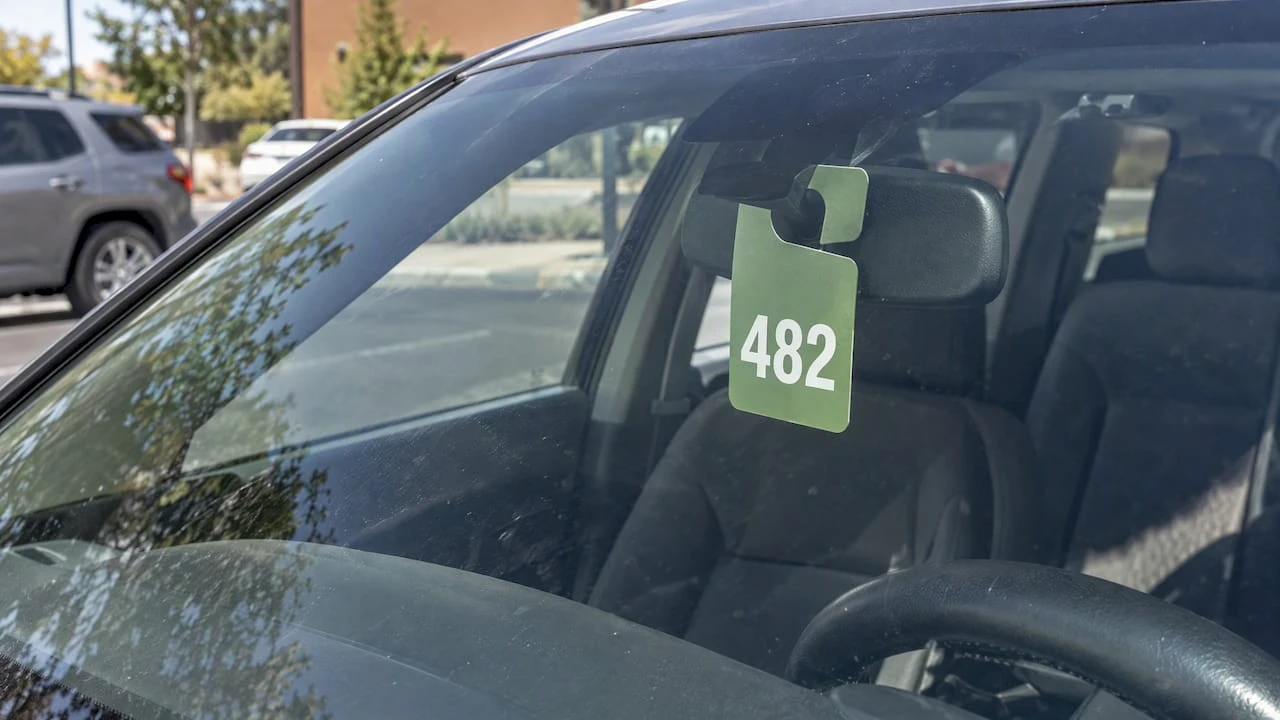
Permit Number Size: How Big Should Parking Permit Numbers Be?

There is no single required size for a permit number. For parking permits, the right size is the one an officer, attendant or gate monitor can read at their normal working distance, in poor light, without stepping closer. For mailers, the “permit number” is an administrative identifier inside a postal indicia, and the rules govern the indicia, not the number alone. This guide covers both meanings, then goes deep on the one most parking operators need: how to specify numbers on decals, hang tags and temporary permits so they are read the first time.
TL;DR
- A parking permit number has no universal size. Size it for the distance and speed at which it must be read, then confirm it on a proof.
- Specify more than height: font weight, ink color, background contrast, position on the permit and the exact starting and ending numbers.
- Security marks and numbering work together. Public bid documents set marks close enough to be recognized from 10 feet.
- For postal permit imprints, the controlling rules cover placement, clear space and minimum type, not a fixed number size.
- Ask for a printed proof and test it outdoors before the full run is produced.
Table of Contents
- What “permit number” means depends on who is asking
- Size is really about legibility at distance
- What to define besides the height
- Security marks and numbering belong in the same design
- How to specify permit numbers: a step-by-step process
- Temporary permits and printed forms
- If you meant a postal permit number
- Our perspective: what we see on orders
- Ordering numbered permits and tickets from Caymil
- FAQ
- Sources
What “permit number” means depends on who is asking
The phrase is used in several unrelated fields, which is why search results for it are mixed. Highway agencies issue oversize and overweight permits with their own number formats. Alarm ordinances assign registration numbers. Mailers hold a postal permit. Parking operators number physical credentials: decals, hang tags, temporary permits and validation stubs.
If you manage parking, the question behind the search is usually practical: how large should the number be so enforcement can read it, and what else should I define before I send artwork to print? The sections below answer that. If you landed here looking for postal rules, jump to the section on mailing permits.
Size is really about legibility at distance
When a permit is read from a patrol vehicle, a gate lane or across a lot, a number that looks generous on a design screen can fail in the field. Public purchasing documents show how institutions think about it. A university police parking decal bid specifies decals that are numbered consecutively in defined ranges, with separate ranges and colors for different permit groups. The emphasis is on rapid identification, not on an abstract measurement.
That is the right way to frame the decision. Ask three questions:
- How far away is the reader? A gate attendant at a window reads at arm’s length. A patrol officer in a moving vehicle may read at several car lengths.
- How fast must the read happen? Manual lot sweeps tolerate a pause. Gate lanes and event ingress do not.
- What is behind the number? Glass tint, a dashboard, glare and dirt all reduce contrast.
A useful working rule is to start from the largest digit height the permit face allows after your logo, permit type, expiration and security elements are in place, then give the number priority over decorative elements. Our guide to enforcement first monthly permit design walks through how to lay a permit out so it can be read in about three seconds.
A real specification for comparison
Government documents occasionally state exact figures. A state parking permit expiration decal specification describes month decals measuring 1.25 by 2.00 inches and year decals measuring 1.25 by 1.25 inches, printed in black on white. It calls for bold, centered characters in 60-point Helvetica. That is a very large character on a very small decal, and it shows the principle: when a credential must be read quickly, the number or letter dominates the face.

Your permit will not match that document, since it serves a different purpose. The takeaway is the method. The buyer named a typeface, weight, point size, colors and layout instead of saying “make it readable.”
What to define besides the height
Buyers often specify the physical size of the permit and stop there. The numbering is where reprints happen. Define each of these in writing.
| Element | What to specify | Why it matters |
|---|---|---|
| Digit height | Inches or points, measured on the proof | Sets the read distance |
| Typeface and weight | A bold, plain sans serif is typical | Avoids confusion between similar digits such as 1 and 7 |
| Ink and background | High contrast, usually black on a light field | Holds up under glare and dirt |
| Position | Same spot on every permit | Lets officers learn where to look |
| Number range | Exact first and last numbers for each lot of permits | Prevents duplicates and gaps |
| Prefix or letter code | Lot, zone or year indicator | Lets staff sort permits at a glance |
| Digit count | Fixed length, with leading zeros if needed | Keeps database fields and visual checks consistent |
Say where the sequence starts and stops
A common mistake is asking for “sequential numbering” without giving the first and last numbers. The printer cannot guess your records. The bid mentioned above lists each permit group with its own start and end values, which is the model to follow. If you reissue permits each year, decide whether numbers restart or continue, and whether a prefix identifies the year. Reusing numbers across years is how an expired permit gets mistaken for a current one.
Plan for material and finish
Durable stock matters because a number that scuffs off is no longer a number. Hang tags are commonly produced on polyethylene, and decals use adhesives designed for glass. Reflective finishes help at night, but they can create glare at certain angles and can interfere with barcode scanning, so test them with your actual readers before approving a run. Our article on reflective permit decal specifications covers what to put in an RFP to avoid reprints.
Security marks and numbering belong in the same design
A readable number is also a copyable number. If the permit is easy to photograph and reproduce, a clear number only makes forgery simpler. That is why specifications pair legibility with security.
The same state document requires security marks that make reproduction extremely difficult, with marks separated by no more than 0.50 inch on the month decal and 0.75 inch on the year decal, so that they can be recognized from a distance of 10 feet. The point for operators: security features should be visible at enforcement distance, not only under close inspection.
Practical ways to combine the two:
- Print the number in a fixed zone that security elements do not cross, so the digits stay clean.
- Add a second identifier, such as a barcode or a short code, that matches the visible number in your records.
- Use tamper-evident adhesive stock so a transferred decal shows damage. See our guide to tamper evidence for parking permits.
- Train officers on what a genuine permit looks like. Our field guide to fake permit detection is written for that purpose, and our piece on parking ticket security covers the revenue side.
How to specify permit numbers: a step-by-step process
- Set the read distance. Walk the lot or gate lane and note where the reader stands and how long they have.
- Choose the credential type. Window decal, hang tag, or temporary paper permit each offer a different amount of space. A decal or badge-shape window permit offers a different layout than a hang tag.
- Reserve the number zone first. Place the number before logos, slogans and secondary text.
- Fix the numbering rules. Write the prefix, digit count, first number and last number for every permit group.
- Pick colors by group. Color coding by permit class helps, but keep the number itself black or another high contrast ink.
- Approve a proof. Print it at actual size, tape it to a windshield or mirror, and read it from your real distance, in sun and in shade.
- Reconcile on delivery. Check the first and last permits in each lot against your order, and keep the records tied to the numbers.
For municipalities and campuses that buy through formal bids, our RFP-ready specs for city permit decals outlines what a complete specification should include.
Temporary permits and printed forms
Temporary permits are often filled in by hand or printed on demand, so the number may be pre-printed while dates and plates are added later. Pre-printed numbering gives you control: every sheet is accounted for. A frequent complaint from drivers and enforcement alike is small print on temporary permits that cannot be read from outside the vehicle. If you issue them, give the number and expiration date the largest areas on the form, and leave enough room for handwriting in block letters. Preprinted, numbered forms for parking are one way to keep that process controlled.
If you meant a postal permit number
Mailers also search this phrase. A USPS permit number identifies your permit account. It is not a design element with its own size. The rules apply to the indicia that contains it.
According to the USPS guide to permit imprint design, the imprint may be four or five lines long and must appear in the upper right in relation to the delivery address. Required elements include the class marking, the words “U.S. Postage Paid,” the city and state where the permit is held, and the permit number. One mail-software reference summarizing the rules says the permit information must be in type no smaller than 4-point and be surrounded by a defined clear space. Postal standards change, so confirm current requirements with USPS or your mail service provider before printing.

Our perspective: what we see on orders
We have printed numbered tickets and permits since 1937, and the same pattern shows up again and again. Operators agonize over the outside dimensions of a permit and give the number a single line in the order notes. Then the proof arrives and the number is too small, too light, or placed where a mirror hook covers it.
Our advice is simple. Treat the number as the main function of the permit. Decide who reads it, from how far, and under what conditions. Write down the sequence start and end, the digit count and any prefix. Ask for a proof and test it outdoors. Where fraud is a concern, combine bold numbering with security features that are visible from a distance, not just inspected up close.
The same discipline applies to tickets. Valet, barcode and machine-issued tickets all depend on numbering that is clear on the first copy and on every carbonless copy beneath it. Good specifications save more money than a lower unit price on a run that has to be reprinted.
— Richard
Ordering numbered permits and tickets from Caymil
If you need numbered credentials, we offer parking permit decals with sequential numbering, plus custom parking tickets and numbered valet products for operators, hotels, hospitals, campuses and municipalities. When you contact us, bring your read distance, your numbering ranges and any security requirements, and we will help you turn them into a clear proof. You can start from our main site to browse permit and ticket products. For ticket sizing questions, our parking ticket dimensions guide is a good companion to this article.
FAQ
Is there a standard size for a parking permit number?
No single standard applies across the industry. Buyers set the size based on read distance and the space on the permit. Public bid documents tend to specify typeface, weight, color and layout rather than leaving it open, which is the approach worth copying.
What color should permit numbers be?
High contrast is the rule, and black on a light background is the most common choice. Use color for permit class or zone, but keep the digits in a dark ink so they stay readable in glare and on dirty glass. Test any reflective finish first, since it can cause glare at some angles.
What should I tell the printer about numbering?
Give the prefix or letter code, the number of digits, and the exact first and last number for each group of permits. Also name the position of the number on the permit and the digit height you approved on the proof. Leaving out the start and end values is a common cause of confusion during printing.
Does a USPS permit number have a required size?
The number itself has no separate size rule. The permit imprint indicia must follow USPS layout rules, including upper right placement, four or five lines and a clear space around it. A mail-software reference notes a minimum of 4-point type, but confirm current standards with USPS.
Sources
- Troy University bid for university police parking decals
- Hawaii parking permit expiration decal specifications
- USPS: How to Design Permit Imprint Indicia
- AccuZIP: Design and placement rules for USPS permit imprint indicia