
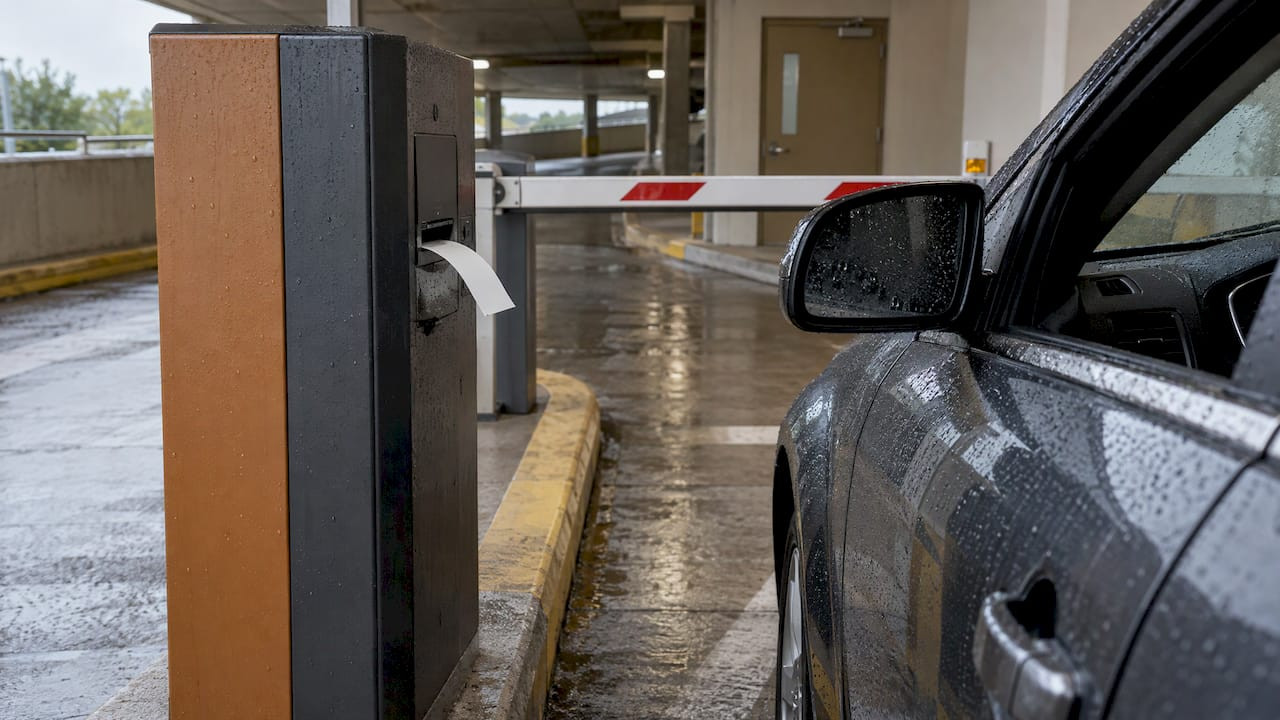
Spitter Ticket Moisture: Keep Machine-Issued Tickets Readable

Moisture causes two separate failures in machine-issued “spitter” tickets. The paper swells or curls and jams the dispenser, or the printed image smears or fades once the ticket gets wet. Both are controlled before the ticket ever reaches the lane: by choosing stock built for damp conditions, storing it in a stable room, and handling it correctly at the dispenser. We make and supply dispenser and spitter tickets for the major parking systems, and this guide covers what operators need to know to keep tickets feeding, printing and scanning in humid and rainy conditions.
TL;DR
- Humid or rainy weather makes ordinary paper absorb water, and that is a known cause of jams in pay-and-display machines.
- A ticket has to do two things in damp air: stay flat enough to feed, and keep its image readable. Good stock is judged on both.
- Store thermal stock at controlled temperature and humidity, use the oldest boxes first, and keep it away from heat and solvents.
- When a ticket curls, sticks, prints faintly or fails to scan, check the stock and storage first, then the dispenser path.
- Moisture-related problems are cheaper to prevent with the right stock than to clear lane by lane.
Table of Contents
- Why moisture hits spitter tickets so hard
- The two properties to look for: flatness and wet-smear resistance
- Match the stock to the equipment
- Storage: where most moisture problems begin
- Troubleshooting: what the symptom is telling you
- Prevention checklist for operators
- Perspective
- Ordering tickets built for your system
- FAQ
- Sources
Why moisture hits spitter tickets so hard
A spitter ticket is a small piece of paper that has to travel through a narrow path, be printed or read, and be pushed out to a driver, often in an open-air lane. Every part of that journey is sensitive to the water content of the paper.
A report on pay-and-display machines quoted parking officials and a machine maker saying that in humid or rainy weather paper absorbs moisture and jams the machines. That report is from New Zealand and dates to 2005, but the physics has not changed: paper fibers take on water, swell unevenly, and no longer travel through rollers and guides the way dry stock does.
In practice, operators see moisture show up in a handful of ways:
- Curling. The ticket arcs or twists, so the leading edge catches on a guide or the exit slot.
- Sticking. Tickets in a fan-fold stack or a roll cling to each other and feed two at a time, or not at all.
- Smearing or fading. A wet or damp ticket loses print quality, especially if the driver handles it with wet hands or leaves it on the dash.
- Scan failures. A faint or smudged barcode or magnetic stripe area fails at the exit reader, which sends the driver to the attendant and slows the lane.
Each of these costs time at the lane and, in a facility that relies on ticket data for revenue control, can cost accuracy as well.
The two properties to look for: flatness and wet-smear resistance
The paper industry treats these as a pair. A thermal paper maker’s leaflet on car-park tickets describes its grades as having optimized wet-smear resistance, and says the thermal image remains legible and the paper stays flat despite variable heat and humidity. The point for an operator is that a ticket which resists smearing but warps is still a jam waiting to happen, and a flat ticket whose image washes out is still a failed ticket.
When you review stock, ask about both:
- Does it stay flat? Look at how the stock behaves after sitting in a humid garage office or a cart on a damp ramp, not just fresh from the carton.
- Does the image survive water? For thermal stock, this depends on the coating. The same leaflet lists top-coated and non-top-coated thermal grades and rates resistance to water, heat, light, alcohol, oil and fat, and plasticizers, with grades differing by level.
What a protective top coat is for
A top-coated thermal paper carries an extra protective layer over the heat-sensitive coating. One manufacturer’s data sheet for a top-protected thermal paper describes it as intended for ticketing that needs enhanced resistance to moisture, fat, oil and alcohol, and lists parking tickets, transportation tickets and receipts among its applications. Its stated basis weight is 75 g/m² and its caliper 74 μm. Those two numbers matter at the dispenser, because weight and thickness affect how the ticket bends through the path.
The practical takeaway: for lanes exposed to rain, wet hands, sunscreen, hand sanitizer or spilled drinks, specify stock with a protective top coat and match its weight and thickness to what your dispenser was designed to feed.
Match the stock to the equipment
Moisture performance only helps if the ticket also fits the machine. Spitter and dispenser tickets are cut to precise sizes, with specific thickness, notch or sensor marks, and sometimes magnetic stripe or barcode zones. Our products are made to be compatible with major parking systems including Amano, TIBA, SKIDATA, FLASH Parking, Scheidt & Bachmann and Flowbird.
Before reordering, gather this information:
| What to confirm | Why it matters in damp conditions |
|---|---|
| Dispenser or system make and model | Determines size, thickness and sensing requirements |
| Ticket format (thermal, magnetic stripe, barcode, printed paper) | Each reacts to moisture differently |
| Where the lane sits (covered, open-air, ramp, entry kiosk) | Open lanes need stock rated for water and temperature swings |
| Current failure (jam, curl, smear, scan error) | Points to stock, storage or the machine |
| Typical quantity and turnover | Slow turnover increases the time stock sits in humid air |
If your facility uses thermal rolls for a TIBA system, we stock TIBA parking thermal rolls MP60 and MP30. For a broader look at the paper side, our guide to parking ticket paper, thermal rolls and what lasts walks through the choices, and the top material options for 2026 compares them.
Storage: where most moisture problems begin
Tickets often fail because of where they sat, not what they were. A carton in a damp storage closet or a hot trunk can arrive at the lane already compromised.

The manufacturer data sheet cited above gives clear conditions for its thermal paper: store it at 20–25°C (68–77°F) and 40–50% relative humidity, and use it within one year of manufacture for optimal performance. It adds that prolonged storage outside those conditions might reduce shelf life. Our own guide on ticket stock storage covers the same discipline for parking managers, including first-in, first-out rotation.
A simple storage routine:
- Keep cartons sealed until needed. Open packaging exposes the whole stack to room air.
- Store off the floor and away from exterior walls, pipes and drains. Cold, damp surfaces raise local humidity.
- Use first in, first out. Write the receive date on each carton and pull the oldest first.
- Stage only a shift’s worth at the booth. The booth is usually the least stable environment in the facility.
- Keep thermal stock away from heat. The same data sheet warns that exposure above 50°C (122°F) may cause premature imaging or discoloration, which is a real risk in a parked vehicle or a sun-baked cabinet.
- Keep it away from solvents. The data sheet also warns that inks containing alcohol or volatile organic solvents can discolor the thermosensitive coating, so keep markers, cleaners and stamp pads off the stack.
Heat and moisture often arrive together in summer, which is why our guides on heat-resistant tickets and on stopping thermal ticket fading pair well with this one.
Troubleshooting: what the symptom is telling you
Work from the symptom to the likely cause. Start with the stock and storage, because that is the cheapest thing to change.
Tickets curl or arc
Curl usually means uneven moisture absorption or heat. Check where the carton was stored and how long the stack has been in the booth. Rotate in fresh, conditioned stock and see whether the curl stops.
Heat can cause curl even when moisture is controlled. In the New Zealand report, a PVC ticket stock resisted water absorption in the machines but still curled when left on a sunlit dashboard. Moisture resistance alone does not fix every handling issue, so look at the full life of the ticket, from the dispenser to the driver’s windshield and back to the exit lane.
Tickets stick or double-feed
Sticking points to damp stock or a humid dispenser cavity. Remove the affected stack, check for condensation inside the unit after temperature swings, and load tickets from a sealed carton. If the problem returns every rainy week, the stock grade and the dispenser’s enclosure are the two things to review.
Print is faint, smeared or discolored
On thermal stock, check three things in order:
- Age and storage. Old stock or stock exposed to heat can image prematurely or fade.
- Contact with liquids or solvents. Sanitizer, hand lotion and markers are common culprits.
- Printhead condition and settings. Dirt on the printhead can look like a stock problem.
Our checklist for thermal ticket fading and the notes on thermal reactive ink tickets go into the fade side in more detail.
Tickets fail at the exit scanner
When barcodes or magnetic stripes fail only after wet days, suspect the ticket surface before the reader. Compare a failed ticket against a fresh one from the same carton. If the fresh ticket reads cleanly, the cause is exposure. If it does not, check the reader, the ticket specification and the format.
Jams that appear only in humid weather
If a lane jams on damp days and runs smoothly on dry ones, record the dates against the weather for a couple of weeks. A clear pattern points to paper behavior. Then compare the ticket’s weight and thickness with your dispenser’s specification and with the stock data you have.
Prevention checklist for operators
Use this as a weekly routine at each location:
- Confirm that stock on the lane was stored in a controlled room and is in date order.
- Check that dispenser doors seal and that no water reaches the paper path.
- Look at a sample of printed tickets for contrast and edge flatness.
- Test a ticket through the exit reader on a rainy day, not only on a dry one.
- Log every jam or misread with the date, the weather and the carton’s receive date.
- Order enough to avoid emergency stock, but not so much that cartons sit for many months.
That last point is a balance. Thermal data sheets state a use-within-one-year window, so ordering for the next few months of volume keeps stock fresh while avoiding stockouts.
Perspective
Moisture complaints reach us in a predictable pattern. A lane runs well for weeks, the weather turns, and suddenly the dispenser jams or the exit reader rejects tickets. The first instinct is to blame the machine. More often, the answer is in the stock and in how it was stored.
Since 1937 we have specialized in tickets for parking, valet, hospitality and events, and we make our tickets with durable printing in mind. We also keep millions of tickets in stock and ship nationwide, which helps operators reorder in smaller, fresher quantities instead of holding months of paper in a damp back room.
Our advice is to treat the ticket as part of the system. Tell us the dispenser or parking system, the ticket format and where the lane sits, and we can help you specify size, material, numbering, barcoding and layout that suit your equipment. That is the difference between a ticket that merely fits the machine and one that keeps your lane moving in bad weather.
Richard
Ordering tickets built for your system
We manufacture stock and fully custom machine-issued tickets, with options for sequential numbering, barcoding, logos, security features and custom colors. Our machine-issued valet tickets and dispenser and spitter tickets cover the formats parking operators, hotels, casinos, hospitals and event venues use most. Pricing for these categories is quoted on request, so tell us your system and volume when you reach out.
If your operation also runs manual valet, our barcoded valet tickets and multi-part carbonless valet tickets work alongside machine-issued stock. Browse the full range on caymil.com.
FAQ
Why do spitter tickets jam more in wet weather?
Paper absorbs moisture from humid or rainy air, swells and warps, and then no longer feeds cleanly through narrow dispenser paths. This effect has been reported by parking officials and a machine maker for pay-and-display machines. Controlled storage and stock designed for humid conditions reduce it.
What humidity and temperature should ticket stock be stored at?
One thermal paper data sheet specifies 20–25°C and 40–50% relative humidity, with use within one year of manufacture, and warns that temperatures above 50°C may cause premature imaging or discoloration (manufacturer data sheet). Check the storage guidance for the exact stock you buy, and rotate older cartons first.
Can a ticket be moisture resistant and still fail?
Yes. Water resistance does not cover every handling issue. In one report, a ticket stock that resisted water absorption in the machines still curled on a sunlit dashboard, so heat and handling matter as well as moisture.
Which ticket types suit damp or open-air lanes?
For thermal tickets, look for grades with a protective top coat and stated resistance to water, plus the right weight and thickness for your dispenser. Paper makers publish resistance ratings by grade, as in this car-park ticket range. Give us your system and lane conditions and we can match a format to it.
How often should I reorder spitter tickets?
Order to match a few months of usage so stock stays within the manufacturer’s use-by window and does not sit in humid storage. Keep a small reserve for peak events and rotate first in, first out.
Sources
- Sticky problem in parking, NZ Herald
- Thermal paper for car park tickets, 2024 product leaflet
- AT810 Thermal Top 1S-80 FSC product data sheet