
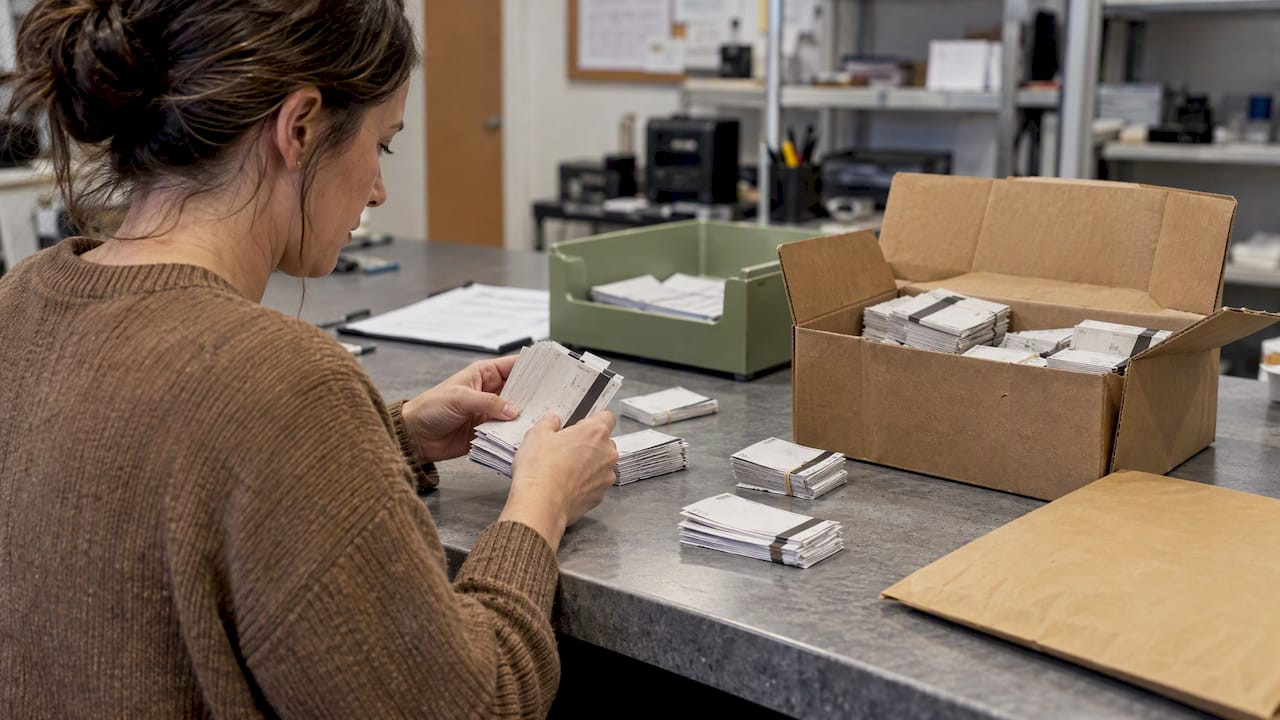
Ticket Number Audit: How Parking Operators Reconcile Tickets

A ticket number audit is a check that every serially numbered ticket you printed is accounted for: issued and paid, voided, returned, or still unused in a box. When the sequence has a gap, a duplicate or a number nobody can explain, the audit finds it and traces the cause. For parking garages, valet companies, hotels and event venues, it is one of the simplest and most effective ways to protect revenue.
This guide covers what the audit compares, how to run it step by step, how it changes for paper, machine-issued and barcoded tickets, and how to document the results.
TL;DR
- A ticket number audit reconciles tickets issued, sold and unused against inventory logs, sales records and a physical count, then explains every break in the sequence.
- It only works when tickets are pre-numbered and used in order, and when the customer’s claim check carries the same number as the attendant’s stub.
- Reconcile by shift or revenue period, review void rates monthly, and separate the people who collect, count and deposit.
- Keep physical counts, monthly reconciliation files and scanned evidence for any unresolved discrepancy.
- Auditing is far easier when numbering, barcodes and carbonless copies are designed into the ticket from the start.
Table of Contents
- What a ticket number audit actually checks
- Why sequence matters
- How to run a ticket number audit, step by step
- A worked example
- Paper, machine-issued and barcoded tickets
- Controls that make the audit stronger
- Documenting and retaining the results
- Our perspective: audit-ready starts at the printing stage
- Tickets built for clean reconciliation
- A simple audit schedule
- FAQ
- Sources
What a ticket number audit actually checks
A manual parking ticket is pre-numbered so that the operation can collect the relevant information and give the customer a receipt of payment. That is how a county internal audit division describes manual parking tickets in a review of its parks operations. The same review treats the audit as a reconciliation of tickets issued, sold and unused, with the aim of accounting for them and detecting any that are missing.
In practice the audit answers four questions about every number in a range:
- Was it issued? A customer received it, and a matching stub or record exists.
- Was it paid? Revenue for that number appears in the cash, card or account deposit.
- Was it voided, lost or returned? An exception record explains why the ticket did not produce standard revenue.
- Is it still unused? It sits in a known box, in a known location, and a physical count confirms it.
Any number that fits none of those four is an exception. The audit exists to find exceptions quickly, while the trail is still fresh.
Why “ticket number” is the anchor
The serial number is the one field that links the customer’s copy, the attendant’s copy, the shift report and the deposit. Without a printed, unique number, you are comparing totals. With one, you are comparing individual transactions. Our guide to sequential numbering on parking tickets goes deeper on how numbering formats are set up, and our piece on valet ticket numbering covers the valet side.
Why sequence matters
The same county review recommends that pre-numbered manual tickets be sold in sequential order, which reduces the risk that tickets will be lost or misused without anyone noticing. When tickets leave the box in order, a missing number stands out. When attendants grab from several boxes at random, the same gap hides in the noise.
Two situations make sequence especially valuable:
- Valet. Tickets are handed out at a fast pace, often by several attendants working one podium, and cash may change hands at the end of a stay rather than the start.
- Overlapping crews. When a shift crosses midnight or two crews share a stand, it is easy to lose track of who held which range.
The claim check must match the stub
With multi-part valet tickets, the reconciliation is undermined if the claim check the customer holds does not carry the exact serial number printed on the attendant’s stub. That point comes up in a guide to valet ticket fields and disclaimers. Printing the same number on every part, in one pass, removes the chance of mismatches. Our 2-part, 3-part and 4-part valet tickets are built around that principle, with sequential numbering across every part.
How to run a ticket number audit, step by step
The method below follows the core of the county audit guidance, with practical additions from parking-industry checklists.
Step 1: Build a ticket inventory log
Record every box when it arrives: the first and last ticket numbers, the date received, and who received it. The county review describes an inventory log that lists each box, its ticket-number range, and the park and lane receiving it. For a garage or valet operation, swap in the location, podium or lane, and the shift lead who signed for it.
Step 2: Log issuance and sales
When a box goes to a lane or crew, record the range handed out and who accepted it. At the end of each shift or revenue period, record the last number used and the revenue collected for that range. Reconciliation templates recommend reconciling by shift or revenue period instead of by calendar day alone, because operations that span midnight or overlap crews cannot be cleanly split at 12:00 a.m.
Step 3: Count what is left
The physical count of unused tickets is the step that turns paperwork into proof. Count the remaining tickets in each box and compare the first unused number to the last number logged as issued. The county guidance calls for comparing the inventory and sales logs with a physical count of unused tickets, and for formally documenting and retaining that count.
Step 4: Reconcile three ways
For each range, you should be able to say:
Tickets received = tickets issued + tickets voided + tickets returned + tickets unused
Then compare issued and paid tickets with deposits. The same audit refers to a monthly three-way reconciliation, which is a sensible rhythm for most operations. Keep each month’s file together so a reviewer can follow it later.
Step 5: List and explain every break
Walk the numbers in order and mark every gap. For each one, identify the break in the serial sequence and determine its cause. Typical explanations:
- A ticket spoiled during printing or tearing, with the voided copy retained.
- A ticket issued but filed in the wrong shift envelope.
- A ticket handed out and never recorded.
- A ticket issued, paid in cash and not deposited.
The last two are the ones you are looking for. The first two are housekeeping, and fixing them reduces false alarms.
A worked example
Suppose a hotel valet stand receives a box of 1,000 tickets numbered 10001 to 11000. At the end of the week, the log shows:
| Category | Count |
|---|---|
| Tickets issued and paid | 842 |
| Voided (all copies retained) | 9 |
| Returned unused to the manager | 0 |
| Physically counted in the box | 146 |
| Total accounted for | 997 |
That leaves three numbers unexplained. The audit now narrows the search: find the missing numbers in the sequence, check whether they fall within one shift or one attendant’s range, and look for them in void envelopes, lost-ticket records and deposit reports. If they appear nowhere, they are documented as unresolved, with scans of the surrounding tickets and the shift reports attached.
The void line also carries information. Parking-industry guidance suggests reviewing the void rate monthly and investigating rates above 1 to 2 percent. In this example, 9 voids out of 851 tickets used is about 1.1 percent, so it sits at the low end of that range, but a single attendant accounting for most of them would still deserve a look.

Paper, machine-issued and barcoded tickets
The logic of the audit is the same across formats, but the evidence differs.
| Ticket type | What the audit relies on | Typical weak point |
|---|---|---|
| Multi-part paper valet | Printed serial number on every part, stubs, physical count | Hand-written changes, missing stubs |
| Machine-issued or dispenser (“spitter”) | Equipment counters, transaction reports, roll or stack counts | Old or manufactured tickets presented at exit |
| Barcoded | Scan logs matched to printed number | Barcode and printed number out of sync |
Paper tickets
Paper audits are mostly physical: stubs, envelopes and counts. Carbonless multi-part tickets help because each copy carries the same number, so a stub can be checked against a claim check or a receipt. See our forms for parking for the supporting logs and reports operators use alongside them.
Machine-issued and barcoded tickets
With machines, the system supplies counts, but the audit should still verify them. Facilities with older PARCS equipment that lacks sequence-number verification or timestamp validation are particularly vulnerable to fraud with old or manufactured tickets. That is one reason ticket stock matters: consistent, readable printing and a unique number on every ticket give the equipment and the auditor something to verify. Our article on PARCS parking system tickets covers compatibility, and the variable data checklist explains how to keep barcodes and printed numbers aligned.
Some operators also add independent records, such as plate-recognition cameras, as a second source for checking ticket counts. Planning for ANPR in retail car parks shows how that data is typically set up so it can later support investigations of unexplained transactions.

When the law sets the rules
Some states regulate this directly. New York’s tax regulation 20 NYCRR 538.3 requires tickets to be consecutively numbered in an approved manner. If duplicate numbers are used within the same calendar year, unique identifiers must distinguish them, such as different paper color, ink, or alphanumeric prefixes or suffixes. It also requires parking facility operators to keep each original ticket or other documentation, or a true copy, separated by day. Check your own state and local requirements, and ask your accountant or tax adviser what applies to your facility.
Controls that make the audit stronger
An audit finds problems after the fact. Controls reduce how often they occur.
- Secure storage. Unused tickets stay in a locked location with limited access.
- Documented transfers. Every box that moves between locations or people is signed for.
- Separation of duties. The person who collects money should not also count it or prepare the deposit, a point reconciliation templates repeat.
- Unannounced reviews. Periodic surprise counts are harder to anticipate and prepare for.
- Independent comparisons. The Arizona Auditor General recommends comparing records that are unrelated to the receipting system with deposit records. In one case, comparing issued permit decals to cash collection reports revealed a skimming scheme.
For more, read our guides to parking ticket security and validation abuse.
Exceptions deserve their own review
Exceptions are where revenue most often leaks. Audits typically compare manual rate adjustments, lost tickets and voided tickets with exception logs and daily reports to establish that each one was legitimate. A voided ticket with all copies attached and a supervisor’s initials is a clean exception. A void with one copy missing is a question.
Documenting and retaining the results
An audit nobody can review later has little value. Keep:
- Physical count sheets, formally documented and retained.
- Monthly three-way reconciliation files.
- Photos or scans of supporting documents for any unresolved discrepancy, so a later reviewer sees a complete audit trail.
- The name of each source report and its export time beside every financial figure, so the number can be traced to the system log it came from.
- Original tickets or true copies, separated by day, wherever your state requires it.
Our explainer on the parking audit trail shows how these records fit together, and the guides on parking facility audits using tickets and how garage revenue audits work describe the wider process.
Our perspective: audit-ready starts at the printing stage
We have manufactured parking and valet tickets since 1937, and the audits our customers describe go smoothly or painfully for the same reason: how the ticket was built. A clear, sequential number on every part, a carbonless copy that is legible all the way through, and a format that matches the equipment in use save more audit time than any spreadsheet.
Three habits separate operations that reconcile in an hour from those that spend days:
- They order tickets in defined number ranges and log each range on arrival.
- They assign ranges to a stand or crew rather than letting boxes float.
- They treat a void as a record to keep, never a ticket to discard.
We would rather an operator find a gap in week one than discover it in a year-end review.
— Richard
Tickets built for clean reconciliation
If your next audit exposes inconsistent numbering, illegible copies or tickets that do not fit your equipment, the fix starts with the stock. Caymil offers stock and custom tickets with sequential numbering, barcoding, logos, security features and multi-part carbonless formats, compatible with major parking systems including Amano, TIBA, SKIDATA, FLASH Parking, Scheidt & Bachmann and Flowbird. Our 4-part valet tickets and barcoded valet tickets are each listed from $42 to $48, and our ticket racks help keep stock organized at the stand.
A simple audit schedule
| Frequency | Task |
|---|---|
| Every shift | Record first and last ticket numbers used, collect voids, count revenue |
| Weekly | Spot-check one range against stubs and deposit |
| Monthly | Full three-way reconciliation, void-rate review, file the documents |
| Unannounced | Surprise physical count of unused boxes at random stands |
Start with one stand or one lane and one box. Once the routine works there, extend it across the operation.
FAQ
What is a ticket number?
It is the unique serial number printed on a ticket, and on every part of a multi-part ticket. It ties the customer’s claim check, the attendant’s stub and the revenue record to a single transaction.
How often should we audit ticket numbers?
Reconcile at the end of every shift or revenue period, and perform a full review monthly. Add unannounced physical counts at random intervals so crews cannot anticipate them.
What should we do when a ticket number is missing?
Compare the inventory and sales logs with a physical count, then check void envelopes, lost-ticket records and deposits for that number. If it remains unexplained, document it with scans of the surrounding tickets and shift reports, and escalate it to a manager.
How long should we keep audit records?
Retention depends on your state, local rules and your accountant’s advice. As a baseline, keep physical counts and monthly reconciliation files for review, and where regulations such as New York’s apply, keep original tickets or true copies separated by day.
Sources
- Orange County internal audit report on manual parking tickets
- Parking operations audit checklist
- Parking revenue audit and ticket reconciliation template
- Valet ticket template: required fields and disclaimers
- Arizona Auditor General fraud prevention alert on cash receipts
- Parking audits are more important than ever
- 20 NYCRR 538.3, issuance of tickets
- Parking revenue leakage prevention