
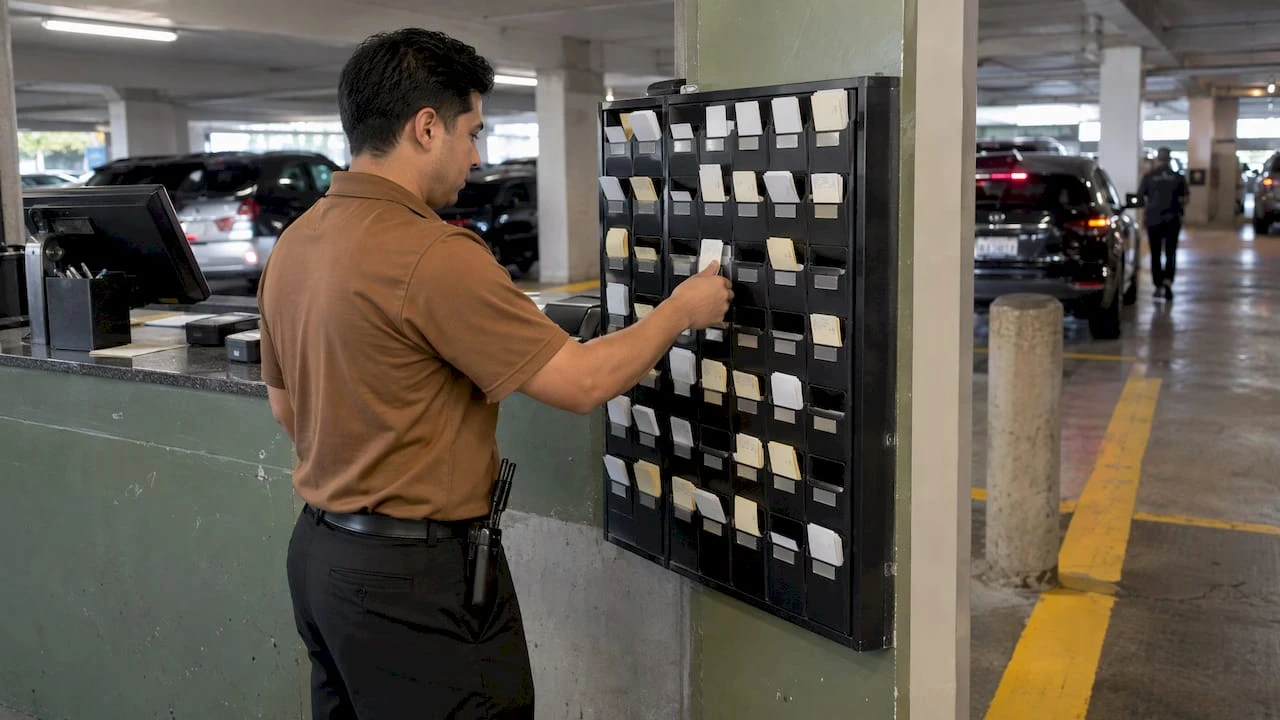
Ticket Rack Organization for Valet and Parking Operations
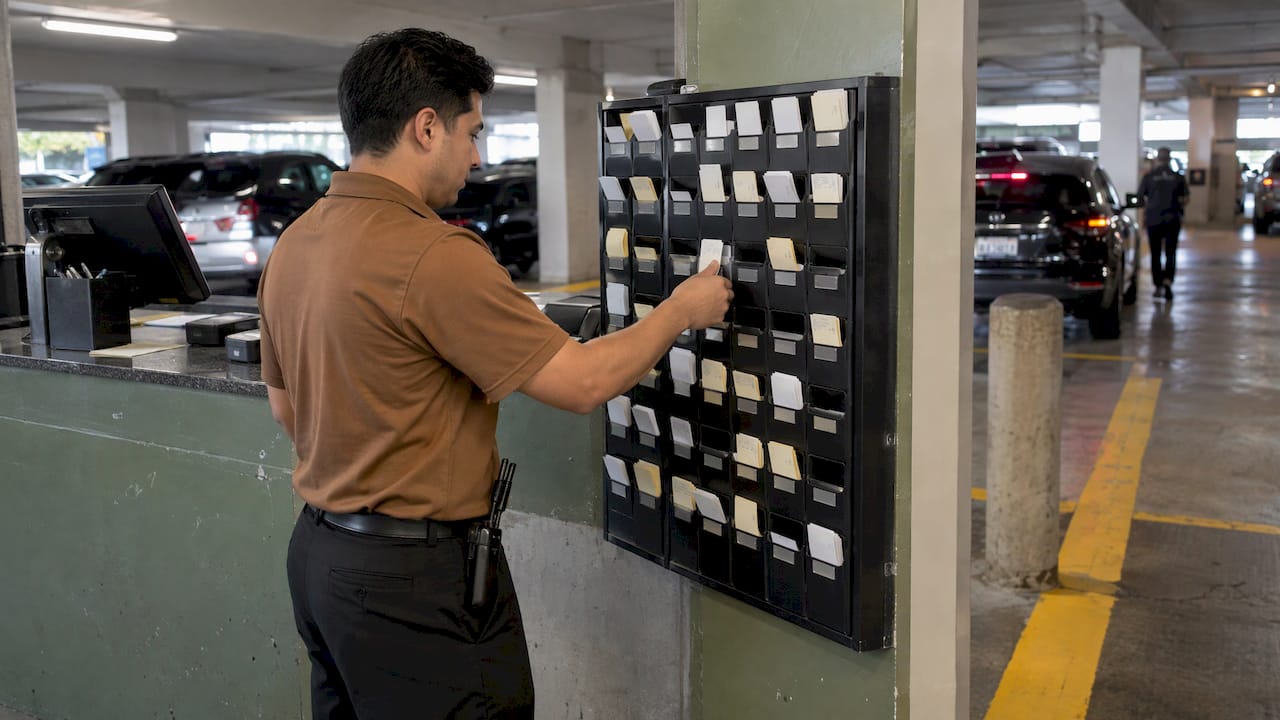
A ticket rack is organized when any attendant, on any shift, can put a claim ticket in the right slot and pull the matching one in seconds without asking anyone. That comes from four decisions: a fixed numbering sequence, a rack position tied to each ticket number, clear labels and sections, and a handoff routine. A steel rack sized to your volume makes those decisions easy to enforce, and our parking ticket racks are built for exactly this work in valet stands, garages and hotel drives.
TL;DR
- Tie every rack pocket to a ticket number, so the number on the guest’s claim stub tells staff where the matching stub sits.
- Use one logical sequence, large visible numbers, and signed sections when you run more than one rack or stand.
- Keep unused ticket stock separate from active tickets, label it, and rotate it oldest first.
- Reconcile the rack against your log at every shift change and at close.
- Match the rack to the ticket size you print, and check number placement before you reorder.
Table of Contents
- Why rack organization decides how fast you return cars
- Step 1: Fix the numbering before you fix the rack
- Step 2: Tie each pocket to one ticket number
- Step 3: Label sections and position the rack for the work
- Step 4: Organize unused stock as carefully as the active rack
- Step 5: Build a handoff and reconciliation routine
- Step 6: Reduce mix-ups at the moment of return
- Choosing a rack that fits your tickets
- Coat check and hospitality variations
- What to order
- Our perspective
- FAQ
- Sources
Why rack organization decides how fast you return cars
The rack is where the paper side of a valet or parking operation either holds together or falls apart. When a guest hands over a stub, the attendant needs to find the matching ticket, confirm it, and send a runner. Every second spent hunting adds to the wait at the stand, and a misplaced ticket can mean a vehicle retrieved late or released to the wrong person.
The principles are not unique to parking. Venues that handle paired paper tickets, such as coat checks and box offices, solve the same problem: one part stays with the guest, and the matching part stays in a known position. A coat-check organization guide describes the same paired workflow, with one numbered ticket on the hanger or storage position and the other given to the guest. In valet, the rack pocket plays the role of the hanger.
Step 1: Fix the numbering before you fix the rack
Rack organization starts at the printing stage. If tickets arrive in sequence, the rack can follow the sequence, and staff never have to think about where a number belongs.
- Use sequential numbering. Numbers that run in order let you assign pocket 1 to ticket 1 and so on, which is the simplest system any new hire can learn in a minute.
- Keep numbers large and clear. The coat-check guide above recommends large, visible numbers in a logical sequence. On a printed ticket, that means leaving the number area uncluttered by logos or fine print. Our guide to keeping ticket numbers clear of the edge covers number position and the 5 mm margin that keeps digits readable after cutting and perforating.
- Use distinct number ranges for separate stands. If you run a hotel entrance and a ballroom stand, or two garage levels, give each its own range. The same guide recommends distinct ranges for separate rooms or service counters, so a ticket found in the wrong place is obvious at a glance.
Pick the part count with the rack in mind. A 2-part ticket suits a stand where one stub goes on the dash or with the guest and one stays on the rack. A 3-part or 4-part carbonless ticket adds a copy for the key, the vehicle or the office. Our 2-part valet tickets, 3-part valet tickets and 4-part valet tickets are all available, and if you need scanning, barcoded valet tickets add a code to the same layout.
Step 2: Tie each pocket to one ticket number
The core rule is direct correspondence. Each numbered rack position should match the claim-ticket number, with no translation step between the two. If pocket 37 holds ticket 37, staff can retrieve it without searching, and a gap in the rack shows a missing ticket immediately.
A few practical points:
- Number the rack, not just the tickets. Pocket numbers should be as readable as the ticket numbers, from where the attendant normally stands.
- Work in blocks. Break a long sequence into groups of 10 or 25 with a visible divider or label, so the eye can jump to the right block.
- Plan for the busiest night. If your peak is 120 vehicles, a 50-pocket rack means rolling over. Decide in advance how the second block is labeled so that ticket 51 is never confused with ticket 1 from earlier in the shift.
- Designate a spot for exceptions. Oversized items, lost-ticket cases and held vehicles need a designated location instead of an improvised pocket.
Our 50-pocket ticket rack is made from high-quality steel for valet and parking use, and measures 5-1/8" x 26-1/4", so it mounts on a wall or stand without taking much space. Ticket racks are listed at $125 on our ticket racks page. Two racks side by side, each with its own sign, give you a clean 1 to 50 and 51 to 100 layout.
Step 3: Label sections and position the rack for the work
Labels do the job that memory does badly under pressure. Separate similar-looking sections with clear signs, as the coat-check guide advises, so that two racks or two blocks never look interchangeable.
For a valet stand, consider this layout:
| Zone | What it holds | How to mark it |
|---|---|---|
| Active rack | Stubs for vehicles currently parked | Pocket numbers, block dividers every 10 or 25 |
| Reserved or hold | Vehicles pre-requested, VIP, or staged for an event end | A distinct color or sign, kept apart from the main sequence |
| Exceptions | Lost tickets, damaged tickets, oversized vehicles | A labeled spot, reviewed at every handoff |
| Unused stock | Blank books or fanfold not yet issued | A closed, labeled bin or shelf, away from active tickets |
Position the rack where the attendant who takes the stub can reach it without turning away from the guest, and where it is shielded from rain, wind and sun. Paper curling and fading make numbers hard to read, so a covered stand protects legibility.
Step 4: Organize unused stock as carefully as the active rack
Most rack problems begin in the supply closet. If a book of tickets runs out mid-shift, or a roll arrives that does not fit the dispenser, the sequence breaks and so does the rack logic.
An experienced ticket-office guide recommends keeping a label describing each ticket type on the rack, keeping the lowest-numbered ticket visible, and recording stock type, quantity, serial numbers and storage location. Those habits carry straight over to valet:
- Log the starting and ending number of every book or roll you put into service.
- Store boxes with the number range facing out.
- Issue the oldest stock first, so ranges never get stranded.
- Keep paper in a stable environment. Our guide to ticket stock storage gives a target of 23±5°C and 50±10% relative humidity with first-in, first-out rotation.
- Set a reorder point based on your busiest week. Our ticket inventory management guide walks through how to avoid running out.
If you issue from a machine, the supply format matters too. Choosing between fanfold and roll stock affects how tickets load and stack, which we cover in fanfold vs roll tickets. For dispenser-based lanes, see our manager’s guide to dispenser rolls, and our machine-issued valet tickets and dispenser and spitter tickets cover those formats.
Step 5: Build a handoff and reconciliation routine
The rack is only as reliable as the routine around it. A shift change is the point where one person’s mental map disappears, so the map has to live on the rack and in the log.
A simple routine for each handoff:
- Count the active pockets. The outgoing and incoming attendant count the filled slots together and compare the total to the log.
- Check the sequence. Look for gaps and duplicates. A ticket number in the wrong pocket is the most common sign that something was returned in a hurry.
- Review the exceptions spot. Anything there gets a name next to it: who owns it, and what is the next step.
- Note the next ticket number. The incoming shift starts where the last one ended, written on the log.
- Sign the log. Two signatures make the handoff real.
The National Restaurant Association’s guidance on kitchen operations points to well-organized stations and a system that prioritizes orders, with staff trained to back one another up. The same habit applies at a stand: when one attendant is slammed with arrivals, the other takes the retrievals, and the rack layout means either of them can work it. The Association also describes the expediter role as one that keeps the station clean, organized and stocked. At a valet stand, the lead attendant or shift supervisor fills that role.
Reconcile at close
At close, every ticket issued should be accounted for: returned, voided, or still on the rack as a vehicle that remains on site. The same principle holds well beyond parking. Operations that move goods check the ticket details against their records before the work is signed off, as in this walkthrough on matching signed tickets to AP records. In a valet operation, the log is your record, and the rack is the physical proof.
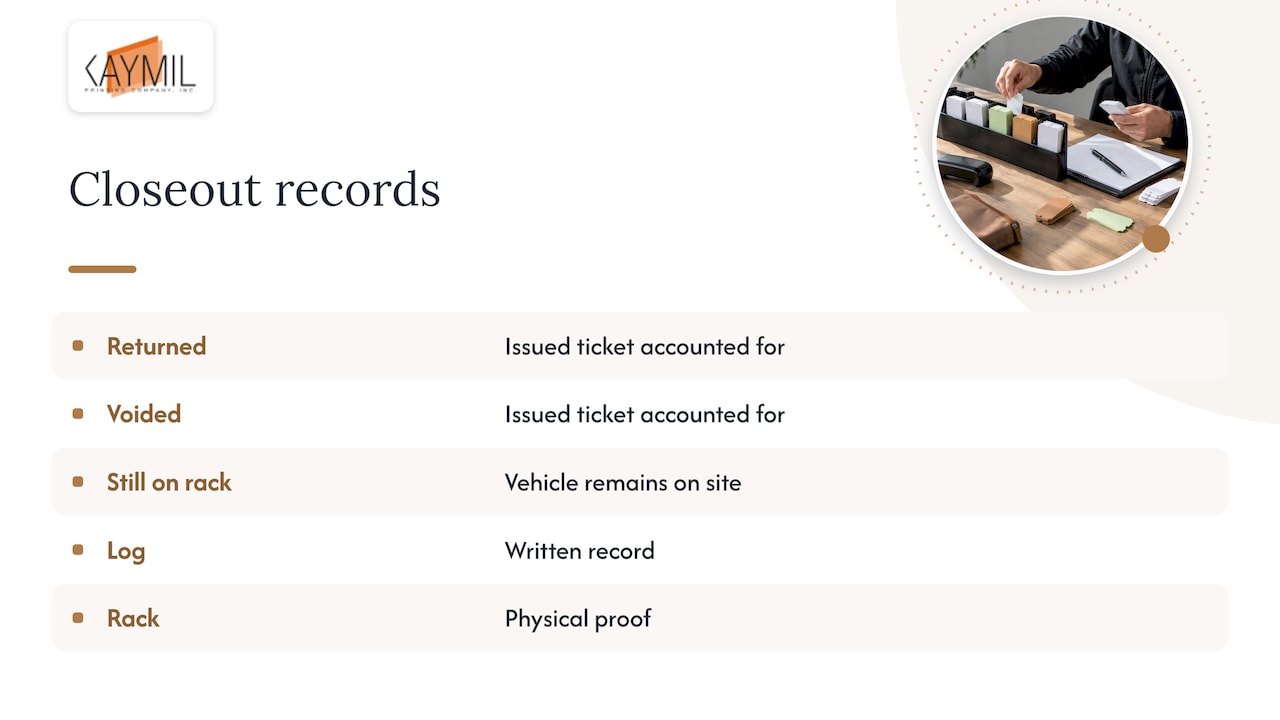
A box-office model works the same way. The MIT Front of House Guide advises keeping a separate stock and sales tracking system and periodically reconciling what remains against the seating chart. For valet, the “seating chart” is your lot or garage map.
Step 6: Reduce mix-ups at the moment of return
Most wrong-vehicle errors happen at the point of return, when the line is long. Build a short verification into the habit:
- Check the stub, then the pocket. The attendant reads the number on the guest’s stub, goes to that pocket, and confirms the number on the rack ticket matches before sending a runner.
- Verify before releasing. The coat-check guide recommends checking the identifier, locating the assigned position and verifying the number before returning an item.
- Handle lost stubs through one path. Lost-ticket cases go to the exceptions spot and a supervisor, with whatever identification your policy requires, never settled informally at the rack.
- Practice the bad moments. The same guide suggests testing the whole process under realistic busy conditions, including simultaneous arrivals and pickups, similar-looking items, and a lost or damaged ticket. Run that drill before a big event, not during it.
Legibility matters at this step. A smudged or faint number slows verification. Review the layout on your tickets before every new print run, and use our print proof checklist to catch number, barcode and layout errors before signoff.
Choosing a rack that fits your tickets
A rack that does not fit the ticket is a recurring cost in time. Venues have been known to replace a rack because their new tickets were wider than the old pockets. Before you buy, or before you change ticket size, check these points:
- Pocket count versus peak volume. Match capacity to your busiest shift, with room to roll over.
- Ticket width and height. Measure the stub or ticket part that goes in the rack, not the full ticket.
- Material. Steel holds up to daily handling, wall mounting and weather at an open stand.
- Footprint. A narrow rack suits a podium, a kiosk or a short wall.
- Mounting. Decide on wall, stand or counter before you order.
If you are standardizing across several locations, use the same rack and the same numbering logic at each one, so a transferred attendant knows the system on day one.
Coat check and hospitality variations
Hotels, casinos and event venues often run valet, coat check, luggage claim and bell desk from the same lobby. The rack principles do not change, but keep each service visually separate, with its own number range and color. Our guidance on choosing 2 or 3 ticket parts for coat check explains how the part count affects what stays on the rack, and our coat check tickets are available stock or custom printed.
What to order
For a standard valet stand, the practical set is a rack sized to peak volume, sequentially numbered tickets in the part count you need, and a labeled place for unused stock. Caymil carries ticket racks, valet tickets, barcoded tickets, coat check tickets, permit decals and forms for parking, and our tickets are compatible with major parking systems including Amano, TIBA, SKIDATA, FLASH Parking, Scheidt & Bachmann and Flowbird.
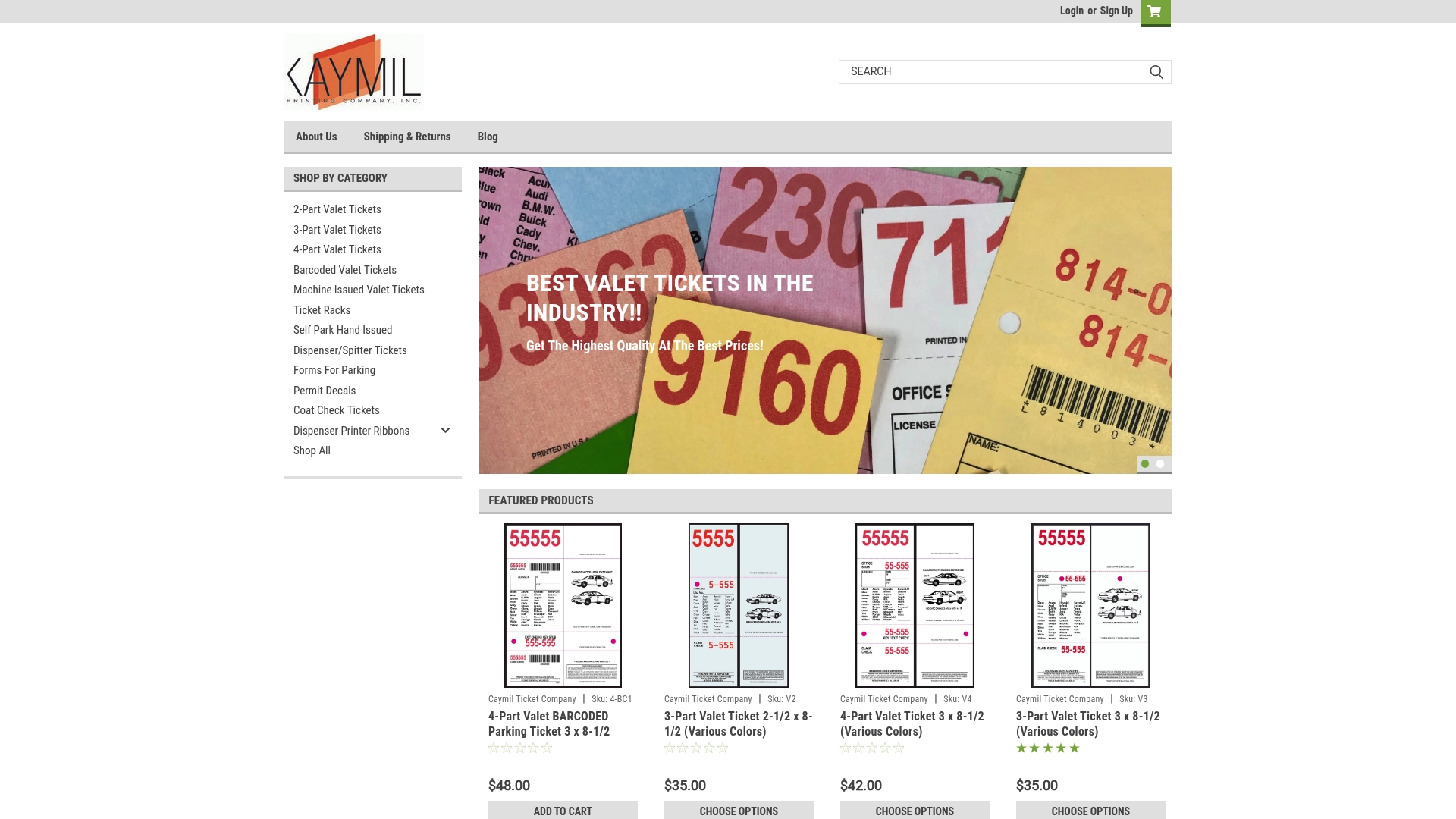
Caymil has manufactured parking and valet tickets since 1937 and ships nationwide from stock, with custom options for sequential numbering, barcoding, logos, security features and custom colors. Start with the 50-pocket ticket rack, then add valet tickets numbered to match it.
Our perspective
Since 1937 we have printed tickets for parking garages, valet stands, hotels and casinos, and the pattern is consistent: a ticket system works when the paper, the rack and the routine are designed together. Operators who treat the rack as an afterthought end up fixing it during their busiest hour.
That is why we make both sides of the stub-and-rack pair. A sequentially numbered ticket with clear, large digits is designed to drop straight into a numbered pocket, and a steel rack is designed to hold up to daily use. When the two are planned as one system, training a new attendant takes minutes, and handoffs become a count instead of a conversation.
Our advice is simple. Decide the numbering first, match the rack to your peak volume, keep your stock labeled and rotated, and reconcile at every shift change. If you want the tickets printed to fit your rack, with your logo, your colors and your numbering, that is what we do every day.
Richard
FAQ
How many pockets should a valet ticket rack have?
Size it to your busiest shift, with room to roll over into a second block. If a typical peak is 40 to 45 vehicles, a 50-pocket rack covers it. For larger volumes, run two racks with separate signs, such as 1 to 50 and 51 to 100.
Should the rack be in numerical order?
Yes. Numerical order with each pocket matched to a ticket number is the fastest system for most stands, because staff go straight to the right slot. It also exposes gaps and duplicates the moment you scan the rack.
How do I keep tickets from fading or curling?
Store unused stock in a stable environment and keep the active rack covered and out of direct sun and rain. Our storage guidance gives a target of 23±5°C and 50±10% relative humidity, with oldest stock used first.
What should I do when a guest loses a claim stub?
Route it to a single exceptions process run by a supervisor, using the identification your operation requires, and note the case in the log. Keep the matching ticket in a labeled exceptions spot until the vehicle is released.
Can I use the same rack for coat check and valet?
You can use the same type of rack, but keep each service in its own labeled section with its own number range and ticket color. That prevents a coat check stub from being mistaken for a valet stub at a busy lobby desk.
Sources
- MTG Front of House Guide, MIT
- How to Organize a Coat Check and Reduce Wait Times
- National Restaurant Association: 8 strategies to boost on-premises sales
- National Restaurant Association: restaurant industry job descriptions
- Ticket Holders, ControlBooth
- Fuel Delivery Invoice Format: Match Signed Tickets to AP Records