Foil Stamping for Parking Permits: What to Specify

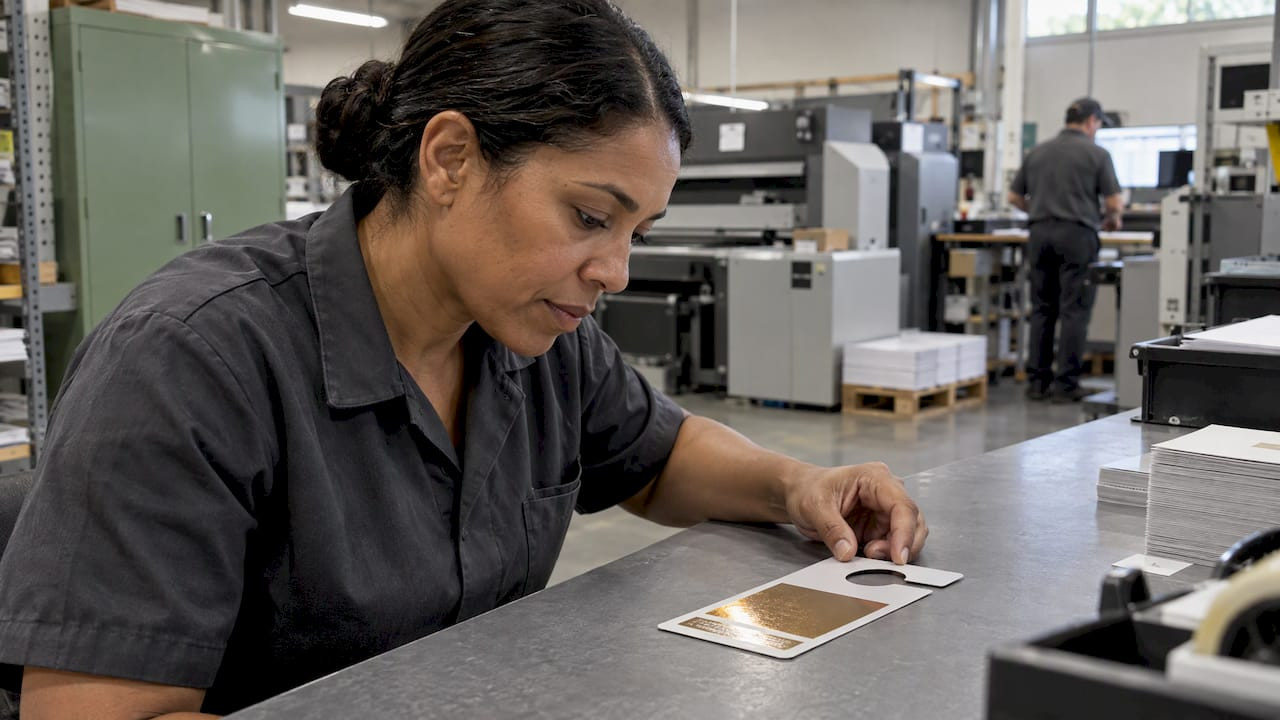
Foil stamping puts a metallic or holographic layer on a parking permit using a heated die, and it is one of the most practical ways to make a hang tag or decal hard to copy and easy for an attendant to verify at a glance. The result depends less on the foil itself than on how you specify it: the stock, the artwork, the foil type and a proof on the real material. This guide covers each decision so your permits arrive looking right and doing their job. For permit hang tags, decals and custom security features, Caymil’s permit decals and the rest of our catalog are built for parking operators.
TL;DR
- Foil stamping transfers a metallic or holographic layer to the permit with a heated die and pressure. It is a printing process, not an ink.
- Holographic and metallic foils are hard to reproduce on a desktop printer or copier, which is why they work as a visual check for attendants.
- Keep foil artwork bold: larger type, looser spacing, solid single-color shapes. Fine detail and tight spacing fill in.
- Always specify the permit stock and review a proof on that stock before a full run.
- Pair foil with sequential numbering and a consistent permit design so a missing or fake tag is obvious.
Table of Contents
- What foil stamping adds to a permit
- How the process works on a permit
- Design rules that keep foil legible
- Stock matters as much as foil
- Durability: what to confirm before you order
- What foil costs
- Pairing foil with the rest of your permit security
- A step-by-step spec for ordering foil-stamped permits
- Promo: permits built for your lot
- Our perspective
- FAQ
- Sources
What foil stamping adds to a permit
A permit has one job: tell an attendant, in a second or two, that a vehicle belongs. Anything printed in standard ink can be scanned and reproduced. Foil changes that.
According to PostPress magazine, hot stamping embeds the foil feature into the substrate and can leave a tactile effect. Metallic foils protect against duplication because their high reflectivity and bright finish are hard to recreate digitally. Holographic foils create light-diffractive features that shift color and appearance with the viewing angle, which makes accurate copying very difficult.
The same source describes up to three levels of authentication for foil security features:
- Level one: visual, no tools. An attendant sees the shimmer or the shift and moves on.
- Level two: checked with a tool such as magnification or a laser pen.
- Level three: forensic laboratory testing.
For a garage, campus or hotel lot, level one is the one that matters day to day. Your staff are walking a row of windshields or standing at a gate. A foil mark that is visible without any tool is the feature they will actually use.
PostPress also reports that sequential numbering can be added to the holographic image on the foil roll before stamping, so both the hologram and the stamped document can be traced. Foil can also carry halftone images, text threads and covert information revealed by back-lighting or UV light, features that take more skill and equipment to replicate.
How the process works on a permit
You do not need to run the press, but understanding it explains every spec decision that follows.
The Foil & Specialty Effects Association designer’s guide explains that conventional hot foil stamping uses a heated die mounted on a platen. Foil lies between the die and the permit material. Heat and pressure release the decorative layer from its carrier and bond it to the material wherever the die makes contact. Flat foil stamping leaves a flat image rather than a raised one.

Two practical consequences follow.
The die either touches the permit or it does not. Foil artwork has no gradients or tints. Anything you want in foil should be a solid shape.
Pressure is a balance. Neenah Papers’ design guide notes that too little pressure makes foil lift off, while too much leaves an impression in the stock. Paper weight and texture dictate the pressure. It also describes “picking,” where foil tears away and leaves holes or jagged edges, and says a clean release is the key skill. Fine lines and solid areas need different release pressures, worked out during make-ready, the setup the printer does before the run. It also says printing is normally done before foil stamping.
That last point matters for permits. The base design, with your logo, lot name, color coding and numbering, is printed first, and the foil goes on afterward. Your artwork should show both layers clearly so nothing is left to interpretation.
Design rules that keep foil legible
Foil that looks sharp on a screen can fail on a 3-inch hang tag. The most common problem is fill-in, where small gaps between foil elements close up.
Millcraft’s foil stamping guidance says larger type generally stamps more reliably than small type. Tight spacing risks fill-in, so looser kerning (letter spacing) and more leading (line spacing) help. Large solid areas or fine details may need multiple passes.
The FSEA guide adds that porosity, texture, fine detail and large solid areas can all affect results, and that larger type with looser spacing tends to avoid fill-in.
For a permit, apply that like this:
- Use foil for the mark, not the data. A logo, seal, shield, border or a simple word like the lot name is a good foil element. Small permit numbers, expiration dates and plate fields are better left in standard print, where they stay readable.
- Keep shapes simple. One bold emblem reads from several feet away. A detailed crest does not.
- Leave room around each foil element. Do not crowd it against cut lines, punch holes or numbering fields.
- Put the foil in the same place on every permit. Consistency is what lets an attendant spot a fake. A 2019 University of Connecticut bid for parking permit decals required a gold or silver foil Oak Leaf Symbol at the same location on each decal, with standardized designs and permit identifiers.
Stock matters as much as foil
The same foil can look different on two materials. Millcraft’s guidance says paper porosity can change the foil result, recycled stock may need greater pressure and its fibers can affect die longevity, and stock color especially changes the look of clear or translucent foil. It recommends testing the chosen foil on the intended stock.

The FSEA guide says the same thing in plainer terms: the result depends on foil formulation, stock qualities, and the depth and complexity of the artwork and dies. Coordinate with the stamping supplier and proof the foil on the stock you intend to use.
For permits, stock decisions usually come down to where the permit lives:
- Hang tags hang from a mirror, move in and out of vehicles and get handled constantly. Reinforcement around the hole and a stock that resists creasing protect both the tag and the foil. See our guide to reinforced hang tags for what to specify.
- Decals sit on glass in sun and weather. Material and adhesive choices come first. Our notes on municipal permit decal specifications and reflective permit decals cover what to put in a request for quotes.
- Lamination changes the surface the permit shows to the world. Our comparison of laminated vs. unlaminated permits will help you decide before foil enters the picture.
Durability: what to confirm before you order
Foil is not one material. The FSEA guide notes that choices include metallic and nonmetallic colors, matte and gloss finishes, pigments, holographic effects and patterned effects, and that durability, scratch resistance, fade resistance, chemical resistance, opacity and adhesion vary by formulation. Labels & Labeling adds that hot-stamping foils must suit the substrate and can be formulated for abrasion, oil and grease, and chemical resistance.
So the right question is not “is foil durable?” but “which foil, on which stock, for how long?” Define your answer in the order:
- Permit life. Is this a daily, monthly or annual permit? A one-day event permit has different needs from a year-long employee tag.
- Exposure. Dashboard sun, exterior glass, rain, hand wear, windshield wipers.
- Foil finish. Holographic for copy deterrence, metallic gold or silver for a clean visual mark, matte or gloss to suit the design.
- Proof. Approve a sample on the real permit stock.
For a benchmark on how a large buyer words this, the UConn bid specified that the base material and printing show only minimal fading and discoloration under ultraviolet exposure for up to one year. That is a useful model for the durability sentence in your own permit spec.
What foil costs
Foil adds a die and a stamping pass, so it is priced separately from a plain printed permit and its cost falls as quantity rises. The UConn bid shows how a professional buyer handles that. For roughly 20,390 window decal permits, the university asked for separate unit prices for permits with and without foil stamping, with tiered pricing from 0 to 50 units up to more than 1,000.
You can borrow that structure. When you request a quote, ask for:
- a unit price with foil and a unit price without it, side by side
- price breaks at the quantities you actually buy, such as a full annual run and a mid-year top-up
- the one-time cost of the die and whether it can be reused for later orders
- the cost of replacement or spare permits at lower quantities
Because the die is reusable for the same artwork, keeping your foil design unchanged from year to year is the simplest way to hold down repeat costs. Change the color of the permit stock each year to show that a permit is current, and leave the foil mark alone.
For reference, Caymil lists permit decals at $88 as a one-off price on our site. For custom hang tags, send us your permit design and quantity for a quote.
Pairing foil with the rest of your permit security
Foil is a strong visual check, and it works best as one layer. A permit system that holds up combines several simple controls:
- Sequential numbering. Every permit has a unique number, so a duplicate or a missing tag shows up in your log.
- Color coding. Different permit classes, lots or levels get different colors that attendants learn quickly.
- Consistent design. The same logo, foil placement and layout on every permit.
- Controlled issuance. A record of who received which number.
Caymil prints custom permits and tickets with sequential numbering, logos, security features and custom colors. For a broader view of controls across tickets and permits, read our guide to parking ticket security and fraud prevention. If you manage contractor or vendor access, tracking contractor parking permits shows how numbering helps you find missing tags fast.
Event operators have a different rhythm. A day-of-event permit is issued in volume and used once, so foil may be reserved for the premium or reserved-parking class while general permits stay in standard print. Our guides to day-of-event permits and temporary event permit printing walk through that setup.
Hotels and casinos have their own wrinkle: groups arrive in oversized vehicles and need a clear plan for where those vehicles park and how they are identified. The details in hotel parking for passenger vans are worth knowing when you decide which temporary permits to issue and in what quantity.
A step-by-step spec for ordering foil-stamped permits
- Decide what the foil must do. Deter copying, signal authenticity at a glance, or support branding. Holographic suits the first; metallic suits the other two.
- Choose the permit type and stock. Hang tag or decal, reinforced or laminated, color and size.
- Prepare the foil artwork. Build the foil element as a solid single-color shape, separate from the printed layer, with generous spacing and larger type. Label the foil clearly in the file.
- Specify the foil. Color or holographic pattern, finish, and the exposure it needs to survive.
- Add numbering and print features. Sequential numbers, barcodes if your gate system reads permits, and color coding.
- Approve a proof on the intended stock. This is the step that catches fill-in, lift-off and stock effects before the run.
- Set quantities with a spare allowance. Include replacements for lost or damaged permits and ask for price breaks at each level.
- Plan the next order. Keep the foil design stable so the existing die and process carry over.
Foil stamping relies on a heated die, a press and a trained operator who sets the pressure for each stock, which is why it is specified in a print order and not improvised on site.
Promo: permits built for your lot
Caymil Printing Co. has manufactured parking and valet tickets since 1937 and supplies permit hang tags, temporary parking permits and permit decals to parking operators, hotels, casinos, hospitals, universities and municipalities across the United States. Our custom products can include sequential numbering, logos, custom colors and security features, and they are compatible with major parking systems including Amano, TIBA, SKIDATA, FLASH Parking, Scheidt & Bachmann and Flowbird.
To start, review our parking permit decals, or visit Caymil and send your permit design and quantity.
Our perspective
We have been printing parking tickets and permits since 1937, and one pattern holds across lots, garages, hotels and campuses: the permits that work are the ones an attendant can verify in a second.
That is why we treat security as part of the design, not an add-on. Sequential numbering gives you a record. Consistent placement of a bold mark gives your staff something to look for. Custom colors let a lot manager tell one class of permit from another across a full row of vehicles.
Foil is the visual layer that completes that picture. When you specify it, keep the artwork bold, put it in the same place every time, and approve a proof on the real stock. Those habits matter more than any single feature.
Our focus is manufacturing for parking operations, with stock on hand and custom options for branding and control. If you are weighing a permit change, bring us your design and your quantities, and we will work from there.
Richard
FAQ
What is foil stamping on a parking permit?
It is a process that uses a heated die and pressure to transfer a thin metallic or holographic layer onto the permit at the points where the die touches. The foil is a layered film, not ink, which is why it can produce a true metallic shine or a holographic shift that standard printing cannot.
Does foil stamping stop permit forgery?
It makes forgery considerably harder. Metallic foils are difficult to reproduce digitally because of their reflectivity, and holographic foils change appearance with viewing angle, according to PostPress. Combine foil with sequential numbering and consistent design for the strongest result.
What should I avoid in foil artwork?
Avoid small type, tight spacing, fine detail and gradients. A die either touches the permit or it does not, so foil elements work best as bold, solid shapes with room around them. Keep numbers and dates in standard print so they stay readable.
Can foil go on any permit stock?
Most stocks can take foil, but results vary with porosity, texture, color and finish. The best practice is to name your permit stock in the order and approve a proof of the foil on that exact material before the full run.
Sources
- Foiling the Forgers: Hot Stamping Foil Adds Security to Documents, PostPress
- The Designer’s Guide to Foil Stamping and Embossing, Foil & Specialty Effects Association
- Print University Parking Permits, University of Connecticut bid, 2019
- Foil Stamping Considerations, Millcraft
- Reviewing the hot foiling process, Labels & Labeling
- Hotel parking for passenger vans