
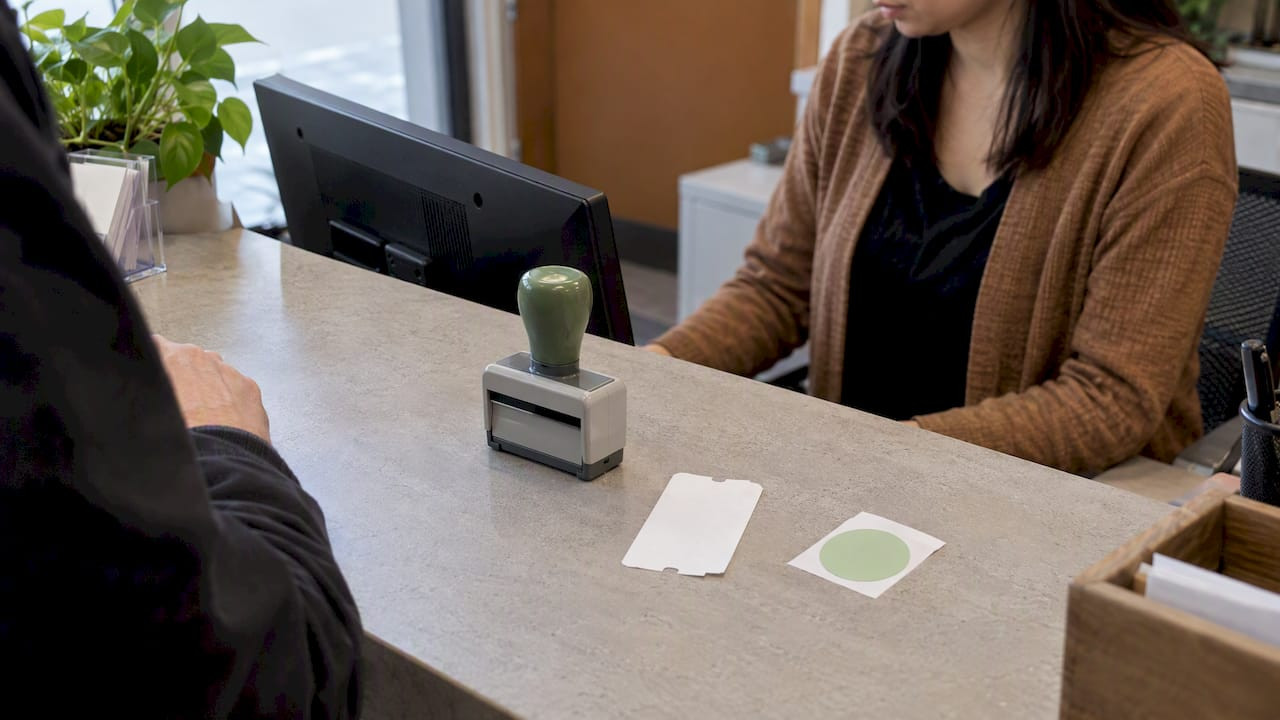
Validation Stamp vs. Sticker: Which Is Right for Parking?

For most parking operations that rely on automated equipment, a numbered, barcoded validation sticker is the stronger choice. A stamp still works where a quick, low-tech mark is enough and a person checks the ticket at exit. The right answer depends on how your exit is controlled, who hands out validations, and how much revenue leakage you can tolerate.
This guide is written for operators: garage managers, valet companies, hotel and casino parking teams, hospitals, universities and event venues. It compares the two methods on the things that decide the outcome: control, scanning, durability, cost of handling and design.
TL;DR
- A stamp is a reusable physical tool that marks a ticket. It is simple and intuitive, but it can be lost, stolen, misused, worn out or smeared into an unreadable mark.
- A sticker is a printed, single-use validation that is attached to the ticket. When it carries a barcode and a serial number, equipment can read it and you can audit it.
- Stamps suit staffed exits and small programs. Stickers suit automated lanes, large merchant programs and any operation that needs tracking.
- Good validation design comes down to scannable barcodes, consecutive numbering, consistent placement and materials that survive real conditions.
- Whichever you pick, limit who holds the validations and verify them at exit.
Table of Contents
- What a validation stamp and a validation sticker actually are
- Where validation fits in the ticket flow
- Validation stamps: where they work and where they fail
- Validation stickers: where they work and where they fail
- Stamp vs. sticker side by side
- Designing a validation ticket or sticker that works
- Security and control: the part that decides the winner
- Choosing by type of operation
- Our perspective
- Getting validation pieces printed
- FAQ
- Sources
What a validation stamp and a validation sticker actually are
A validation lets a customer park free or at a discount after a qualifying purchase, visit or appointment. The merchant, front desk or department confirms the visit, and the parking operator absorbs or bills back the discount. The only real question is how that confirmation reaches the exit.
A stamp is a physical instrument kept at a merchant’s register or reception desk and pressed onto the customer’s ticket after a qualifying purchase or visit, as Parking Professional describes it. The mark is the proof. The cashier, attendant or exit lane then reads it by eye.
A sticker is a printed piece that is peeled and adhered to the ticket, or handed to the parker separately. The University of Maryland, for example, describes validation stickers attached to entry tickets and scanned together with them. Its printed barcode validations may be given to the parker or affixed to the ticket, and it also offers online validations that use the parking ticket number.
That last point matters for your decision. The sticker is one point on a spectrum that runs from a hand stamp, to a printed barcode, to a fully digital validation tied to a ticket number. Many operations use more than one.
Where validation fits in the ticket flow
The validation has to connect to the way the ticket is processed. Three real-world workflows show the range.

Sticker on the ticket, scanned at exit. The University of Maryland’s garage instructions require a sticker validation to be adhered to the back of the ticket. At exit, the parker scans the front first and then the back, so the system can determine the amount due. The order of the scans is part of the design: the equipment needs a predictable layout to work.
Staff-applied digital validation. The University of Texas shows an operator workflow in which authorized staff scan a QR-coded garage ticket or search for its GUID, select a validation, apply it, and then tell the parker to exit. Staff can use a desktop camera or a mobile camera, or type in the GUID when a code will not scan.
Plate or ticket-number validation. UNC’s guide says authorized departments can validate by license plate or parking-ticket number, and that its LPR system prints the plate and entry time on the ticket. In that kind of system, nothing physical needs to be added to the ticket at all.
A stamp fits none of these automated flows well. It belongs to the first generation of validation: a person at the exit looks at the ticket, sees the mark and waves the car through or charges the reduced rate. That can work, but it puts the whole decision in the hands of whoever is at the gate that minute.
Validation stamps: where they work and where they fail
Strengths
Stamps are tangible and intuitive, which is why they have lasted. A merchant needs no software, no printer and no training beyond “press here.” Setup cost is low, and a stamp can serve a small program with a handful of participating businesses. For a staffed valet stand or a small lot with a cashier at every exit, a visible mark is easy to check at a glance.
Weaknesses
The weaknesses are well documented. Parking Professional lists loss, theft, employee misuse, worn equipment and ink smearing that can make a validation unreadable. It also notes that separate stamps for different merchants or validation levels can become unwieldy.
In practice, that means:
- No built-in limit. A stamp has no quantity. Anyone with access can mark as many tickets as they like, and you will only see it in revenue.
- No identity. One merchant’s mark looks like another’s unless you maintain a different stamp for each, and then you have the unwieldy stamp collection described above.
- Wear and smear. Ink fades, pads dry out, and a smudged mark on a thermal or coated ticket may be impossible to read at exit.
- Hard to audit. Unless you count tickets by hand, you cannot reconcile how many validations a merchant gave out against how many were redeemed.
A stamp is not wrong. It is just a control that depends on trust and a human eye, and it offers little proof after the fact.
Validation stickers: where they work and where they fail
Strengths
A sticker can carry what a stamp cannot: a barcode, a serial number, a logo, a color code for a validation tier and security features. Those make a validation machine-readable and traceable. The University of Maryland states that its printed validation barcodes are single-use, and that duplicates can cause the customer to be denied validation and charged the ticket cost. That is a control a stamp cannot offer.
UNC says its validation system lets departments customize and track validation issuance and usage, supporting a secure and auditable process. Auditable is the key word. When every validation has an identity, you can see who issued it, when it was redeemed and whether it was redeemed twice.
Weaknesses
Stickers are not free of risk. A sheet of unused validations is as good as cash. The same University of Maryland guide says printed barcodes must not be photocopied, and for a reprint caused by a printing error it instructs operators to securely destroy the original, delete the source barcode file and store printed barcodes in a restricted location. If you issue stickers, you take on the job of controlling them.
Adhesion and placement also matter. A sticker that peels off a coated ticket, or sits where the scanner cannot see it, causes a stuck lane and an unhappy customer. These are design problems rather than reasons to avoid stickers, and we cover them below.
Stamp vs. sticker side by side
| Factor | Validation stamp | Validation sticker |
|---|---|---|
| Reading at exit | By eye, by an attendant | By scanner when barcoded, or by eye |
| Traceability | Little or none | Serial numbers and barcodes allow tracking |
| Reuse risk | Unlimited marks from one tool | Single-use when barcoded and controlled |
| Loss or theft exposure | The stamp itself | Unused sheets or rolls |
| Wear | Ink fades, pads dry, marks smear | Depends on facestock and adhesive |
| Fit with automated lanes | Poor | Strong when placement is consistent |
| Setup effort | Minimal | Design, printing and issuance control |
| Best for | Small, staffed programs | Large, multi-merchant or automated programs |
Designing a validation ticket or sticker that works
Whether you print a validation sticker, a validation ticket or a multi-part valet ticket, the same design principles apply. Public procurement documents are useful here because they spell out requirements that operators have learned the hard way.
Make it scannable and consistent
A University of Connecticut procurement specification for parking permits requires scanner-readable serial numbers and barcodes, consecutive numbering without duplicates or gaps, and consistent barcode placement. Those three requirements cover most failures: unreadable codes, repeated numbers and a code in a different place on every batch.
Before you commit to a large run, check the symbology your equipment reads. Our guide to parking barcode formats for operators walks through what to confirm before printing 50,000 tickets.
Match the size to the label stock you will actually use
If you print validations in house, the sheet format matters. The University of Maryland’s bulk-print instructions specify Avery 5963 labels with 10 barcodes per page and Avery 5160 labels with 30 barcodes per page. The barcode must fit the label with enough clear space around it, and a denser sheet leaves less room for error.
Add security where the money is
The Connecticut specification also includes customization options such as color photographs and patterns, and a holographic or refractive counterfeit-deterrent element. You do not need that on every validation, but the principle holds. The higher the value of the validation, such as free all-day parking at a casino or hospital, the more a visible security feature earns its cost. Color-coding by tier also helps attendants spot the wrong validation at a glance.
Our article on parking ticket security and fraud prevention covers sequential numbering, tamper deterrents and reconciliation habits in more detail.
Build for the weather and the wear
The same Connecticut specification requires permit materials resistant to cracking, splitting, peeling, blistering, discoloration and softening from -25°F to +200°F for up to one year. That is a permit exposed to a windshield, but it is a useful benchmark for any outdoor ticket or sticker. A validation that goes from a hot dashboard to a cold garage should still scan. For tickets, see our garage parking ticket durability tips.
Put the essentials on the face
A good validation layout is short. Keep these on the piece:
- A barcode in the same position every time
- A human-readable serial number as a backup when scanning fails
- The program or merchant identifier, or a color that stands for it
- The value or rule, such as a fixed discount or free time
- Your logo, so attendants and customers recognize it as genuine
Security and control: the part that decides the winner
The stamp-versus-sticker question is really a control question. Parking Professional’s program-design guide recommends numbered validation instruments, account-level quantity limits and exit verification against an authorized merchant. A stamp struggles with all three. A numbered, barcoded sticker supports all three.
The program design itself also changes what you need. Parking Professional describes flat-discount and spend-threshold programs, including fixed discounts and free parking for a set time. A flat discount is simple enough for a stamp. A spend-threshold program, where the merchant must confirm a purchase amount before issuing a validation, benefits from a numbered piece that can be reconciled against sales.
Practical controls that work with either method:
- Issue by account. Give each merchant or department a counted allotment and record it.
- Lock it up. Keep unissued stickers and stamps in a restricted location, as the University of Maryland advises for printed barcodes.
- Verify at exit. Check that the validation belongs to an authorized merchant and has not been used before.
- Reconcile regularly. Compare validations issued, redeemed and billed. Our guide to auditing a parking facility using tickets shows how.
- Destroy errors. Spoiled prints should be securely destroyed rather than tossed in a bin.
Choosing by type of operation
Valet operations. Valet tickets already carry numbers and tear-off parts, so a validation is often a feature of the ticket itself. Multi-part carbonless formats keep a copy with the vehicle, one with the guest and one for your records. See our 2-part, 3-part and 4-part valet tickets.
Garages with automated exits. Choose barcoded stickers or printed validations, and confirm the layout your lane reads, including whether it scans the front and then the back. Our overview of why barcode tickets make parking garages more efficient explains the operational gains.
Hotels and casinos. Validation is a guest-experience tool as much as a revenue control. Casinos in particular use validated tickets to reward play and track comps. Read why casinos use validated parking tickets.
Hospitals and universities. Departments issue many validations for patients, visitors and guests, so tracking by department matters. The public university examples above show how much they rely on ticket numbers, barcodes and restricted access.
Event venues and small lots. If one attendant checks every vehicle on the way out and the program has few participants, a stamp can be perfectly adequate. Move to numbered stickers once you add merchants, lanes or discount tiers.
Our perspective
We have printed parking and valet tickets since 1937, and the pattern we see is consistent. Operators rarely choose a stamp because it is better. They choose it because it was already there. The trouble starts when the program grows: more merchants, more lanes, more staff turnover, and a revenue report that no longer matches the validations.
Our view is that a validation should be treated like any other revenue document. It should carry a serial number, sit in a consistent place, scan on the equipment you already run and be counted when it is issued. That is why we build our tickets with sequential numbering, barcoding, logos, security features and multi-part carbonless options, and why we match them to the parking systems operators use.
We do not tell every operator to abandon the stamp. If your exit is staffed, your program is small and a mark is all you need, a stamp is a reasonable tool. If you are spending time disputing validations, chasing missing revenue or watching lanes stall on unreadable codes, move to a numbered, barcoded format and put a simple issuance log behind it.
— Richard
Getting validation pieces printed
If you decide on printed, numbered validations, we manufacture stock and fully custom tickets with sequential numbering, barcodes, logos and security features, and we ship nationwide. Our barcoded valet tickets are listed at $42 to $48 on the product page, and our 4-part valet tickets carry the same published range. For validation tickets, permits, coat check or other custom formats, start at Caymil and tell us the system you run so we can match the layout.
FAQ
What is the difference between a stamp and a sticker for parking validation?
A stamp is a reusable tool that presses an ink mark onto a ticket. A sticker is a printed, single-use piece that is attached to the ticket or handed to the parker. Stickers can carry barcodes and serial numbers that equipment can read and you can audit, while a stamp mark is checked by eye.
Can a validation sticker be scanned at exit?
Yes, when it carries a barcode and sits where the scanner expects it. The University of Maryland, for example, has parkers scan the front of the ticket first and then the back, where the sticker is adhered, so the system can calculate the amount due. Test your layout on your own equipment before a large print run.
Are stamps less secure than stickers?
Usually, yes. A stamp can be lost, stolen or misused, and it leaves no serial number to trace. A numbered sticker can be counted, issued by account and checked at exit, though unused sheets must be stored in a restricted location.
When is a stamp still the better choice?
A stamp suits small programs with few merchants and an attendant at every exit. It costs little to set up and needs no printer or software. Once you add merchants, discount tiers or automated lanes, numbered stickers become easier to control.
What should I include on a validation ticket design?
Include a consistently placed barcode, a readable serial number, a merchant or program identifier, the discount rule and your logo. Add a security element for high-value validations, and choose materials that hold up to the temperatures and handling they will see.
Sources
- Parking Validation Systems: A Complete Guide, Parking Professional
- Parking Validation Program Design, Parking Professional
- Parking Garage Equipment, University of Maryland Parking and Transportation
- Parking Validation, University of Maryland Parking and Transportation Services
- Online Portal Validation Instructions, University of Texas Parking
- Department Parking Management, UNC Transportation and Parking
- Print University Parking Permits, University of Connecticut bid specification