
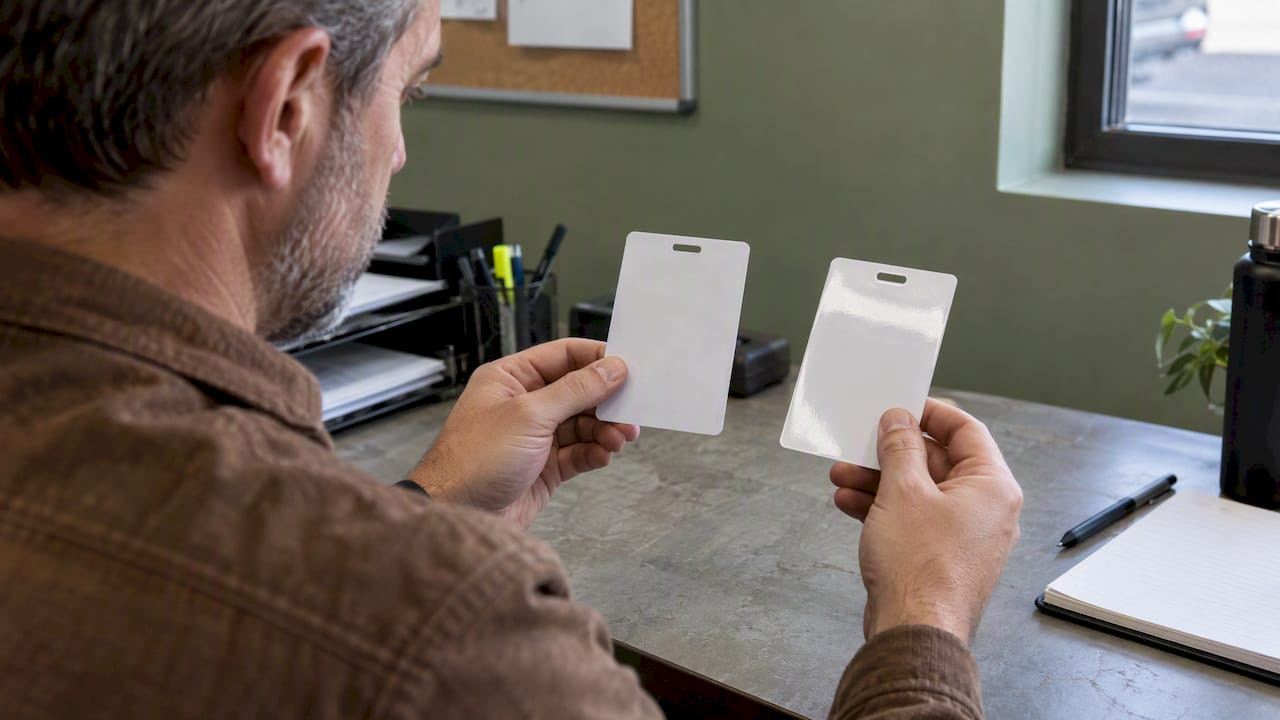
Laminated vs. Unlaminated Parking Permits: How to Choose

Laminate a parking permit when it will hang, sit, or ride in a vehicle for months, face sun and handling, or carry a barcode that must scan all season. Leave it unlaminated when it is short-lived, such as a daily, event, or temporary pass, or when a heavy coated stock already survives its intended use. The right answer depends on how long the permit lives, where it is displayed, and what has to be read from it.
This guide is written for parking operators, facility managers, hotels, campuses, and municipalities who order permits in volume. It covers what lamination actually does, what it does not do, how it affects scanning, and a simple way to match the finish to the job.
TL;DR
- Lamination adds a plastic layer that resists handling, wipe-downs, and moisture, which suits permits that stay in use for months or years.
- Unlaminated permits cost less and work well for daily, event, and temporary passes that are discarded within days or weeks.
- Lamination is water-resistant, not a guarantee of waterproofing, and it does not by itself stop UV fading. Ink and substrate matter just as much.
- Gloss laminate can cause glare that hurts barcode and QR scanning. Matte or delustered finishes are the safer choice for machine-read permits.
- Write the lifespan, climate, and scanning method into your order specification before you choose a finish.
Table of Contents
- What lamination changes on a permit
- Laminated vs. unlaminated at a glance
- Are laminated permits waterproof?
- Fading and sun exposure
- Lamination and barcode or QR scanning
- When you need laminated permits
- When unlaminated permits are enough
- Questions to settle before you order
- Our perspective
- Order permits built for your operation
- FAQ
- Sources
What lamination changes on a permit
Lamination bonds a thin plastic film to a printed sheet using heat, pressure, or both. The film carries an adhesive layer that fuses to the paper and forms a protective barrier, which makes the result stiffer and water-resistant. The same source notes that fingerprints, oils, dirt, and abrasion land on the plastic rather than the paper, and that some films block UV light to varying degrees.
For a parking permit, that translates into four practical effects:
- Surface protection. Printed text, plate numbers, and zone codes stay intact when the tag is handled daily, swung on a mirror, or tossed on a dash.
- Moisture resistance. Rain on an open windshield, condensation inside a car, and a damp garage no longer soak into the stock.
- Stiffness. A laminated tag holds its shape, hangs straight, and resists curling.
- Cleanability. Dirt and smudges wipe off the surface rather than into it.
An unlaminated permit depends entirely on its stock and ink. A coated cardstock with a good print can serve well for weeks. Plain uncoated paper will curl, scuff, and fade faster, and that is the version enforcement staff end up squinting at.
Laminated vs. unlaminated at a glance
| Factor | Laminated | Unlaminated |
|---|---|---|
| Handling wear | High resistance; surface takes the abrasion | Depends on stock; edges and print scuff sooner |
| Moisture | Water-resistant surface | Absorbs moisture unless the stock is coated or synthetic |
| Readability over time | Stays legible longer with wipe-clean surface | Can smudge, curl, or fade |
| Scanning | Matte is safe; gloss can cause glare | No added glare, but a worn code can fail |
| Unit cost | Higher | Lower |
| Best for | Monthly, annual, contractor, employee, and resident permits | Daily, event, temporary, and visitor passes |
| Reprint risk | Lower over a long term | Higher over a long term |
The cost difference per unit is usually smaller than the cost of reprinting and reissuing a failed permit, and the reissue also costs staff time and creates disputes at the gate. That is why lifespan, not sticker price, should drive the decision. For more on construction choices, see our overview of parking ticket material options and the comparison of plastic vs. paper hang tags.
Are laminated permits waterproof?
They are water-resistant, and the distinction matters when you write a specification. A sealed film keeps rain and spills from reaching the paper, but the protection is only as good as the seal. If the film is flush with the edge of the document, moisture can still creep in at the cut edge over time, and a pouch that is sealed on one side leaves the other three edges to the bond. One print-and-imaging shop makes the point that lamination is not watertight when the document edge is exposed. Treat any claim of full waterproofing with caution unless the supplier tests for it.
For operators, the practical takeaways are:
- A laminated tag survives rain, spills, and wipe-downs far better than bare paper.
- Prolonged soaking, hot car interiors, and repeated freeze and thaw cycles test the bond at the edges and corners.
- Rounded corners and a slight border of film beyond the printed area reduce lifting.
- A synthetic or plastic substrate removes the paper-wicking problem altogether.
Fading and sun exposure
Dashboards are punishing. Lamination can slow fading when the film has UV-blocking properties, but a clear film with no UV inhibitor mostly protects against abrasion and moisture, not sunlight. Ink choice is the other half of the answer. We cover practical steps in slowing UV fading on disability parking permits.
Government specifications show how seriously fading is treated when permits must last. Hawaii’s parking-permit expiration decal specification calls for resistance to cracking, peeling, blistering, and temperature change for at least 60 months, and for colors that resist fading and moisture over the same period. The New Jersey Motor Vehicle Commission’s request for quotation for disability placards likewise asks for weather-resistant materials and UV-resistant inks guaranteed for multiple years. These are state placard programs, not rules for private lots, but they are a useful benchmark: when a permit has to last years, the spec names the materials and the ink, not just the finish.
Lamination and barcode or QR scanning
If your permits are scanned at a gate, handheld, or enforcement vehicle, finish matters as much as durability. Gloss film reflects light, and reflected light washes out the contrast a scanner needs. A packaging printer’s comparison of finishes notes that matte lamination reduces glare from reflections, while gloss can reflect direct lighting and make reading harder.

The federal government has run into the same distinction. In Baldridge v. GPO, the Federal Circuit contrasted clear laminate, which is glossier, with delustered laminate, which may have a matte or satin finish, in a specification that required laminate to stay clear and not distort printed matter.
Scanning problems are not only about film. Section508.gov lists the usual causes of hard-to-scan printed codes: codes that are too small, low resolution, poorly lit, or low contrast. Lamination can make any of these worse if it adds glare or a haze over a small code, and it cannot rescue a code that was printed too small.
A checklist before you commit to a laminated, machine-read permit:
- Choose a matte or delustered film rather than high gloss.
- Print the code at a size and quiet-zone margin your scanners handle comfortably.
- Keep high contrast: dark bars on a light, uncluttered background.
- Test sample permits on the actual scanners, in the actual lighting, at the actual mounting angle.
- Confirm the symbology matches your system. Our guide to parking barcode formats walks through the choices.
When you need laminated permits
Choose lamination when one or more of these is true:
- The permit lives longer than a month. Monthly, quarterly, semester, annual, and resident permits are handled, hung, and removed hundreds of times.
- It is displayed outside or against glass. Hang tags on mirrors and permits in open-air windshields see sun, rain, and heat.
- It must stay readable at a glance. Enforcement staff need to read the number, color, and expiration in a few seconds. Our post on monthly permit design explains how layout and finish work together.
- Reissuing is expensive. Contractor, employee, and hospital staff permits are tied to access, and replacing worn ones adds administrative work. See how operators track missing contractor tags.
- Counterfeiting or tampering is a concern. A laminate is harder to peel and alter without visible damage, and security films can carry marks that are hard to copy.
- A public-sector specification calls for it. Municipal solicitations often name material durability; our article on RFP-ready specs for city permit decals shows how to write them.
When unlaminated permits are enough
Lamination is not always worth paying for. Unlaminated permits are a sound choice when:
- The permit is used for a day, a weekend, or a single event and then discarded.
- It is placed inside a vehicle, out of direct weather, and replaced often.
- The stock is already heavy, coated, or synthetic, so a film adds little.
- You want the lowest cost per permit for high-volume visitor or temporary passes.
- The permit is a paper form that will be filed, such as a record or validation slip.
For short-term needs, a temporary parking form or permit on a sturdy stock covers the job without the extra step. Even then, avoid plain bond paper for anything displayed outdoors, and print on coated stock when you can.
Questions to settle before you order
Use these questions as a specification worksheet. They keep the lamination decision tied to your real conditions.
- How long must the permit stay legible? Days, a season, a year, or multiple years?
- Where is it displayed? Mirror hang tag, interior dash, exterior windshield, or an adhesive decal?
- What is the climate? Strong sun, heavy rain, freezing temperatures, or a covered garage?
- How is it verified? Visual check only, handheld scanner, or fixed gate reader?
- How is it issued? A box of pre-numbered permits, printed on demand, or distributed through an HR or student system?
- What happens if it fails? Reprint cost, staff time, and complaints at the gate.
- Is there a stock thickness requirement? Heavy cardstock feels like a real permit rather than a flyer, and that affects how seriously people treat it.
On the last point, thicker is not always better in a hang tag: it must still hang flat on the mirror and fit the post. Our guide to reinforced hang tags covers how reinforcement at the hole cuts tearing and reprints, and our five hang tag design decisions piece addresses sizing and layout.
Our perspective
We have been manufacturing parking and valet tickets since 1937, and the same lesson keeps repeating: the permit that fails is rarely the one that was too plain. It is the one that was specified for a week and used for a year.
When operators ask us whether to laminate, we start with the lifespan and the reader, not the finish. A permit that hangs in a vehicle all season needs a surface that stays clean and legible. A permit that gets scanned needs a finish that does not fight the scanner. Get those two right and the reprint cycle largely disappears.
Our approach is to build permits around the way the operation runs: the stock, the print, the numbering, the barcode, and the surface treatment are decided together, and compatibility with major parking systems is part of the conversation from the start. Specialist knowledge of valet, garage, hotel, hospital, and municipal use is what we bring to that conversation, and it is why operators send us their permit questions before they send us their artwork.
Richard
Order permits built for your operation
Caymil supplies stock and custom parking permits, permit decals, hang tags, and forms for parking operators, hotels, hospitals, universities, and municipalities. Whether your permits need a durable surface, sequential numbering, a barcode, or a simple low-cost temporary format, you can start with permit decals and our full product range or browse parking forms for short-term needs.
Tell us how long the permit must last, where it will be displayed, and how it is checked, and we will help you match the format to the job.
FAQ
Are laminated parking permits waterproof?
They are water-resistant rather than fully waterproof. The film protects the surface from rain, spills, and wipe-downs, but cut edges can still admit moisture over time. A synthetic substrate or a well-sealed film with a border gives the best moisture performance.
Does lamination stop a permit from fading?
Not on its own. Some films block UV light to varying degrees, but a clear film without UV protection mainly guards against wear and moisture. Fade-resistant inks and a suitable stock do much of the work, so specify all three together.
Can lamination interfere with barcode scanning?
Yes, mainly through glare. Gloss film reflects light and can wash out contrast, while matte or delustered film keeps the code readable. Always test a sample permit on your own scanners under real lighting before ordering a full run.
Is an unlaminated permit ever the better choice?
For daily, event, visitor, and temporary passes, yes. If the permit is used briefly, kept inside the vehicle, and discarded, a coated stock without film delivers the function at a lower cost per unit.
Which permits should always be laminated?
Permits that stay in use for months or years, hang in sun and weather, or must remain readable to enforcement at a glance. Monthly, annual, resident, employee, and contractor permits are the usual candidates.
Sources
- How Does Laminating Work? Heat, Pressure, and Film
- Laminate & Encapsulate, Capital Imaging
- Parking Permit Expiration Decal Specifications, State of Hawaii
- New Jersey Motor Vehicle Commission, RFQ for Disability Placards
- Comparing Matte vs Gloss Lamination for Packaging
- Baldridge v. GPO, U.S. Court of Appeals for the Federal Circuit
- Accessibility Bytes No. 8: Accessible QR Codes, Section508.gov