Matte vs. Gloss Tickets: Which Finish Works Best

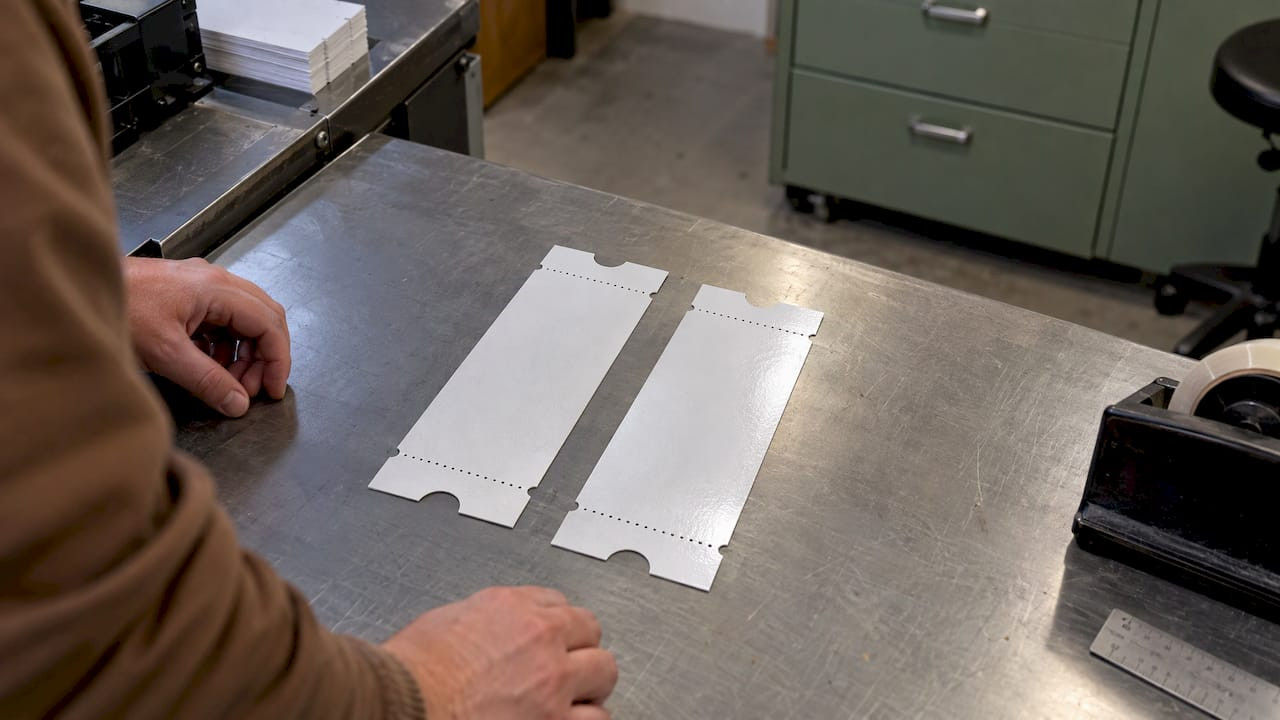
For most valet, parking and hospitality tickets, matte or uncoated stock is the practical choice. It takes pen ink, cuts glare on barcodes and stays readable under garage and porte-cochere lighting. Gloss earns its place when color depth and moisture resistance matter more than writing on the ticket or scanning it. The right answer depends on how the ticket is used: handwritten, machine-issued, scanned, handled in the rain, or kept as a keepsake.
This guide compares the two finishes on the points that matter to operators: writability, scanning, glare, fingerprints, moisture and cost. It ends with a quick chooser by ticket type.
TL;DR
- Matte is the safer default for tickets people write on, scan or read under mixed lighting. It resists glare and fingerprints.
- Gloss deepens colors and resists moisture, but it can reflect overhead light, repel pen ink and cause barcode misreads.
- Barcoded tickets: keep gloss off the code area. Matte or uncoated stock scans more reliably under venue lighting.
- Handwritten valet tickets: choose uncoated or matte stock so the writing sets instead of smearing.
- Before a big run, approve a production-representative sample, because the same artwork looks different on each finish.
Table of Contents
- What matte and gloss actually mean on a ticket
- Which finish is easier to write on?
- Barcodes and scanning: where gloss causes the most trouble
- Glare, readability and color
- Fingerprints, scuffs and moisture
- Does the finish change the cost?
- How to choose by ticket type
- Our perspective
- Get tickets built for your operation
- FAQ
- Sources
What matte and gloss actually mean on a ticket
A finish is the surface of the ticket: either the paper itself or a coating applied over the ink. Gloss has a shiny, reflective surface. Matte is flat, with little or no shine. The difference is how the surface handles light. A matte surface scatters incoming light in many directions, so the ticket looks uniform from any angle. A glossy surface sends back a directional highlight plus a diffuse component, which is why gloss looks rich from one angle and mirror-like from another (ColorArchive’s surface finish guide describes the optics).
It helps to separate three things people lump together under “finish”:
- Uncoated stock. Plain paper with no coating. It is the most writable surface and is common for multi-part carbonless valet tickets.
- Coatings. A thin layer of aqueous or UV varnish. Matte and gloss versions both exist. Flint Group, which makes UV varnishes, lists its DigiCoat UV varnish range as suitable for tickets, tags and boards, with tested scuff, scratch and abrasion resistance on digital print.
- Lamination. A film bonded over the printed sheet. It adds protection, but it is the finish most likely to block handwriting and add reflections.
Thermal tickets and machine-issued “spitter” tickets are a separate case. Their surface is determined by the thermal or paper stock and the printer, not by a decorative coating. If your tickets come out of a dispenser, our guide to parking ticket paper, thermal rolls and what really lasts is the better starting point.
Which finish is easier to write on?
Matte, and uncoated above all. Valet attendants write plate numbers, vehicle descriptions, key tag numbers and damage notes by hand, often quickly and often outdoors. A ticket that fights the pen slows the line.
The practical ranking looks like this:
- Uncoated stock accepts almost any pen. It is the one surface you can count on completely.
- Matte or satin aqueous coating usually accepts a ballpoint, though gel and felt-tip ink can sit wet and smear.
- UV gloss resists ink because the pen is writing on cured plastic-like coating.
- Any laminate, including soft-touch, is a poor surface for writing.
That ranking comes from a printing guide by SHIFT Design, and a second printer’s overview of paper options makes the same point: gloss UV coating does not accept handwriting or ballpoint marks, while matte aqueous coating accepts ballpoint and marker cleanly.
The fix is simple when you plan for it. Coating the front and leaving the writing area or back uncoated is routine. For a multi-part valet ticket, where the writing has to transfer through carbonless copies, uncoated stock is the natural fit. Our 2-part, 3-part and 4-part valet tickets are built for that workflow.

Barcodes and scanning: where gloss causes the most trouble
If a ticket is scanned, finish becomes an operational issue, not a style choice. Glossy surfaces reflect overhead lights, uplights, sun and phone flash. A scanner or camera that catches that reflection sees a washed-out patch where the code should be.
The sources that test this agree:
- Revel’s materials guide notes that matte laminate typically improves real-world scan reliability by resisting glare and fingerprints, while glossy laminate often looks premium but scans worse under venue lighting.
- QR Code Developer reports that the same code file can scan fine on matte cardstock and fail under glossy lamination, and suggests matte lamination or a spot-matte finish over just the code area as a way to keep protection without glare.
- A guide to QR event tickets advises matte finishes for printed passes and a contrast ratio of at least 4:1, with dark modules on a clean, light background.
- Whizz-Tech’s troubleshooting guidance lists glare from glossy laminate among the main reasons venues reject codes and recommends printing black on matte white.
Most of that testing involves QR codes and phone cameras, but the physics applies to the laser and imager scanners used in garages: reflections hurt contrast. For a barcoded parking or event ticket, the rule is to keep the code area matte or uncoated, dark on light, with plenty of quiet space around it.
Decide the finish before the proof, not after. Our print proof checklist walks through the barcode checks to make at signoff, and our barcoded valet tickets are made for exactly this use.
Glare, readability and color
This is where gloss has a real case. Gloss deepens shadows and pushes saturation, so logos, photographs and bold brand colors look richer. Datacolor’s color measurement research explains that the same pigment formulation can look darker and more saturated at high gloss and lighter, softer and slightly washed out at matte.
The tradeoff is angle. Printer guidance describes glossy pieces as creating glare that makes small text disappear at certain angles under ceiling lights. Matte has no glare, so text reads anywhere without tilting the ticket. But matte can make dark areas look lighter and intense colors a bit more restrained: a solid black can drift toward charcoal and a deep navy toward slate.
What that means for tickets:
- Small type (terms, liability language, lot rules) is more dependable on matte or uncoated stock.
- Large brand blocks and logos can look stronger on gloss, as long as nothing the attendant must read or scan sits under the shine.
- Dark backgrounds magnify every finish flaw. Gloss shows fingerprints instantly, and dark matte can show scratches as light lines.
There is a color-matching trap here as well. A color’s CMYK values do not tell you how it will look once a finish is applied. For color-critical work, the recommendation from Unified Color is to approve a sample made with the final substrate, printing process and coating, viewed under realistic lighting. If your brand color has to match across tickets, permits and signage, read our guides on Pantone vs. CMYK printing and spot vs. full color.
Finish behavior shows up well beyond tickets. A venue light test of chrome vs. metallic balloons is a good picture of how the same reflective surface can look brilliant in one room and harsh in another, which is the same lighting question you face at a valet stand.
Fingerprints, scuffs and moisture
Tickets live rough lives: pockets, dashboards, rain at the valet podium, wet hands in a garage. Here is how the two finishes compare.
| Factor | Matte or uncoated | Gloss (coated) |
|---|---|---|
| Handwriting | Best (uncoated), good (matte aqueous) | Poor, especially UV gloss |
| Barcode scanning | More reliable under mixed lighting | Can reflect and wash out contrast |
| Glare on small text | Minimal | Can hide text at some angles |
| Color depth | Softer, slightly lighter | Deeper, more saturated |
| Fingerprints | Less visible | Show readily, especially on dark colors |
| Scuffs | Can burnish and leave faint shiny marks | Hard UV gloss resists scratching and scuffing |
| Moisture | Depends on coating or stock | Coating adds a protective layer |
Two cautions keep this from being a simple scoreboard. First, UV coatings, matte or gloss, are harder and more scratch-resistant than aqueous, and Cheap Discount Printing’s UV coating guide notes that matte UV also hides fingerprints on dark areas. So the finish type and the coating chemistry both matter. Second, moisture protection on a ticket is mostly about the stock and print method. Whether paper swells, curls or loses print in the rain is a stock question first and a finish question second. Our guides on ticket paper and moisture and dust-resistant ticket media cover those conditions, and for thermal tickets, the thermal fading checklist and the guide to cold weather thermal tickets explain what protects the print.
Permits are a different job from entry tickets. A hang tag or decal sits in the sun and rain for months, so a protective laminate can make sense there even though it would be a poor choice for a ticket someone writes on. See our comparison of laminated vs. unlaminated parking permits.
Does the finish change the cost?
Sometimes, and it depends on the job. General print-industry guidance says matte finishes often carry a somewhat higher price than traditional gloss, but that varies with quality, process and the printer. In ticketing, the larger cost drivers are usually part count, numbering, barcoding, custom colors and run size. A coating decision rarely outweighs those.
For reference, our published prices on the site include 4-Part Valet Tickets and Barcoded Valet Tickets at $42-$48, and 3-Part Valet Tickets at $35-$250 depending on the configuration. Custom jobs are quoted to your specifications, so the way to know what a finish costs for your run is to ask for a quote on your exact ticket.
A cheaper way to think about cost: a ticket that smears, scans badly or fades costs more in slowed lines, re-issued tickets and disputed claims than any coating difference on the invoice.
How to choose by ticket type
| Ticket | Recommended surface | Why |
|---|---|---|
| Handwritten multi-part valet ticket | Uncoated carbonless stock | Takes pen and transfers copies cleanly |
| Barcoded valet or event ticket | Matte or uncoated, code area free of gloss | Avoids reflections that wash out contrast |
| Machine-issued spitter ticket | The stock matched to your printer or system | Surface is set by the paper or thermal stock |
| Coat check and luggage claim tickets | Uncoated or matte | Staff write numbers quickly, often in dim rooms |
| Upscale hotel or casino branded ticket | Matte for refined feel; gloss only where nothing is written or scanned | Matte reads as elevated and avoids fingerprints |
| Permit hang tags and decals | Protective coating or laminate for exposure | Months of sun, rain and handling |
The hospitality angle is worth stating. Nightlife printers observe that matte often reads as more elevated and intentional for upscale venues, while glossy makes colors pop for photography-heavy or bold graphic designs, per M3 Printing’s flyer comparison. For a luxury hotel or casino valet stand, that usually points to matte or uncoated on the working ticket, with the brand carried by logo, color and clean layout.
A short decision path:
- Will anyone write on the ticket? If yes, go uncoated or matte.
- Will anything be scanned? If yes, keep the code area matte and high contrast.
- Will it face rain or heavy handling? Ask about stock and coating together, not finish alone.
- Is color depth the priority? Consider gloss on non-writing, non-scanning areas.
- Approve a sample on the real stock before the full run.
Our perspective
We have been manufacturing parking and valet tickets since 1937, and the pattern is consistent: the ticket that works best is the one built around the job it does at the stand, not the one with the flashiest surface.
Valet attendants write fast, in weather, under inconsistent light. Garage lanes scan and read hundreds of tickets an hour. In those conditions we would put readability, clean copies and dependable scanning ahead of shine. That is why our valet lines are built around multi-part carbonless formats, sequential numbering, barcoding and clear layouts, and why we focus on durable printing and compatibility with systems such as Amano, TIBA, SKIDATA, FLASH Parking, Scheidt & Bachmann and Flowbird.
Branding still matters, especially for hotels, casinos and hospitals. Custom logos, colors and security features let a ticket look like your property without sacrificing what the attendant or scanner needs from it. When you are unsure about a finish, bring us the use case: handwritten or machine-issued, scanned or not, indoor or outdoor. We will help you configure the ticket around it.
Richard
Get tickets built for your operation
Caymil manufactures stock and custom tickets for valet operators, parking garages, hotels, casinos, hospitals, universities and event venues, with sequential numbering, barcoding, logos, security features and custom colors. Start with our barcoded valet tickets if you scan at exit, or browse the full catalog at Caymil for custom parking tickets, coat check tickets, permit decals and ticket racks. We keep millions of tickets in stock and ship nationwide.
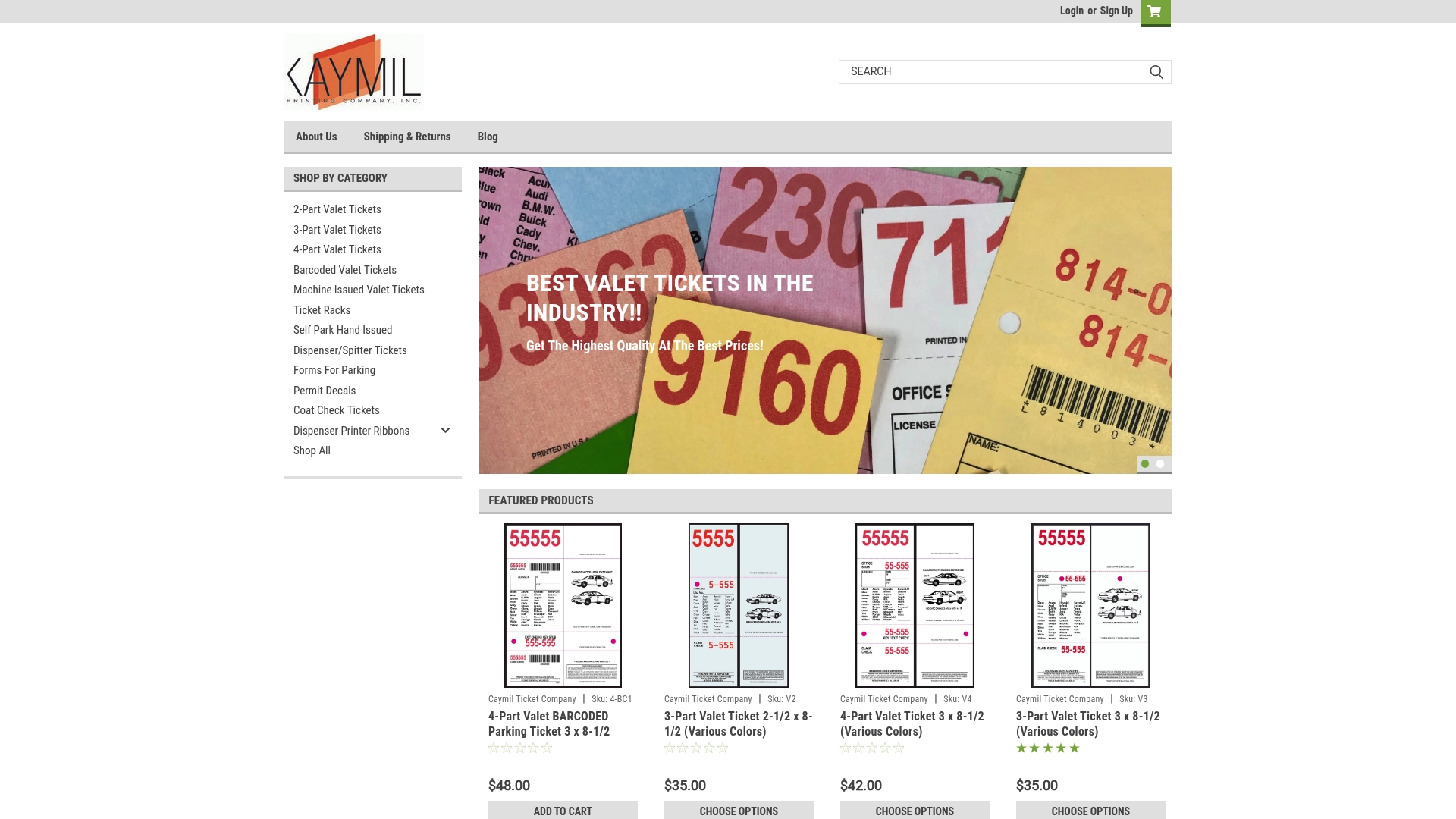
If you need a custom job, tell us how the ticket is written on, scanned and stored, and we will configure it to match. For counter and stand organization, our 50-pocket ticket rack pairs with your valet tickets.
FAQ
Is matte or gloss better for valet tickets?
Matte or uncoated is better for most valet tickets. Attendants write on them, and matte or uncoated stock accepts ink, resists fingerprints and avoids glare under mixed lighting. Gloss coatings, UV gloss especially, can repel ballpoint and make handwriting smear or skip.
Does a glossy finish stop barcodes from scanning?
It can. Glossy coatings and laminates reflect overhead light and flash, which washes out the contrast between bars and background. Several QR and barcode guides recommend matte finishes, or a matte spot over the code area, and angle-testing scans under bright light before you finalize a design.
Can I write on a gloss ticket?
Usually not reliably. UV gloss and laminates tend to resist ink, so writing sits on the surface and can smear. If a ticket needs both a glossy look and handwriting, a common approach is to coat one side or leave the writing area uncoated. Confirm that with your printer before ordering.
Does the finish change how my brand colors look?
Yes. Gloss usually makes colors look deeper and more saturated, while matte makes them look slightly lighter and softer. The shift varies with stock, ink and coating, so approve a sample on the actual material before a full run.
Is gloss better for tickets exposed to rain?
A coating adds a protective layer, but moisture performance depends mostly on the stock and the print method. For outdoor valet or garage use, choose the paper or thermal media first, then the finish. Our guide to ticket paper and moisture covers what to look for.
Sources
- ColorArchive: Surface Finish and Color Perception
- Flint Group: DigiCoat UV varnish
- SHIFT Design: Print Finishes Compared
- Revel: QR Tags, How to Choose Materials That Scan Fast
- QR Code Developer: How printing techniques impact QR code scannability
- Pageloot: How to Create Secure QR Code Event Tickets
- Whizz-Tech: Ticket QR Code Not Scanning
- Datacolor: How Gloss Affects Color Measurement
- Unified Color: Matte vs Gloss Lamination
- Cheap Discount Printing: The Complete UV Coating Guide
- M3 Printing: Matte vs. Glossy Flyers in Nightlife
- Paper stock options guide
- Chrome vs. Metallic Balloons: Atlanta’s Venue Light Test