

Folio-Integrated Parking Charges: A Manager’s Guide

A folio-integrated parking charge posts parking fees directly to a guest’s room account inside the hotel’s property management system (PMS), so the guest settles the cost at checkout alongside room, food, and beverage charges. No separate kiosk payment. No cash exchange at the garage exit. The parking system communicates with the PMS through an API or middleware layer, and the charge appears on the hotel folio just like any other posted item.
For hotel and parking managers, the operational takeaway is straightforward: folio integration removes a payment friction point at departure, reduces front-desk labor, and creates a single reconcilable revenue stream. It does require a working API connection between your parking platform and your PMS, and that compatibility check is the first conversation to have with any vendor.
Before you go further, three questions to ask vendors immediately:
- Does your parking platform have a validated integration with our specific PMS version (Oracle Opera, Infor, or other)?
- Does the integration support both authorization holds and final-post transactions, or only one?
- What PCI DSS scope does the integration add, and how is cardholder data tokenized?
Table of Contents
- What is a folio-integrated parking charge and how does billing work?
- Which systems and hardware does folio integration actually require?
- What operational and revenue benefits does folio integration deliver?
- What does implementation actually require? A checklist for managers
- What are the most common folio parking configurations?
- How do parking charges post to folios, and how do you reconcile them?
- What does folio parking integration cost, and how long does rollout take?
- How Caymil supports folio-integrated parking operations
- What are the concrete next steps to move from decision to implementation?
- Key Takeaways
- The part of folio integration most operators get wrong
- Caymil keeps the physical layer of your folio parking system reliable
- Useful sources
- FAQ
What is a folio-integrated parking charge and how does billing work?
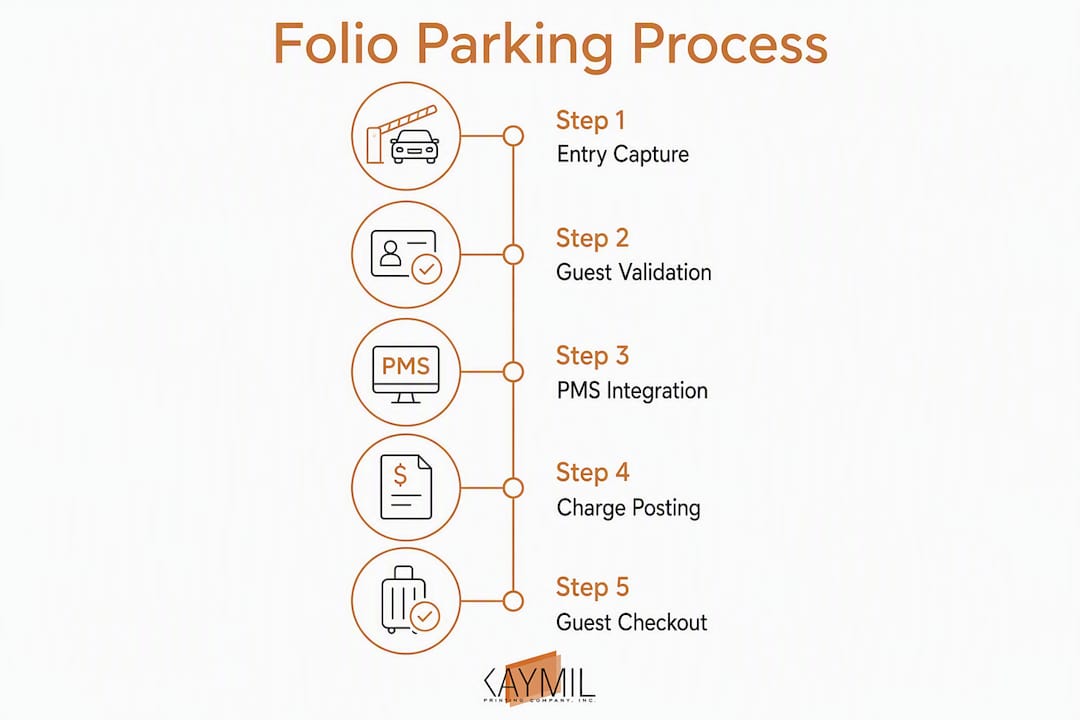
The billing flow starts the moment a vehicle enters the facility and ends when the guest checks out. Understanding each handoff helps managers write a reliable operations SOP and catch failure points before they become guest complaints.
Step-by-step flow:
- Entry capture. The parking system records entry via license plate recognition (LPR), a barcode ticket, or a QR code scan. For valet, a ticket number ties the vehicle to the claim.
- Guest validation. The guest enters a room number at a kiosk, scans a QR code sent by text, or the valet attendant links the ticket to a reservation. FolioCharge™ by Premium Parking uses a smartphone-driven flow where guests enter their room number and license plate to initiate the folio link.
- Reservation lookup. The parking platform queries the PMS (or a middleware layer) to confirm the room number maps to an active reservation. This step also checks rate codes for package-included parking and loyalty entitlements.
- Authorization hold. Many integrations place a pre-authorization on the folio at entry, reserving the expected parking amount. This prevents the charge from being missed if the guest checks out early.
- Final post. At exit, the parking system calculates the final charge (based on duration, rate tier, or package rules) and sends a final-post transaction to the PMS. The folio updates in real time.
- Checkout settlement. The front desk or express checkout collects the full folio balance, including the parking charge, through the hotel’s standard payment process.
The distinction between an authorization hold and a final post is where most integration failures hide. If your parking platform only sends a final post without a prior hold, a guest who checks out before exiting the garage can leave without the charge posting at all. Confirm both transaction types are supported before signing any integration contract.
Pro Tip: Run a test scenario where a guest checks out of the PMS before the vehicle exits the garage. If the final post still lands on the correct folio, your integration handles the most common edge case. If it does not, ask the vendor how they handle late postings.
Which systems and hardware does folio integration actually require?
Folio integration is not a single product. It is a chain of components, and a weak link anywhere in that chain produces missed charges, duplicate postings, or reconciliation headaches. Here is what each component does.
Core components and their roles:
- Property Management System (PMS). The PMS holds the folio. Oracle Opera and Infor are the most common enterprise PMS platforms in U.S. full-service hotels. The PMS must expose an API endpoint that accepts charge-posting requests from external systems.
- Parking management platform / PARCS. The parking access and revenue control system manages entry, exit, rate calculation, and transaction records. Vendors like SKIDATA and FlashParking operate at this layer. Premium Parking’s FolioCharge™ is a product built on top of a parking platform to handle the PMS connection specifically.
- Middleware / API gateway. When the parking platform and PMS do not share a native integration, a middleware layer translates data formats and routes transactions. Some vendors bundle this; others require a third-party integration partner.
- Payment processor / tokenization layer. Even though the guest pays through the hotel folio, the integration must handle PCI DSS scope carefully. Tokenization keeps raw card data out of the parking system entirely.
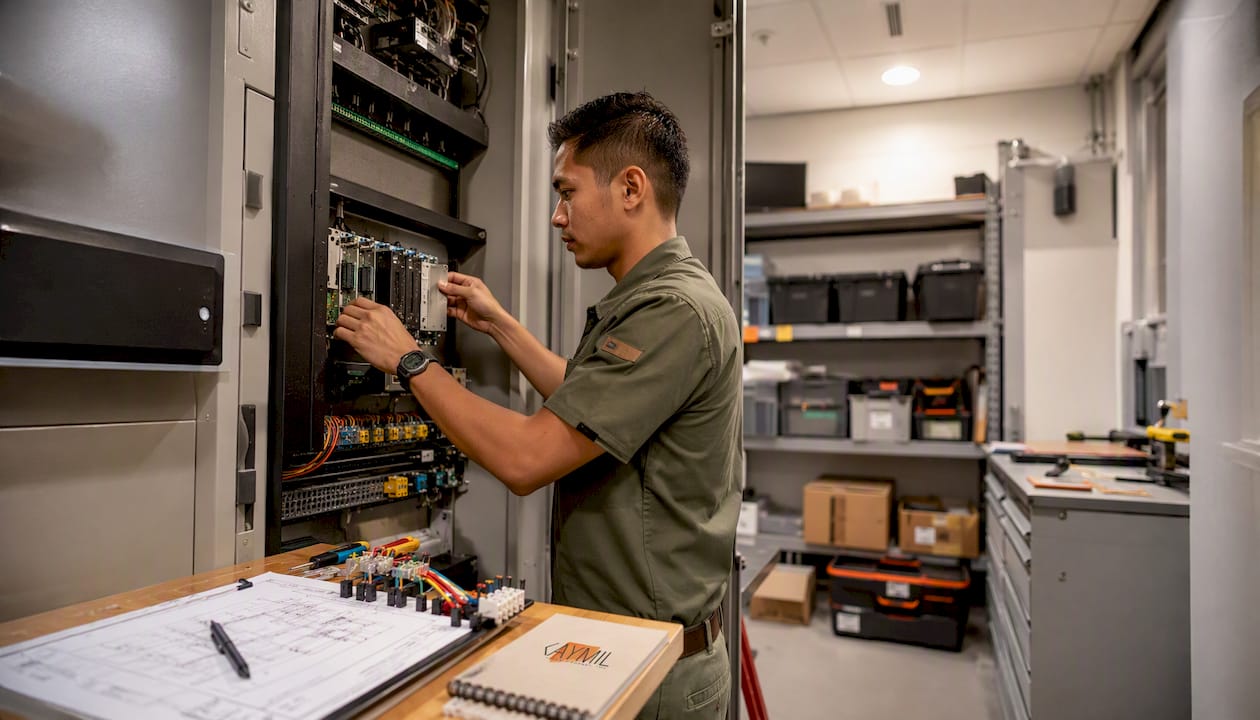
- Entry/exit hardware. LPR cameras, barcode readers, QR scanners, and gate controllers feed the parking platform with the event data that triggers the folio post. Ticket dispensers and valet ticket printers are part of this layer too.
Integration modes vary. A direct API connection means the parking platform calls the PMS natively. A validated integration means the vendor has tested and certified a specific PMS version pairing, which reduces project risk considerably. A middleware translation layer is common when legacy PMS versions lack modern REST API support.
Pro Tip: Ask every parking vendor for their PMS compatibility list before the first demo. A validated integration datasheet for your specific PMS version shortens discovery and testing by weeks.
For a broader look at parking system compatibility across major platforms, Caymil’s compatibility guide covers the hardware and ticket format considerations managers often overlook during procurement.
What operational and revenue benefits does folio integration deliver?
Folio integration ties parking revenue directly to the guest stay, and the operational gains compound across the property. The most immediate benefit is reduced friction at departure: guests do not stop at a kiosk, handle cash, or wait for a receipt. That reduction in front-desk labor is especially pronounced at full-service and luxury properties where guests expect a ticketless arrival and departure.
Removing the separate parking payment step increases on-site parking utilization because guests are less likely to seek off-site alternatives when they know parking will simply appear on their bill. That utilization gain translates directly to captured parking revenue that would otherwise leave the property.
Beyond guest experience, the revenue picture improves in three ways. First, parking charges are harder to miss when they post automatically rather than relying on a guest to pay at a kiosk. Second, package-included parking becomes trackable: the system records whether a guest used a complimentary entitlement, giving revenue managers accurate data on package uptake. Third, loyalty validation at entry creates a frictionless elite experience that supports retention.
On the operations side, poor PMS integration creates significant accounting overhead from manual reconciliation. Automated posting eliminates the daily manual matching that finance teams otherwise spend hours on. Fewer disputes reach the front desk because the folio line item carries a timestamp, duration, and transaction ID the team can pull instantly.
For a deeper look at how hotel parking shapes the guest experience, Caymil’s editorial covers the guest-facing side of these operational decisions.
What does implementation actually require? A checklist for managers
The non-negotiable requirements for a folio-integrated parking project are PMS API support, PCI scope clarity, data mapping for reservation IDs, and a staging environment for testing. Miss any one of them and the project stalls or goes live with errors.
Technical requirements:
- Confirm the PMS version exposes a charge-posting API endpoint and that the parking vendor has tested against it.
- Obtain the API field mapping: room number, reservation ID, folio ID, charge amount, charge description, and timestamp must all transfer correctly.
- Verify the integration supports both authorization holds and final-post transactions.
- Establish a staging or sandbox environment that mirrors production PMS data for testing.
Security and compliance:
- Define PCI DSS scope: the parking system must not store raw card data. Tokenization is the standard approach.
- Confirm all API calls use HTTPS with certificate validation and that webhook endpoints are authenticated.
- Require audit logging on both the parking platform and PMS sides for every transaction posted.
Operational requirements:
- Train front-desk staff on how parking charges appear on folios and how to pull transaction detail for disputes.
- Install clear signage at garage entry explaining that parking will post to the room folio.
- Document the dispute workflow: who contacts the parking vendor, what data to pull, and the timeline for adjustments.
Testing and acceptance:
- Run test scenarios with a live PMS test guest: standard checkout, early checkout, package-included rate, and loyalty entitlement.
- Confirm reconciliation reports from the parking system match PMS folio postings by transaction ID before go-live.
SKIDATA’s validated-integration documentation for Oracle Opera is one example of the kind of vendor proof managers should request during procurement. Validated integrations reduce project risk and shorten the testing phase.
Pro Tip: Always run the acceptance test using a live PMS test-guest record, not a dummy entry. Reservation ID mapping errors only surface when the parking system queries a real PMS reservation structure.
What are the most common folio parking configurations?
Most properties fall into one of four deployment patterns, and the billing rules differ meaningfully across them.
Valet workflows are the most common starting point for folio integration at full-service hotels. In a ticketed valet setup, a multi-part valet ticket ties the vehicle to the reservation at drop-off, and the folio charge posts when the vehicle is retrieved. Ticketless valet uses LPR at the entrance and links the plate to the reservation directly. Tips are typically handled separately, either as a cash transaction or a second folio line item, depending on property policy.
Package-included parking requires the parking system to query the reservation’s rate code in real time. If the rate code includes parking, the system posts a $0.00 charge or a complimentary notation rather than a billable amount. This real-time rate-code check is where many integrations break down: the parking platform must have read access to the PMS rate structure, not just the room number.
Loyalty and elite entitlements work similarly but query a loyalty API or a loyalty-status field in the PMS. A top-tier loyalty member may receive complimentary parking as a benefit, and the system must validate that status at entry rather than at checkout to avoid posting a charge that then requires reversal.
Event and transient day-parking introduces temporary entitlements. A conference attendee may have a pre-reserved parking code tied to a group block rather than an individual room reservation. The parking system needs to handle capacity limits, time-window restrictions, and pre-reservation lookups separately from overnight-stay logic.
For a practical breakdown of valet and parking integration workflows, including how ticketing formats support each configuration, Caymil’s operations guide covers the specifics managers need before briefing a vendor.
How do parking charges post to folios, and how do you reconcile them?
Folio postings for parking are final once the parking system sends the final-post transaction and the PMS accepts it. Authorization holds appear as pending items and convert to final charges at exit. The timing matters for checkout: if a guest checks out before the vehicle exits, the hold may need to convert manually or through a timed reconciliation job, depending on the integration design.

On the folio itself, a parking charge should carry at minimum: the charge date and time, the duration or entry/exit timestamps, the ticket or transaction ID, and a vendor identifier. A folio line that reads only “Parking — $35.00” with no supporting metadata is a dispute waiting to happen.
Daily reconciliation workflow:
- Export the transaction report from the parking system at end of day.
- Match each transaction to a PMS folio posting using the transaction ID.
- Flag any transaction present in the parking system but absent from the PMS (missed post) and any PMS posting without a matching parking transaction (potential duplicate or manual entry error).
- Confirm settlement totals match the merchant account batch for that day.
Reconciliation data table managers should maintain:
| Column | Purpose |
|---|---|
| Transaction ID | Unique identifier from the parking system |
| Entry time | Timestamp for duration calculation and dispute evidence |
| Plate / ticket number | Links physical vehicle to digital record |
| Reservation ID | Confirms correct folio mapping |
| Folio ID | PMS-side reference for the posted charge |
| Posted amount | Dollar amount on the folio |
| Settlement status | Confirmed, pending, or disputed |
Common dispute scenarios: a charge posted to the wrong folio (room number entered incorrectly at validation), a duplicate post (authorization hold and final post both converted), or a guest claiming they did not park. Each resolves faster when the transaction ID and entry timestamp are available immediately. Exporting parking transaction reports daily and matching them to PMS postings by ticket ID reduces chargeback exposure and cuts dispute resolution time.
For practical techniques on reducing parking disputes and ticketing errors, Caymil’s guide covers the front-desk and back-office steps that prevent most common problems.
What does folio parking integration cost, and how long does rollout take?
Cost and timeline vary by property complexity, but the categories are consistent across vendors. Expect four cost buckets: integration engineering (one-time), hardware (one-time or amortized), monthly SaaS fees, and per-transaction or payment processing fees.
Typical pricing models managers will encounter:
- One-time integration fee plus monthly SaaS. The vendor charges for initial development and configuration, then a recurring platform fee. This is the most common structure for mid-market parking platforms.
- Per-transaction fee. Some vendors charge a small fee per folio post rather than a flat monthly rate. This model favors lower-volume properties.
- Hardware amortization. LPR cameras, gate controllers, and ticket dispensers may be bundled into a multi-year contract or purchased outright.
Parking software vendors typically advertise contactless entry, variable pricing, and reporting modules as part of their SaaS offering, with the folio integration as an add-on or premium tier.
Realistic timeline for a standard integration:
- Discovery and scoping: 2–4 weeks
- Integration development and API configuration: 4–8 weeks
- Staging and testing: 2–3 weeks
- Pilot (single property or single garage): 2–4 weeks
- Full rollout: 1–2 weeks per additional location
Variables that stretch the timeline include legacy PMS versions without REST API support, on-site hardware replacements, and PCI scope expansion that requires a security assessment. A property running an older Oracle Opera version may need a middleware layer that adds 4–6 weeks to the development phase.
Checklist for requesting an itemized vendor quote:
- Integration engineering hours and rate
- Monthly SaaS fee and what it includes
- Per-transaction fees, if any
- Hardware costs (LPR, gate, dispenser) and warranty terms
- PCI compliance support and any associated assessment costs
- Ongoing support SLA and escalation path
How Caymil supports folio-integrated parking operations
Folio integration depends on reliable physical hardware at the point of vehicle capture, and that hardware depends on quality tickets and printed media. Caymil manufactures barcoded valet tickets, machine-issued spitter tickets, and multi-part carbonless valet tickets compatible with major PARCS hardware including TIBA, SKIDATA, FLASH Parking, Amano, Scheidt & Bachmann, and Flowbird systems.
Caymil products that directly support integrated operations:
- Barcoded valet parking tickets with sequential numbering for automated scan-and-match reconciliation
- Machine-issued valet tickets for high-volume dispenser systems at garage entry
- 2-part valet parking tickets that give the guest a claim stub and the attendant a control copy
- Ticket racks and dispenser supplies compatible with leading parking system hardware
Sequential numbering on Caymil tickets creates an unbroken audit trail: every ticket number maps to a transaction ID in the parking system, which maps to a folio posting in the PMS. That chain is what makes disputes resolvable in minutes rather than hours. For managers evaluating barcode ticket integration for automated reconciliation, Caymil’s technical guide covers the format specifications and compatibility considerations in detail.
What are the concrete next steps to move from decision to implementation?
Three actions should happen within the first week after approval: inventory your current systems, request API documentation from your parking and PMS vendors, and schedule a staged pilot on a single garage or valet lane.
RACI-style implementation checklist:
- Parking operator — Request a validated-integration datasheet from the parking vendor for your PMS version. Deliverable: datasheet or written confirmation of compatibility.
Pilot success criteria: zero missed folio postings over a 7-day period, reconciliation report matches PMS postings by transaction ID with no unresolved variances, and front-desk dispute rate below baseline.
Key Takeaways
A folio-integrated parking charge requires PMS API compatibility, PCI-scoped tokenization, and a tested authorization-to-final-post flow before any other configuration decision matters.
| Point | Details |
|---|---|
| PMS compatibility is the first gate | Confirm a validated integration exists for your specific PMS version before evaluating any parking vendor. |
| Test holds and final posts separately | An integration that only sends final posts will miss charges when guests check out before exiting the garage. |
| Disclose parking charges to guests | Signage at garage entry and language in confirmation emails reduce disputes and chargebacks at checkout. |
| Reconcile daily by transaction ID | Matching parking system exports to PMS folio postings every day keeps disputes fast to resolve and merchant exposure low. |
| Caymil tickets support the physical layer | Barcoded and sequentially numbered Caymil tickets create the audit trail that makes automated reconciliation reliable. |
The part of folio integration most operators get wrong
The technical integration gets most of the attention in vendor conversations, and that focus is understandable. But the failures that actually cost properties money tend to happen in three places that have nothing to do with API endpoints.
The first is reservation ID mapping. When a guest enters a room number at the kiosk, the parking system queries the PMS for a matching active reservation. If the property has multiple rooms with similar numbers, or if a guest enters a neighboring room by mistake, the charge lands on the wrong folio. That error is invisible until checkout, when the wrong guest disputes a charge they did not incur. The fix is a confirmation step at validation: display the guest’s last name alongside the room number so they can verify the match before the link is created.
The second failure point is inadequate staging. Most vendors will run a test in a sandbox environment, but sandbox data rarely mirrors the edge cases in a live PMS: loyalty members with complimentary entitlements, group-block reservations, or guests with split folios. Running acceptance tests against a live PMS test-guest record, as noted in the implementation checklist above, catches mapping errors that sandbox testing misses entirely.
The third is guest notification. Properties that launch folio parking without updating their pre-arrival emails and garage signage see a spike in front-desk disputes in the first two weeks. Guests who do not expect a parking charge on their room bill assume it is an error. A single line in the confirmation email and a sign at the garage entrance eliminates the majority of those calls before they happen.
Staffing matters too. The front-desk team needs to know exactly how to pull a parking transaction record before the pilot goes live, not after the first dispute arrives. A 30-minute training session with a printed reference card covers it.
Caymil keeps the physical layer of your folio parking system reliable
When a folio integration goes live, the physical ticket at the garage entrance is still the first point of data capture. A barcode that does not scan, a ticket that jams in the dispenser, or a sequential number that skips creates a gap in the transaction chain that no amount of API configuration can fix downstream.
Caymil has manufactured parking and valet tickets compatible with major PARCS hardware since 1937, and that compatibility extends to the systems most commonly used in folio-integrated hotel operations: TIBA, SKIDATA, FLASH Parking, Amano, Scheidt & Bachmann, and Flowbird. Machine-issued valet tickets and barcoded valet tickets with sequential numbering give your reconciliation team the audit trail they need to match every transaction to a folio posting. Fast nationwide shipping and a catalog of stock and custom formats mean you can get the right ticket to the right property without a long lead time. Contact Caymil for a compatibility check or to request samples before your pilot launch.
Useful sources
Managers evaluating folio-integrated parking should pull these documents during vendor scoping and technical review:
- FolioCharge™ launch announcement, Parking & Mobility Magazine — covers the product launch and PMS compatibility claims; verify which PMS versions are currently supported.
- Hotel Tech Insight folio definition — confirms PMS folio structure and what fields third-party systems must post to.
- SiteMinder hotel folio overview — useful for understanding standard folio line-item formats and what guests see at checkout.
- Parking & Mobility Magazine — industry publication for staying current on integration standards and vendor announcements.
FAQ
What does a folio charge mean in a hotel?
A folio charge is any expense posted to a guest’s running account inside the hotel’s PMS, covering room rate, food and beverage, spa, parking, and taxes. The guest settles the full folio balance at checkout.
What is a folio payment?
A folio payment is a credit applied against the folio balance, typically at checkout via credit card, corporate direct bill, or loyalty points. It reduces the outstanding balance to zero and closes the folio.
What are folio-integrated parking charges specifically?
A folio-integrated parking charge is a parking fee posted automatically to the guest’s room folio by the parking system through an API connection to the PMS, removing the need for a separate kiosk payment at the garage.
How does a hotel avoid duplicate parking charges on a folio?
Confirm the integration supports a single authorization hold that converts to a final post at exit, rather than posting both transactions independently. Daily reconciliation matching parking system transaction IDs to PMS folio postings catches any duplicates before they reach the guest.
Do guests need to do anything to use folio-integrated parking?
In most configurations, guests enter their room number at a kiosk or via a QR code link at garage entry. Some systems, like FolioCharge™, use a smartphone flow where the guest enters their room number and license plate to initiate the folio link automatically.