
Ticket Caliper Selection for Parking and Valet Operators

Caliper is the thickness of the ticket stock, and choosing it comes down to three checks: what your printer, dispenser or gate reader can feed, how long the ticket has to survive in a pocket, windshield or cupholder, and how many tickets you need per roll or stack. Start with the equipment specification, then pick the thickest stock inside that range that still suits your volume. This guide explains the units, the trade-offs, how to measure what you already have, and how to turn it into an order.
TL;DR
- Caliper is paper thickness, usually stated in mils (thousandths of an inch) in the U.S. and in microns (µm) elsewhere. One mil is 25.4 µm.
- Stock that is too thin tends to jam the printer more easily. Thicker stock lasts longer in a guest’s hands but gives fewer tickets per roll.
- Your equipment’s stated thickness range is the starting point. Confirm it before you order, especially for machine-issued tickets.
- Compare caliper figures only when they were measured the same way. Measure a sample ticket with a micrometer if the spec is unclear.
- Caliper works together with coating, moisture and heat resistance, and format (roll, fanfold or stack).
Table of Contents
- What caliper means on a ticket spec
- Why caliper changes how a ticket performs
- The trade-off: thickness versus tickets per roll
- Matching caliper to the use
- How to check thickness against your equipment
- What else belongs next to caliper on the spec
- A simple selection process
- Order tickets matched to your equipment
- FAQ
- Sources
What caliper means on a ticket spec
Caliper is the measured thickness of a single sheet. Hengstler’s paper selection guide describes it as paper thickness, often given in mils or micrometers, and notes that manufacturers like to specify thickness because it can be controlled more accurately in production than weight.
In the U.S. the common unit is the mil. Kiosk Marketplace explains that each mil equals 1/1,000th of an inch. Equipment makers outside the U.S. often quote microns, so a spec sheet from a European gate system will not match your supplier’s catalog until you convert.
Mils, microns and grams per square meter
Three numbers describe stock, and they are easy to confuse:
| Measure | What it describes | Typical unit | Conversion |
|---|---|---|---|
| Caliper | Thickness of one sheet | Mils or µm | 1 mil = 25.4 µm |
| Basis weight | Weight of a set area | lb (U.S.) | Varies by paper grade |
| Grammage | Weight per square meter | g/m² | Not a direct thickness |
Weight and thickness are related but not interchangeable, because coatings and fiber density change the relationship. Hengstler gives a thermal-paper rule of thumb: roughly 100 g/m² corresponds to 4.3 mil, or 1 mil to about 23 g/m². Treat that as an estimate for thermal stock only. When a printer manual gives a weight range and your supplier quotes a caliper, ask for the figure in the unit the manual uses.
A quick conversion table helps when reading a spec in either unit:
| Mils | Microns (approx.) |
|---|---|
| 3 | 76 |
| 5 | 127 |
| 7 | 178 |
| 10 | 254 |
| 15 | 381 |
| 30 | 762 |
That last row matters for gate and dispenser equipment. Our own procurement guide on Scheidt & Bachmann ticket specs covers a 170 to 760 µm window, which works out to roughly 6.7 to 30 mils. That is far thicker than a typical thermal receipt, and a good reminder that valet tickets and machine-issued tickets live in different thickness worlds.
Why caliper changes how a ticket performs
Three things move when thickness moves: feeding, durability and feel.
Feeding and jams
Hengstler states that thickness is usually about durability and perceived value, and that paper that is too thin tends to jam the printer more easily. Thin stock can crumple at the feed rollers, curl in humid air or fail to separate cleanly in a dispenser. Stock that is too thick can fail the other way: it will not bend around the path or pass the sensor gap.
Uniformity matters as much as the nominal number. Paperonweb notes that variations in caliper can affect strength and roll quality, and that even thickness supports good roll building and printing. A ticket that averages the right thickness but varies across the sheet can still misfeed.

Durability in the field
Hengstler also points out that thicker paper suits printouts that must survive being kept in a pocket and shown later. That describes most parking tickets. A guest takes a ticket at entry, folds it, drops it in a console, and presents it hours later. Valet tickets get handled by attendants, clipped to key tags and passed through hot, wet or cold conditions.
Thickness is only part of survival. Coating, image stability and environment decide whether a ticket stays readable. If your operation runs outdoors, these guides go deeper:
- Ticket paper and moisture for rain, spills and humid garages
- Heat resistant tickets for dashboards and summer lots
- Cold weather thermal tickets for winter prints
- Thermal ticket fading for a checklist on stopping image loss
Feel and perceived quality
Kiosk Marketplace notes that thicker materials tend to be more durable and are perceived as higher quality. For a luxury hotel or casino valet stand, the ticket is part of the arrival experience. A flimsy slip reads differently from a sturdy, crisp one, so many hospitality operators choose heavier stock for that reason alone.
The trade-off: thickness versus tickets per roll
Kiosk Marketplace advises settling durability, feel and the number of documents per roll before fixing the mil requirement. The logic is simple: for a given roll diameter, thicker stock means fewer tickets on the roll. That means more roll changes, more attendant time and more storage.
Work through it for your own operation:
- Count tickets issued on your busiest day.
- Check how many tickets a roll or fanfold stack holds at the candidate caliper.
- Divide to see how many reloads that day requires per lane or device.
- Decide whether the added durability is worth that many extra changes.
For a high-volume entry lane, fewer reloads can matter more than extra stiffness. For a valet stand issuing a modest number of tickets that guests keep for hours, heavier stock is usually the better value. Format matters here too: our guide on fanfold versus roll tickets explains how to avoid a roll length mismatch when you change stock.
Matching caliper to the use
No single number fits every operation. The right range depends on the device and how the ticket lives.
Thermal tickets from a printer
Thermal parking tickets printed at entry lanes or kiosks usually sit at the lighter end of the range, because they are fed through tight paths and cut. Manufacturers’ published ticket and tag grades illustrate how varied that range is: caliper values on spec sheets for parking and ticket stock fall in the low to mid single-digit mils, but grades differ by coating and application. Always use the grade your printer’s manufacturer or your supplier confirms for your model. For design and durability choices, see our overview of parking ticket paper, stock and thermal rolls and the field notes on thermal ticket printing for events and parking.
Operators with a specific printer can start from a model-specific item, such as our roll tickets for the Intermec 2100 printer.
Machine-issued and spitter tickets
Dispensers, gate machines and spitter units often use thicker card-type stock with specific sensors, notches or magnetic stripes. Here the equipment’s stated range is not a suggestion. Confirm it with the equipment maker or with us before ordering. Our machine issued valet tickets and dispenser and spitter tickets are made for compatibility with major parking systems including Amano, TIBA, SKIDATA, FLASH Parking, Scheidt & Bachmann and Flowbird.
Multi-part valet tickets
Hand-written or pre-numbered valet tickets are built as 2-, 3- or 4-part carbonless sets. Thickness here is the stack, not one sheet, and the guest’s claim stub, the key tag copy and the windshield copy each need to be legible. More parts mean more copies for control and revenue tracking, and a thicker set to write through. Choose the part count by how many records you need, then check that the set is comfortable to write on and clip.
Hang tags, permits and coat check
Permit hang tags hang from mirrors in sun and wind, so they lean toward heavier, more rigid stock. Coat check and luggage tickets are held briefly and stubbed, so durability matters less than clear numbering and clean tearing.
How to check thickness against your equipment
Do not rely on a catalog number alone. Verify in three steps.
Step 1: find the equipment range
Look in the printer or dispenser manual for a stock thickness or weight range. If it gives grams per square meter, convert with care, since the relationship to thickness depends on the paper.
Step 2: measure a sample
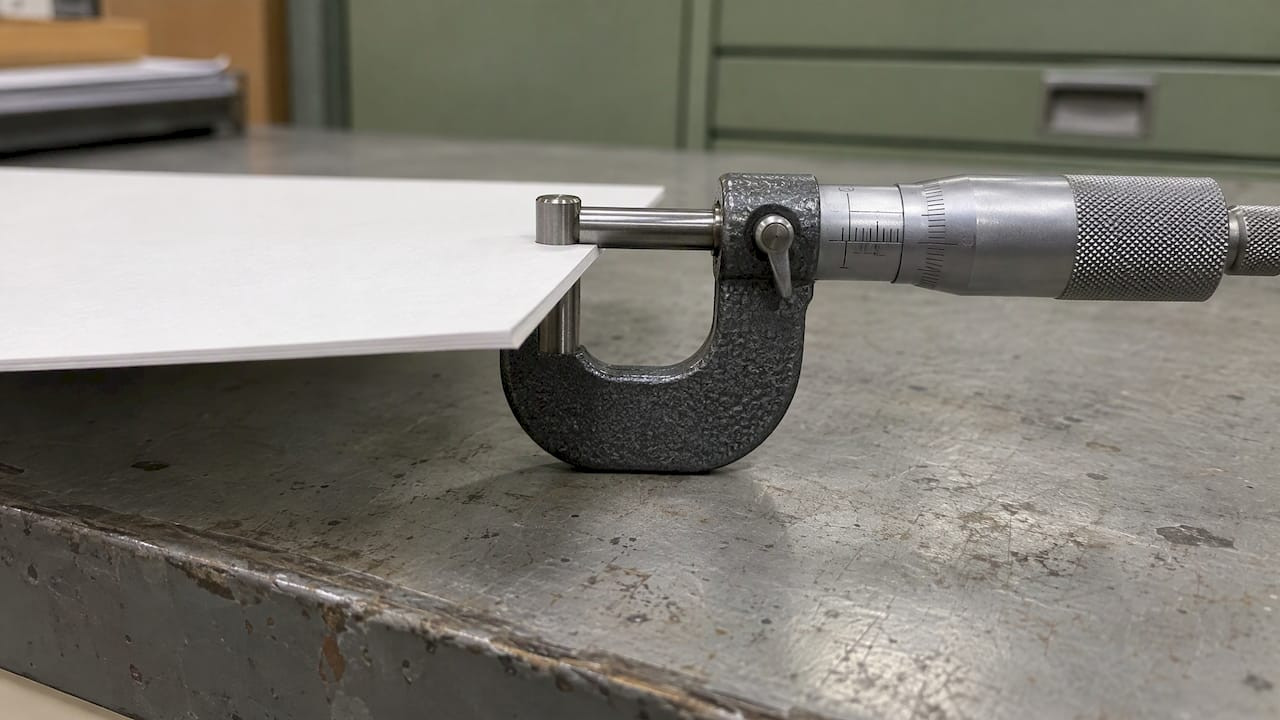
Kiosk Marketplace recommends measuring with a micrometer. For thin stock, fold the paper twice, measure the folded thickness and divide by four to get an average you can compare with the printer specification. A micrometer is a modest purchase and saves expensive misorders.
Step 3: compare like with like
PrinterArchive explains that caliper is meaningful only when the measuring pressure is specified, because paper compresses, and that figures are comparable only when measured the same way. It also notes that the common standards are ISO 534 and TAPPI/ANSI T 411, with the TAPPI method using a 50 kPa micrometer load. So when two suppliers quote different thickness for similar stock, ask which method each used before concluding one is thicker.
What else belongs next to caliper on the spec
Caliper never decides alone. Put these beside it on the order:
- Format: roll, fanfold or stack, with dimensions and core size.
- Print method: thermal, ribbon-printed or pre-printed with numbering.
- Coating and image life: how long the print must stay readable, and under what heat, moisture or cold. Our article on thermal reactive ink tickets and their 30-day lifespan explains how to plan for it.
- Sensors and marks: notches, black marks or magnetic stripes your device reads.
- Security and control: sequential numbering, barcodes, logos and multi-part copies.
A simple selection process
- Write down each device that issues or reads tickets, with model number.
- Record the stock range each manual allows, in mils or microns.
- Decide how long a guest holds the ticket and in what conditions.
- Estimate daily volume and acceptable reload frequency.
- Choose the thickest stock inside the equipment range that meets the volume target.
- Order a small quantity, run it through the real equipment in real conditions, and then place the full order.
Our view on caliper
We have been manufacturing parking and valet tickets since 1937, and the same question comes up in every industry we serve: how thick should the ticket be? Our answer is that thickness should follow the job. A garage lane, a casino valet stand and a hospital permit program do not need the same stock, and we do not treat them as if they do.
Our approach is to start from the equipment. We make tickets compatible with major parking systems, and we keep millions of tickets in stock so operators can get a standard format quickly. When a standard format does not fit, we customize numbering, barcoding, logos, security features and colors, along with multi-part carbonless formats built for clear copies.
We design for durable printing, and we encourage operators to bring us their printer or dispenser model, their environment and their volume. With those three facts, choosing the right ticket becomes a short conversation instead of guesswork.
Richard
Order tickets matched to your equipment
Once you know your range, ordering is straightforward. Caymil supplies stock and fully custom tickets for parking operators, valet companies, hotels, casinos, hospitals, universities and event venues across the United States. Valet operators can browse our 2-part, 3-part and 4-part valet tickets, or barcoded valet tickets for tighter control.
If you run dispensers, see our dispenser and spitter tickets and dispenser printer ribbons. For custom parking tickets, coat check tickets and permit decals, start at caymil.com.
FAQ
What is a good caliper for a parking ticket?
There is no single number. Thermal tickets for printers usually run thinner than card stock for dispensers and gate machines, and the right figure is the one your equipment’s manual allows. Choose the thickest stock within that range that still gives you enough tickets per roll.
How do I convert mils to microns?
Multiply mils by 25.4 to get microns. A 5 mil ticket is about 127 µm, and a 10 mil ticket is about 254 µm. To go the other way, divide microns by 25.4.
Does thicker stock always last longer?
Thicker stock handles being folded and kept in a pocket better, and it feels more substantial to guests. Heat, moisture and cold resistance also depend on the coating and print method, so consider those together with thickness.
Can I measure ticket caliper myself?
Yes, with a micrometer. For thin stock, fold the sheet twice, measure the folded piece and divide by four to get an average. Compare it only with specifications that were measured by the same method.
What should I send when I order custom tickets?
Send your printer or dispenser model, the stock range from its manual, your ticket size, the numbering and barcode needs and the environment where tickets are used. That lets us match the stock and format to your system.
Sources
- How to Choose Paper for Kiosk Printers, Hengstler
- Choosing the right paper for your kiosk: thermal paper thickness, Kiosk Marketplace
- Properties of Paper, Paperonweb
- Paper Weight and Caliper, PrinterArchive